
Elected Representatives and Political Violence
Across the world, local elected representatives are increasingly targeted by disinformation and harassment. Fuelled by social fragmentation, distrust, frustration, and the unchecked spread of false or manipulated content, these behaviours are eroding democratic engagement, weakening public trust, and deterring capable people from public life.
Harassment and disinformation are leading elected officials to self-censor, reduce their public presence, and withdraw from public debate, undermining their ability to represent constituents and engage in robust policymaking.
The drivers are complex and interconnected: Disinformation and harassment are not isolated phenomena, they are enabled and exacerbated by social, political, and technological conditions. Rising inequality, loneliness, and housing stress deepen social fault lines and grievances. These are compounded by low media literacy, platform incentives for engagement, and weak regulation. Political norms are increasingly hostile, while technology has rapidly transformed the information ecosystem, outpacing the ability of governments and communities to respond.
This is not just an online problem: Local leaders report abuse in public meetings, on the street, and even from fellow councillors. Disinformation is no longer just an election concern, it is being used to disrupt housing plans, climate policy, and social inclusion at the neighbourhood level.
What begins online often spills into real-world consequences: Deepfakes, doxing, bot-driven trolling and impersonation campaigns, once confined to global flashpoints, is now appearing in communities and small councils. Cities like London and Toronto have seen deepfake audio targeting mayors. In Australia, while social media remains a primary vector, these tactics are increasingly amplified through offline forums, letterbox campaigns, and local council meetings.
This project is supported by the Australia Resilient Democracy Network through The Australian National University and Australian Department of Home Affairs.
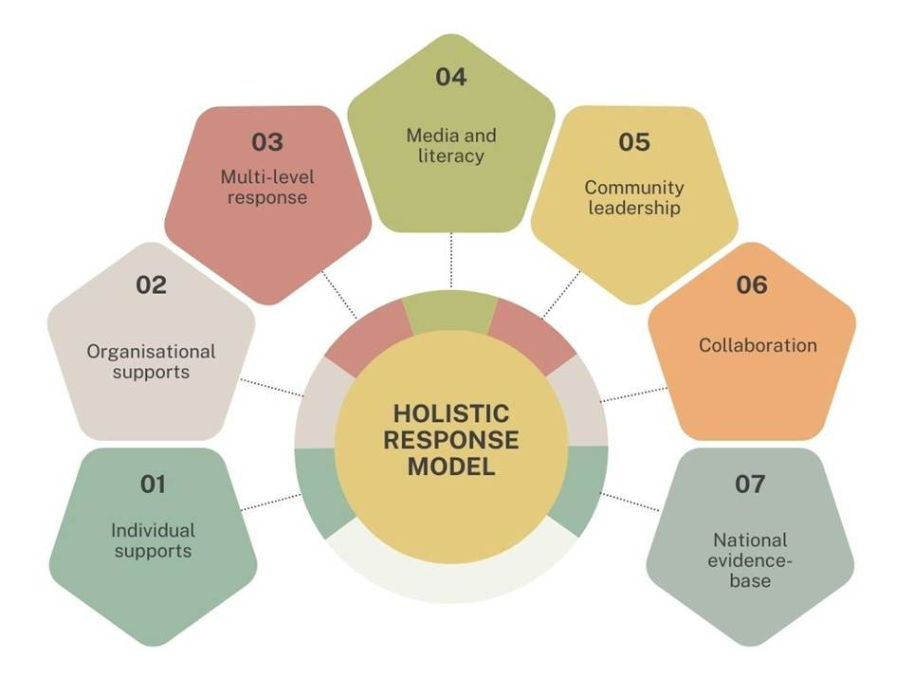
Holistic Response Model: 1. Individual supports; 2. Organisational supports; 3. Multi-level response; 4. Media and literacy; 5. Community leadership; 6. Collaboration; 7. National evidence base.