
Innovation Case Study: Energy Resilient Community Hubs
Bass Coast Shire Council
Strengthening Bass Coast through energy resilience and community connections
Bass Coast shire has partnered with local communities, industry, response agencies and government to deliver catalytic uplift in energy resilience across Bass Coast. Council has delivered 10 Energy Resilient Community Hubs at key sites with co-located community services, creating an eco-system of all-hazards resilience, supported by strong investment in social capital with local networks.
2026 MAVlab Innovation Awards Winner:
The Resilient Infrastructure Award for Emergency-Ready Community Systems, supported by Matter

Project goals:
- Increase energy resilience in priority communities
- Provide BAU climate change benefits
- Support inter-agency response, relief and recovery coordination during power outage events
- Catalyse community-led emergency planning, and support formation of local resilience networks
- Deliver and demonstrate a replicable model for the sector to create systems-level change in emergency management
- Integrate with digital messaging platforms.
Project team:
8 people.
Project duration:
2 years.
Challenge and context:
Communities in Bass Coast face significant exposure to natural disasters, with Gippsland the most disaster-affected region in the state. Bass Coast has a history of disasters – particularly storms and fires – with compounding consequences for local communities and long-wave recovery challenges: including the 2024 storms that knocked out power for more than 11 days in some parts of the Shire.
Power outage is a key vulnerability for communities across the Shire and focus for local communities seeking support from government and to build their resilience to future events. The ongoing and compounding effects of climate change only strengthen the need for all-hazards programs addressing these key vulnerabilities, as the frequency and intensity of weather events strengthens and further impacts centralised power and communications infrastructure.
The emergency management sector itself is in phase transition from traditional ‘command and control’ models to moving toward frameworks of building resilience and community-led approaches, with local government providing pathways to innovation and benefits-realisation for this change. It is well-known across the sector that too much funding and energy goes into response, with money spent on resilience and recovery yielding up to a 9:1 ROI. Despite this, we see continual over-investment in response rather than resilience and recovery, with few projects demonstrating and perverse incentives within reconstruction funding that curtails local government’s ability to ‘build back better.’
Power resilience is a key priority for Bass Coast Shire communities, with a history of disasters strongly underscoring this need – but without existing models for what uplift at scale-able, systems-level would look like, and immature partnership frameworks to leverage industry capital.
Within this environment, Bass Coast has delivered a project and model for the sector to build an eco-system of power-resilient community hubs that amplify community safety, resilience and empowerment outcomes alongside BAU climate change impacts across the Shire.
Solution and innovation:
Within a sector-wide context of one-off power resilience projects, immature models, and misaligned partnerships in this space, Bass Coast Shire set out to do develop and implement a scale-able deliver model for holistic community safety, resilience and climate change mitigation outcomes through our Energy Resilient Community Hubs. This project brought together a cross-functional working group across Emergency Management, Sustainable Environment and Infrastructure teams to develop a shovel-ready site-prioritisation and delivery model for uplift of solar and battery infrastructure at community hubs across the Shire. This approached leveraged strategic commitments across Council’s Climate Action Plan, Municipal Emergency Plan and Council Plan to align priorities and indicators to generate tiered geo-spatial priorities across Council facilities, which served as a shovel-ready matrix as further funding opportunities emerged.
The initial solar and battery installation was funded through a partnership with Emergency Management Victoria, prioritising high-usage sites with co-located community services. Developing the ‘hard’ infrastructure alongside the ‘social software’ of community resilience network building is central to the innovation approach and success of this project, with the Waterline Emergency Network (WEN) established alongside energy resilient infrastructure installations in Corinella and Grantville, and the WEN model has been replicated across the Shire.
The project took a catalytic jump through partnership with AusNet – aligning Council’s authorising environment and prioritisation ahead of time delivered both a powerful proof of concept during the 2024 with Corinella as an Energy Resilient Community Hub supporting community response and recovery, and also positioned Council with a shovel-ready delivery model for funders.
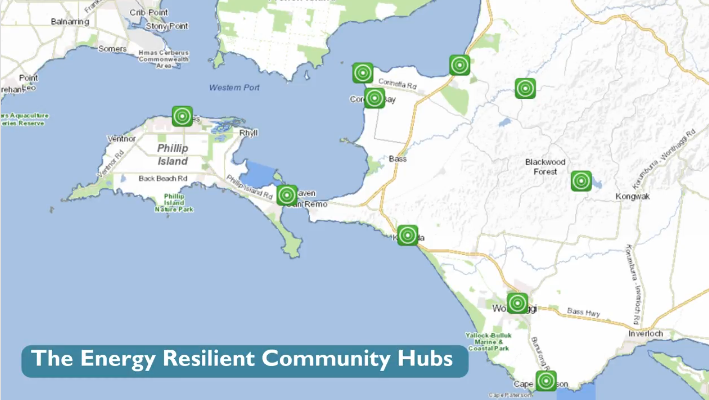
Through partnership with AusNet, Council achieved delivery of a true energy resilient eco-system of 10 Energy Resilient Hubs, serving as sites for self-activated community response and recovery, as well as centres for community preparedness. The Hubs are linked to our digital Emergency Management Dashboard, integrating with digital solutions and messaging.
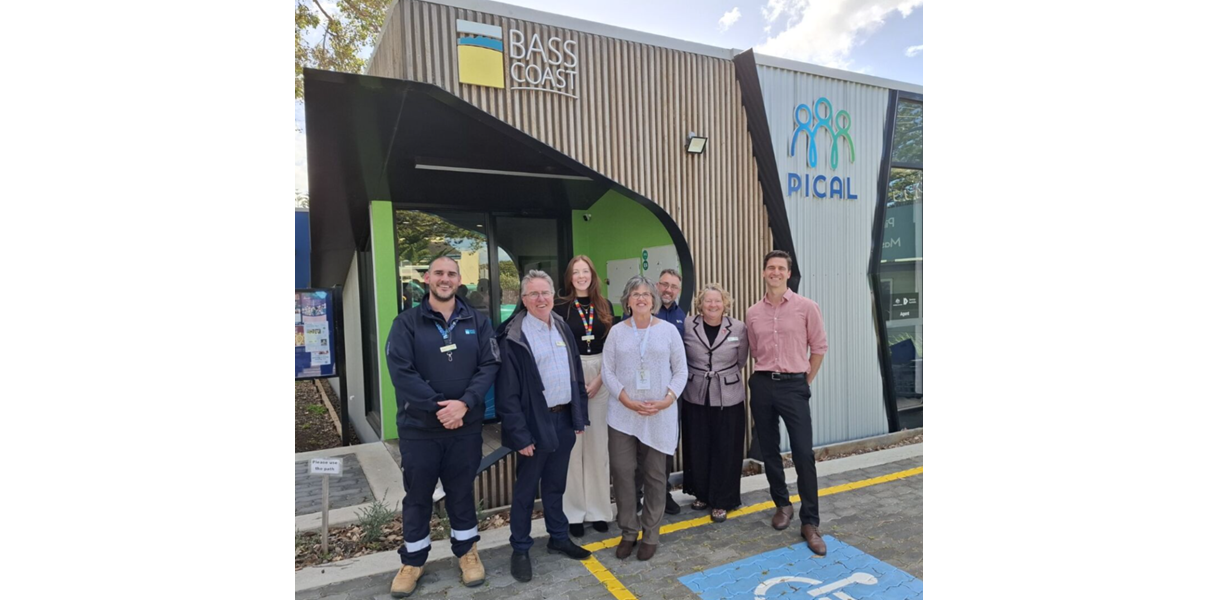
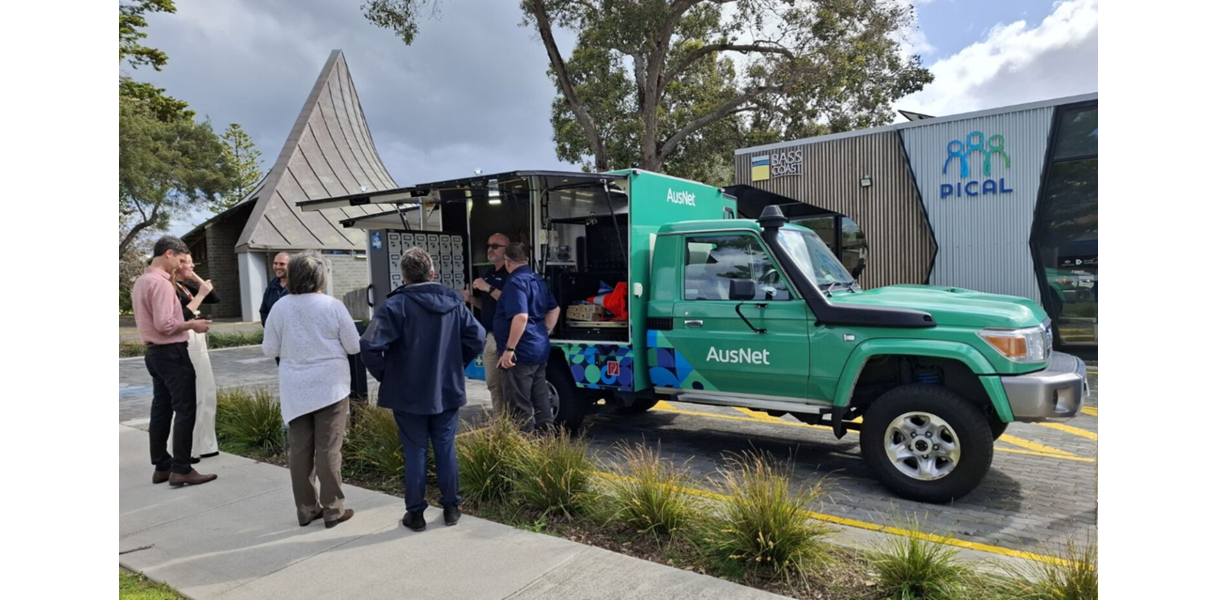
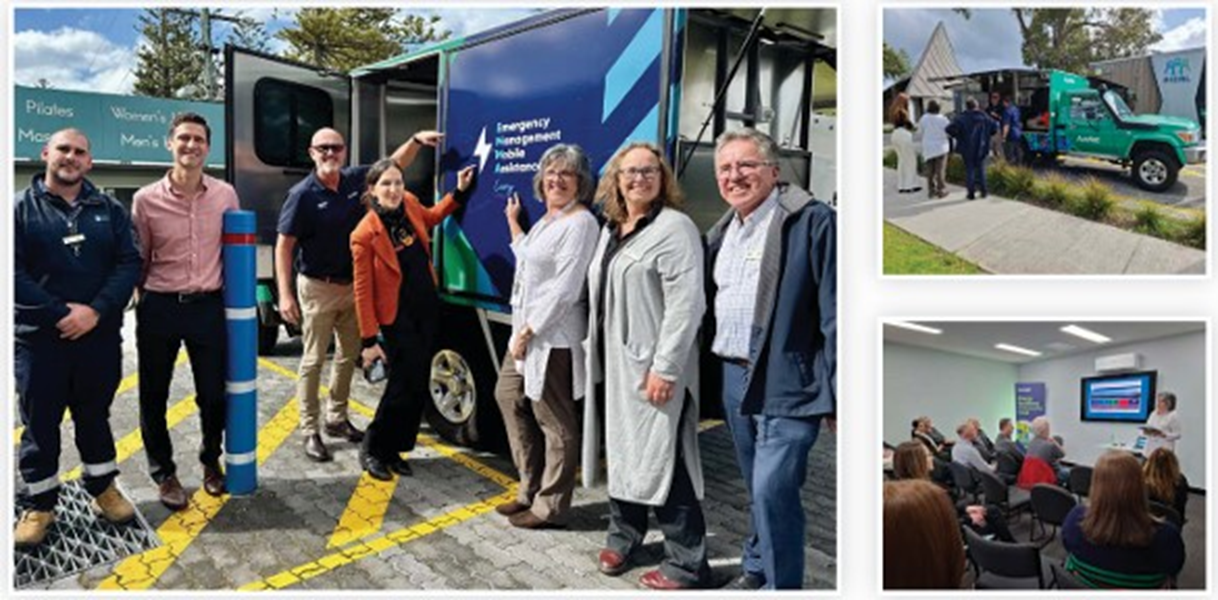
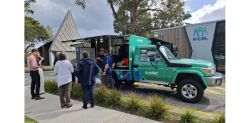
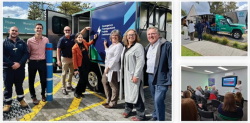
The network of 10 Energy Resilient Hubs across Bass Coast is itself a platform for future co-investment and catalytic uplift in physical and social capital to meet the challenges of climate change in Bass Coast.
Project impacts and short-term outcomes:
The project has supported effective inter-agency community response support and recovery during extreme weather events, maintaining power during outages and providing access for community members to information, showers, and psycho-social support. The Hubs have also supported effective response agency coordination during events, maintaining operations during outages and allowing for distributed models of relief provision where it is needed most across the Shire.
The project has delivered 10 Energy Resilient Hubs in priority locations, ensuring that local communities are resilient to all-hazards emergencies, and delivering benefits to Council and response agencies as communities increasingly take responsibility for their own disaster planning.
Along with the Hubs, the project has served as a vector for further funding attraction, with an additional 9 community-led projects funded – ranging from generators to community education, and publication of the Waterline Emergency Network Community Preparedness Handbook.
The innovative approach to create a network of energy resilience – rather than one-off solar installs – has created a true platform for community-led disaster planning, alongside delivering strong BAU climate change and financial efficiency outcomes at priority sites with co-located services.
The project has also strengthened collaboration across Emergency Management and Sustainable Environment teams, leading to stronger outcomes measurement and joined-up programming to mitigate the impacts of climate change through place-based solutions.
Capability and long-term impacts:
This project has significantly enhanced the long-term disaster resilience of communities across Bass Coast Shire – both through provision of energy resilient infrastructure, as well as through development of social capital and connection around disaster resilience and integration with digital emergency warning platforms.
The project incorporates both BAU climate change mitigation and disaster response, ensuring that facilities where essential services are co-located remain operational during power outages, serve as hubs for community and agency activation, and are identified in community as sites for community preparedness planning.
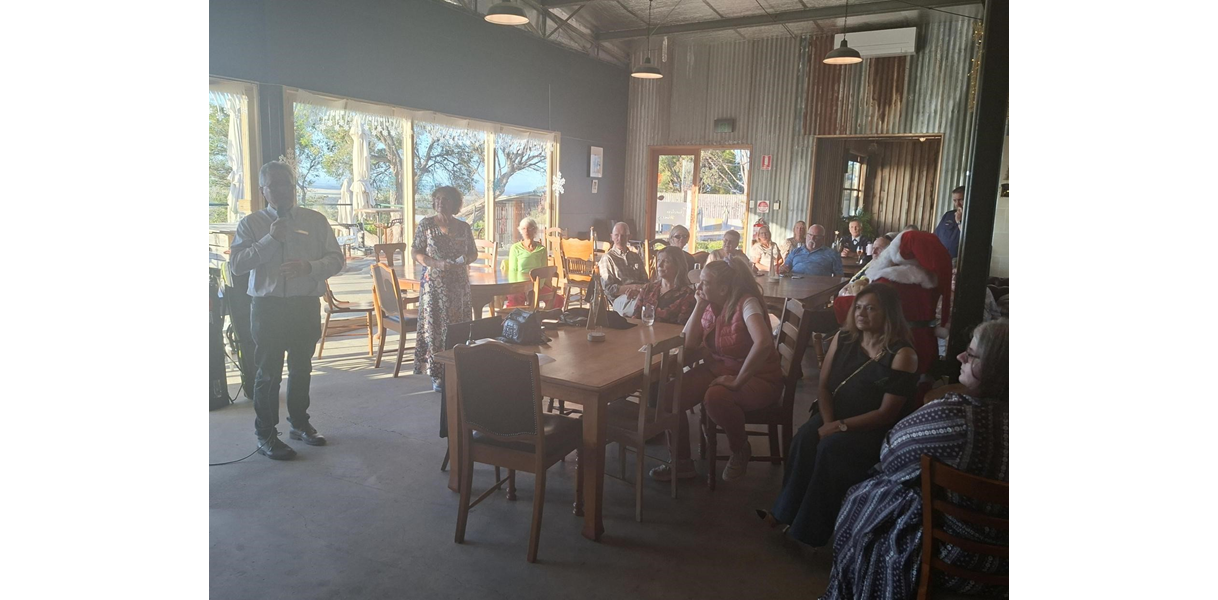
One of the strongest legacies of this project is building the capability across community and emergency management stakeholders for true community-led disaster resilience. Local networks have been entrusted with fobs to access the buildings, and now self-activate during weather and extreme heat events.
The network of 10 Energy Resilient Hubs across Bass Coast is itself a platform for future co-investment and catalytic uplift in physical and social capital to meet the challenges of climate change in Bass Coast.
Scalability and transferability:
The Bass Coast Energy Resilient Community Hubs have provided the sector with a demonstration project of a true systems-level approach to ‘hard’ and ‘soft’ capital energy resilience uplift: leveraging innovative partnerships across community, response agencies, government and industry. The project is supporting regional-level planning around distributed models for relief provision in the emergency management sector, and providing an innovative road map for
The Hubs are integrated into Councils digital Emergency Management dashboard, as well as Council’s Climate Change Actin Portal, providing a powerful example to multiple sectors around the benefits of this integration. The significant funding attraction, implementation of true community-led practice, and scale achieved has transformed emergency management planning in Bass Coast over a short time, with local communities empowered to drive their own relief and recovery in partnership with government and response agencies.