

Innovation Case Study: Port Phillip Family and Domestic Violence Workplace Support Program
Port Phillip City Council
Employee support and capability to prevent family and domestic violence
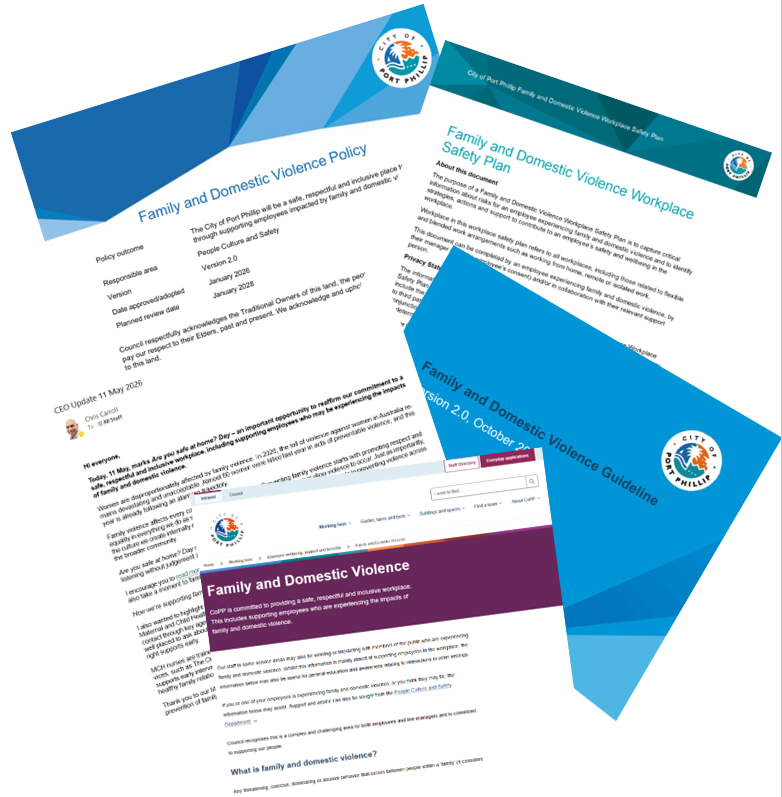
Family and Domestic Violence workplace awareness and capability uplift plan including updated Policy, guidelines and workplace safety plan, all staff keynote speaker with lived experience, intranet update promoting clear information and resources, FDV prevention and awareness training for all people leaders and key roles, updated Workplace Contact Officer framework to support FDV, and regular communication to staff including CEO messaging.
2026 MAVlab Innovation Awards Finalist:
The Skilled to Serve Award for Capability Uplift, supported by Datascape

Project goals:
- Build a clear, shared understanding of family and domestic violence, including its impacts and our individual and collective role in prevention
- Strengthen organisation-wide awareness, confidence and capability to recognise, respond to and appropriately support staff impacted by family and domestic violence
- Enhance manager capability to lead inclusive, flexible and high-performing teams, with a focus on equity, psychological safety and consistent decision-making
- Embed a sustainable, organisation-wide culture of flexible work that supports diverse employee needs while maintaining performance, accountability and service outcomes.
Project team:
The project team comprised seven core members from Organisational Development, Health, Safety and Wellbeing, Human Resources and Diversity, Equity and Inclusion, working collaboratively to design and deliver key outcomes.
Team members contributed alongside their existing roles, balancing project delivery with broader organisational priorities.
Broader council officers were engaged as required, including Human Resources, Diversity, Equity and Inclusion and Internal Communications, to provide specialist input or action.
This small, cross-functional approach enabled strong alignment, shared accountability and practical integration of outcomes into business-as-usual activities.
The core team of the project included:
- Karen Lyon – Head of Safety and Wellbeing
- Chris Jones – Health and Safety Officer
- Jasmin Davidson – Human Resources Business Partner
- Naomi Walton – Head of Organisational Development
- Shanae Greaves – Senior Organisational Development Advisor
- Alexandra Francis – Organisational Development Officer
- Kate Greenwood – Social Policy and Gender Equity Advisor.
Project duration:
2 years.
Challenge and context:
Council identified a significant and complex challenge in strengthening its organisational response to Family and Domestic Violence (FDV). Increasing prevalence, alongside our commitment to advancing gender equality through the Gender Equality Action Plan (GEAP), reinforced the urgency for action. We also recognised the well-established link between gender inequality and gender-based violence and acknowledged that some employees were likely to be directly impacted.
As a local government organisation, we recognise the important role we play not only in supporting those affected, but also in driving awareness, strengthening early recognition, and contributing to the prevention of FDV within our community and workplace.
While baseline supporting documents/policies existed, they were not well understood, visible or consistently applied. Leaders and key staff lacked the confidence, capability and practical guidance to respond appropriately to disclosures. This created a risk, given the sensitive, highly personal nature of FDV and the potential harm arising from inconsistent or inadequate responses.
The challenge was further compounded by the size and diversity of our workforce, spanning multiple locations, roles and work environments. Delivering consistent communication, engagement and capability uplift across this landscape was difficult. In addition, stigma, fear and low trust associated with FDV created barriers to disclosure, particularly for vulnerable and marginalised cohorts.
A critical tension existed between raising awareness and ensuring psychological safety. We needed to build understanding without causing distress or retraumatisation, while equipping leaders to respond appropriately without overstepping professional boundaries. Establishing trust was essential; employees needed confidence that disclosures would be handled safely, respectfully and without negative consequences.
These intersecting factors highlighted the limitations of a traditional, compliance-based approach and required an innovative, organisation-wide response. This innovation centred on embedding a lived-experience focused approach, integrating policy, capability building and cultural change to create a safe, consistent and sustainable approach across leadership, systems and everyday practice
Solution and innovation:
We adopted an integrated, organisation-wide approach to embed FDV awareness, capability and support into everyday systems, leadership practice and culture. This marked a deliberate shift from a policy-led approach to an innovative, holistic, lived-experience model embedded in how we work.
A standalone FDV Policy established clear organisational commitment to prevention, disclosure and support, that centres those impacted by FDV. This was complemented by updated FDV Guidelines and a workplace safety plan template, providing practical, accessible tools for leaders to respond confidently and consistently.
We intentionally centred lived experience through an organisation-wide keynote, building empathy, reducing stigma and shaping the tone of subsequent initiatives.
This was then reinforced through FDV awareness and disclosure training for all people leaders and key roles. Training design was shaped through cross-functional collaboration between Organisational Development, Health, Safety and Wellbeing, HR, and external Family and Domestic Violence specialists, ensuring alignment with best practice and a strong lived-experience focus.
Importantly, training recognised the diverse experiences of First Nations employees, LGBTIQA+ communities and culturally diverse groups.
Accessibility and engagement with all initiatives were strengthened through a central intranet hub and sustained CEO-led communications, using both digital and non-digital channels to reach a diverse workforce.
Through consultation with the Workplace Contact Officer (WCO) network, the WCO framework was redesigned to better meet organisational needs, including the introduction of a focus on FDV response and support. Enhanced support structures, including training, access to specialist advice, debriefs and ongoing support, enable these expanded responsibilities. This strengthens the organisation’s capacity to provide multiple safe, accessible support points for employees experiencing FDV.
Our holistic approach was innovative in its deliberate integration of policy, lived experience, capability uplift and accessible support pathways. This approach created a consistent and sustainable organisational response embedded in everyday practice.
A distributed network of trained responders, including people leaders, People, Culture and Safety team members and Workplace Contact Officers, has created multiple, accessible entry points for support and strengthened organisational readiness to respond to complex situations.
Project impacts and short-term outcomes:
Workforce reach and awareness increased through a coordinated program of communications, leadership messaging and organisation-wide initiatives. Approximately 150 employees engaged with the face to face all-staff keynote, with the recording available to all staff on the intranet for 3 months afterwards. Notably, anecdotal feedback indicated an increase in employees disclosing experiences of FDV to leaders, colleagues and People, Culture and Safety team members following the session. This reflects the immediate impact of a lived-experience focused approach in building trust, reducing stigma and reinforcing psychological safety.
Capability uplift was achieved through targeted training, with 167 people leaders, People, Culture and Safety representatives and Workplace Contact Officers completing FDV awareness and disclosure training. Evaluation data showed strong outcomes, with 99% of participants reporting increased knowledge and skills, and 96% indicating confidence to apply these in their role. Qualitative feedback highlighted improved confidence in recognising signs of FDV, having empathetic conversations and responding appropriately, including maintaining boundaries and connecting employees to support pathways.
Outcomes were further supported through the introduction of clear guidelines, disclosure processes and workplace safety planning tools, improving consistency in responses. This is reinforced by People Matter Survey results, with 83% of respondents expressing confidence that the organisation would support them to access Family Violence Leave. This increased to 87% among women, an important indicator given women are disproportionately impacted by FDV. These results demonstrate measurable improvements in awareness, capability and perceived organisational support.
Collectively, these outcomes reflect strong progress against all three project goals, demonstrating increased shared understanding of FDV, strengthened organisational confidence and capability to respond and support, and enhanced leadership capability to foster inclusive, flexible and high-performing team environments.
Capability and long-term impacts:
This project has strengthened organisational capability by embedding FDV awareness, response and support into everyday systems, practices and leadership behaviours in a way that is sustainable beyond the project.
At a systems level, the updated FDV policy, guidelines and workplace safety plan are now integrated into business-as-usual HR and safety frameworks. This has established clear, consistent and scalable pathways for responding to disclosures, reducing reliance on ad hoc approaches and enabling a more consistent organisational response.
Capability uplift has been sustained through embedding FDV training into leadership development and onboarding. A distributed network of trained responders, including people leaders, People, Culture and Safety team members and Workplace Contact Officers, has created multiple, accessible entry points for support and strengthened organisational readiness to respond to complex situations.
Capability uplift within the workplace has had a broader flow-on impact, acting as a catalyst for ensuring community-facing staff are equipped with clear protocols and support mechanisms to respond to community members accessing Council services who may be at risk of or experiencing FDV. These measures enable staff to respond safely, consistently and with confidence in complex situations. In addition to supporting community members, these mechanisms help mitigate psychosocial risks for staff, contributing to their overall safety, wellbeing and confidence in their roles.
The project has also strengthened ways of working through increased cross-functional collaboration between HR, Safety and specialist support roles. Shared frameworks, clearer accountabilities and improved coordination have enhanced consistency and reduced risk.
Importantly, the initiative has built organisational resilience and adaptability. Increased leadership confidence, stronger psychological safety and improved awareness position the organisation to better anticipate and respond to emerging psychosocial risks. Collectively, this creates a repeatable, scalable model for addressing complex and sensitive workforce issues into the future.
Scalability and transferability:
This project provides a scalable and transferable model that councils can readily adopt or adapt, regardless of size, workforce profile or resource constraints. The approach was deliberately designed as a structured, modular solution, combining policy, capability uplift, communications and practical tools that can be implemented progressively or as an integrated package.
Core components, including the FDV policy, guidelines, workplace safety planning template and intranet resources, can be shared as adaptable templates. These can be tailored to align with local governance structures, workforce contexts and community needs, enabling practical application across diverse council environments.
The tiered capability model further supports scalability. Organisation-wide awareness initiatives are complemented by targeted, role-specific training for people leaders and key support roles. This flexible approach allows councils to scale delivery based on available resources and can be implemented through both digital and face-to-face formats.
A key transferable element is the use of lived experience, leadership visibility and consistent communications to build trust, reduce stigma and encourage help-seeking behaviours. This engagement approach can be readily replicated to strengthen cultural outcomes.
Beyond replication, the project contributes to broader sector capability by positioning FDV as a workplace issue and strengthening early intervention and support. It aligns with UN Sustainable Development Goals, particularly SDG 5 (Gender Equality) and SDG 8 (Decent Work and Economic Growth), by supporting safer, more inclusive workplaces.
Overall, the model offers a practical, evidence-informed pathway for councils to build sustainable FDV capability at scale.