

Innovation Case Study: From Compliance to Insight: AI-Powered Gender Impact Assessments
Gannawarra Shire Council
AI transforms gender impact assessments across rural local government
Gannawarra Shire Council developed an AI-enabled approach to gender impact assessments (GIAs), transforming a resource-intensive compliance task into a fast, scalable and insight-driven process.
This innovation enables staff to produce high-quality GIAs in seconds, improving consistency, reducing workload and embedding gender equality into decision-making across policies, programs and services.
2026 MAVlab Innovation Awards Winner:
The Skilled to Serve Award for Capability Uplift, supported by Datascape
Project goals:
- Ensure consistent compliance with the Gender Equality Act 2020
- Reduce time and resource burden associated with traditional GIA processes
- Improve the quality, consistency and usability of gender impact analysis
- Embed gender equality considerations into everyday decision-making
- Leverage AI to transform GIAs from compliance activity into strategic insight
- Enable staff across the organisation to confidently undertake GIAs without specialist expertise.
Project team:
- Coordinator Inclusive Communities, Jodie Hartley.
- Manager Community Health, Narelle O’Donoghue.
Contributors:
- Manager ICT, Warren Taylor.
- Director Community Wellbeing, Paul Fernee.
Project duration:
The AI-enabled GIA process was designed and implemented within 4–6 weeks through collaboration between Community Wellbeing and ICT teams.
While rapid to develop, the initiative represents an ongoing organisational capability, now embedded across council to support all future policy, program and service design processes.
Challenge and context:
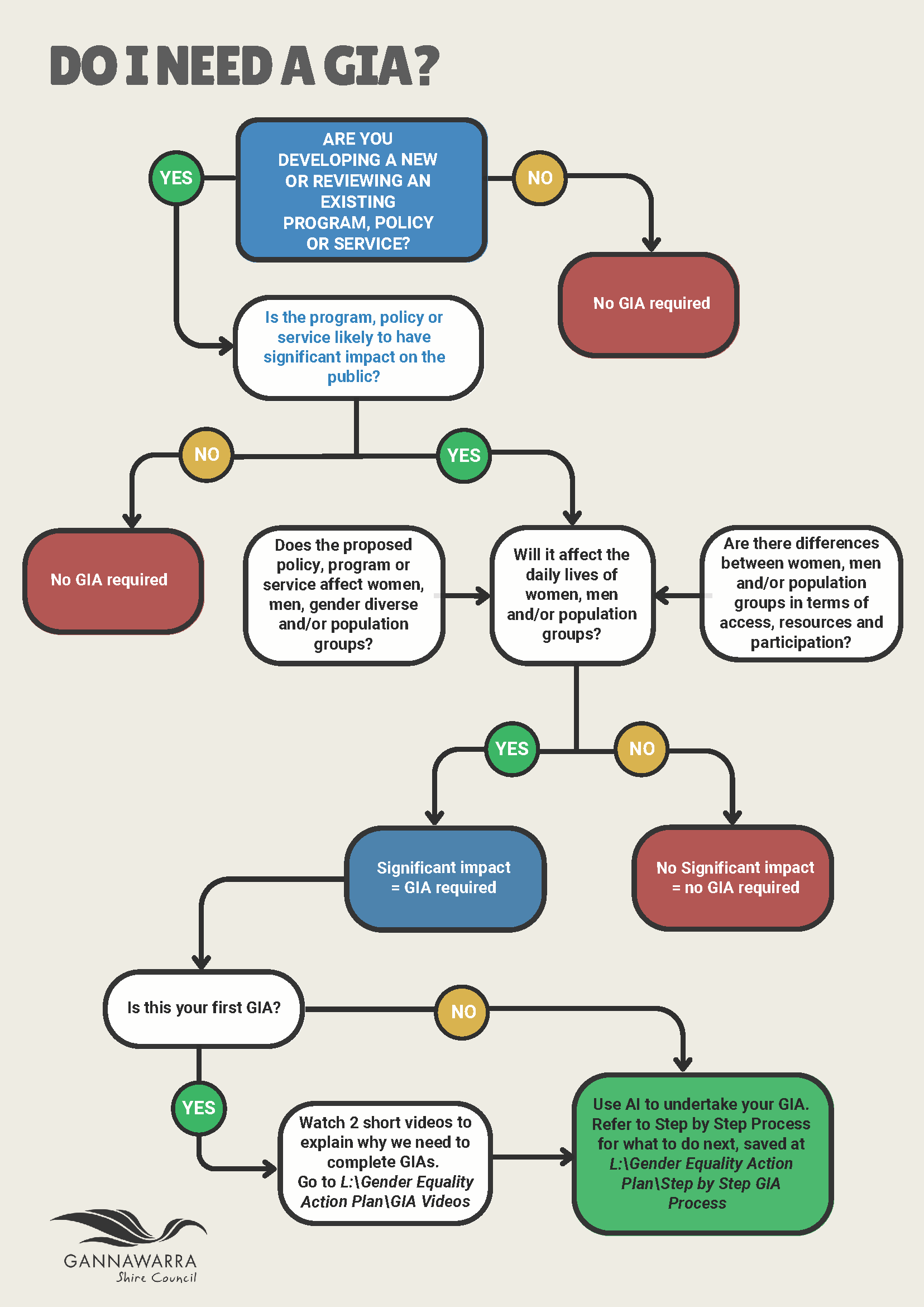
The Gender Equality Act 2020 requires all Victorian councils to undertake Gender Impact Assessments (GIAs) when developing or reviewing policies, programs and services. While critical for advancing equality, GIAs are traditionally time-intensive, requiring data analysis, stakeholder consideration and specialist knowledge.
For a small rural council like Gannawarra, this created a significant challenge. Staff already managing competing priorities often lacked the time, confidence or expertise to complete thorough GIAs. This risked GIAs becoming either a compliance burden or inconsistently applied across the organisation.
The challenge was twofold: ensuring legislative compliance while also maintaining quality and meaningful analysis. Traditional approaches, including manual research, workshops and cross-team collaboration, were not scalable or sustainable given resource constraints.
At the same time, Council recognised an opportunity. The emergence of AI tools presented a way to fundamentally rethink how GIAs could be developed - not just faster, but better.
Rather than treating AI as a simple efficiency tool, Council saw the potential to address deeper issues: consistency, accessibility and analytical rigour. The challenge was to design a solution that maintained integrity and accountability while unlocking the benefits of AI.
This required careful integration of structured templates, local data and guided prompts to ensure outputs remained relevant, accurate and aligned with best practice gender analysis.
Solution and innovation:
The innovation lies in creating a structured, AI-enabled system that transforms how GIAs are produced.
Council developed a three-part solution:
- A standardised GIA framework covering stakeholder, gender and intersectional analysis
- A curated evidence base incorporating local data and research on diverse population groups
- A tailored AI prompt that guides the production of structured, high-quality assessments.
When combined with relevant policy or program information, AI generates a comprehensive GIA in 10–20 seconds.
This represents a significant departure from traditional approaches. Instead of relying on time-intensive manual processes, staff can now access a consistent, scalable and high-quality analytical tool.
Importantly, the innovation is not just speed—it is quality and accessibility:
- AI ensures all GIAs follow a robust and consistent methodology
- Staff without specialist expertise can confidently undertake assessments
- Intersectional considerations are embedded, not overlooked
- Outputs are structured, clear and immediately usable.
The project also demonstrates responsible AI adoption. By grounding outputs in curated local data and structured templates, Council ensures the analysis remains relevant and aligned to community context.
This shifts GIAs from being a compliance task to a strategic input—providing insights that actively shape decision-making rather than simply documenting it.
The innovation has also improved equality outcomes. By making GIAs easier and faster to complete, they are now more consistently applied across projects—ensuring gender considerations are embedded in a broader range of decisions.
Project impacts and short-term outcomes:
The project has delivered immediate, measurable impacts:
- Multiple GIAs completed using the AI-enabled process
- Application across major strategic and operational initiatives, including:
- Council Plan 2025–2029
- Community Engagement Strategy 2025–2030
- Library programming and service planning.
- Reduction in time required to complete a GIA from hours (or days) to seconds.
Beyond efficiency, the project has improved quality and consistency:
- Standardised structure ensures all GIAs meet legislative requirements
- Enhanced depth of analysis, including stronger consideration of gender-diverse and intersecting experiences
- Increased staff confidence in undertaking GIAs.
The innovation has also improved equality outcomes. By making GIAs easier and faster to complete, they are now more consistently applied across projects—ensuring gender considerations are embedded in a broader range of decisions.
This represents a shift from selective compliance to systematic integration.
Capability and long-term impacts:
This initiative has fundamentally strengthened organisational capability in both equality and innovation.
It has:
- Embedded AI as a practical, trusted tool within council operations
- Increased organisational confidence in using data and technology responsibly
- Enabled a consistent, organisation-wide approach to gender equality.
Most significantly, it has changed behaviour. Staff are more willing to undertake GIAs because the process is no longer seen as burdensome. This has normalised gender analysis as a core part of planning and decision-making.
The project also builds digital capability within a rural council context, demonstrating that advanced tools like AI can be successfully adopted without large-scale investment.
It creates a model for:
- Augmenting workforce capability
- Overcoming resource constraints
- Embedding legislative requirements into everyday processes.
This positions council as more adaptive, efficient and forward-looking in responding to future policy and service challenges.
Scalability and transferability:
This model is highly transferable across local government and beyond.
Any organisation required to undertake gender impact assessments—or similar analytical processes—can adopt this approach by combining:
- A structured framework
- Relevant local or organisational data
- Tailored AI prompts.
The solution is particularly valuable for small and rural councils, where resourcing constraints often limit the ability to undertake detailed analysis.
Key benefits of transferability include:
- Minimal cost to implement
- Rapid deployment (as demonstrated by the 4–6 week development timeframe)
- Applicability across multiple policy and planning contexts.
The approach could also be extended beyond GIAs to other forms of impact assessment, including social, health and community wellbeing analysis.
By sharing its methodology, Gannawarra Shire Council provides a practical model for how AI can be used to strengthen compliance, improve analysis and embed equality into decision-making at scale.