

Innovation Case Study: Monbulk Community Microgrid
Yarra Ranges Shire Council
Out of the darkness: A bright future for Monbulk
The Monbulk Microgrid is a council-led community energy project delivering resilience in a disaster-prone region. Linking key community facilities through 100 kW solar and 200 kWh battery storage, it reduces emissions by about 120 tCO2e annually while enabling emergency hub operations for 3,000 households. Co-designed with community and partners, it provides scalable, cost-effective, climate-ready precinct infrastructure with long term benefits
2026 MAVlab Innovation Awards Finalist:
The Horizon Award for Future Climate Leadership and Action, supported by Infrastructure Sustainability Council

Project goals:
- Enhance energy security and climate resilience by delivering a reliable, precinct-scale renewable system capable of operating during prolonged grid outages.
- Reduce greenhouse gas emissions by approximately 120 tonnes CO2e annually through integrated solar and battery infrastructure, supporting local and state decarbonisation targets.
- Enable Monbulk Living and Learning Centre and Sports Pavilion to function as accessible emergency hubs serving over 3,000 households during disasters.
- Embed cross-council collaboration and build internal capability in microgrid planning, delivery, and integrated emergency management operations.
- Strengthen community ownership through genuine co-design, including a working group and youth-led placemaking initiatives reflecting local culture and Wurundjeri heritage.
- Demonstrate a scalable, replicable model that delivers long-term cost savings, environmental outcomes, and social impact, encouraging uptake across other townships and councils.
- Increase community awareness of electrification and resilience actions through engagement, education, and visibility of the microgrid, building trust and inspiring future local climate initiatives.
- Support partnerships with industry volunteers.
Project team:
- Sarah Bond: Executive Officer, Nature
- Corinne Bowen GAICD: Executive Leader, Climate & Disaster Resilience
- Eight others.
Project duration:
2 years.
Challenge and context:
Monbulk sits in the Dandenong Ranges, one of Australia’s most disaster‑affected regions, with communities regularly exposed to severe storms, high winds and bushfire risk. Repeated events – including the June 2021 storms – have caused prolonged power outages, isolating residents, disrupting essential services and undermining confidence in the reliability of centralised electricity supply. In this steep, forested environment, conventional network upgrades alone cannot guarantee energy security for dispersed townships and are often prohibitively expensive relative to local ratepayer bases.
At the same time, Monbulk’s key community facilities – the Monbulk Living and Learning Centre and the Sports Pavilion – play a critical role in supporting social connection, local sport, learning and wellbeing. These buildings were not originally designed to operate as resilience hubs, and escalating energy costs were placing pressure on their financial sustainability. Residents and local groups told Council they needed safe places they could rely on for power, information, refrigeration, communications and connection during emergencies, especially for older people, families with young children, and those without backup power at home.
The core challenge was to deliver climate resilience and energy security for a small township in a way that was technically feasible, financially sustainable and community‑owned. Council had to navigate complex regulatory settings for microgrids, limited precedents for council‑led local energy systems, and the need to coordinate multiple internal teams and external partners. It was also essential to respond to diverse community perspectives – from long‑term residents and sports clubs to local traders and schools – and to rebuild trust in institutions after repeated disasters. These constraints made the challenge both difficult and worthy of an innovative response.
Solution and innovation:
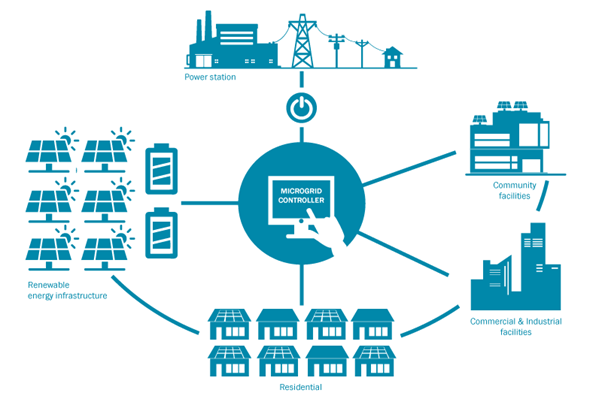
The Monbulk Microgrid is a council‑led community energy initiative designed to strengthen energy security and climate resilience in a disaster‑affected township while supporting the transition to net zero. The project connects the Monbulk Living and Learning Centre and the Sports Pavilion into a shared, precinct‑scale system, combining 100 kW of solar generation with 200 kWh of battery storage. This integrated approach enables the facilities to deliver clean energy, reduce emissions and continue operating as safe, accessible community hubs during power outages.
Rather than treating each building separately, the microgrid operates as a unified energy precinct. Under normal conditions, it provides low‑cost, renewable electricity, reducing emissions by around 120 tonnes of CO₂e annually and improving the financial sustainability of both sites. During outages, the system can operate independently, maintaining essential services such as lighting, refrigeration, communications and device charging. This ensures the two facilities can function as emergency hubs supporting more than 3,000 local households in times of need.
The project demonstrates innovation in several key areas. It integrates climate mitigation, adaptation and resilience into a single system, embedding long‑term sustainability into everyday operations. It also establishes a scalable, precinct‑scale model that can be replicated across other townships, creating a practical blueprint for local energy resilience.
Strong community involvement has been central. Local groups contributed to co‑designing resilience functions and operations, while more than 150 young people helped create a mural on the infrastructure, incorporating the traditional Wurundjeri name “Monbolok” and their vision for a climate‑resilient future.
Delivery required close collaboration across council teams, from feasibility and engagement to engineering, construction and emergency planning. Inclusion and accessibility were prioritised, ensuring the facilities remain welcoming, practical and responsive to the needs of all community members, particularly during emergencies.
Monbulk Microgrid has created enduring capabilities and systems that extend well beyond the project’s immediate scope and timeframe, strengthening organisational resilience and Council’s ability to deliver future climate‑leadership initiatives.
Project impacts and short-term outcomes:
Monbulk Microgrid has already delivered measurable outcomes aligned to its climate and resilience goals.
Quantitative benefits include:
- Installation of 100 kW of rooftop solar and 200 kWh of battery storage capacity shared between the Monbulk Living and Learning Centre and Sports Pavilion.
- An estimated annual emissions reduction of 120 tonnes CO₂e, equivalent to planting 5,700 trees
- Improved energy security for two critical community hubs serving over 3,000 households: both facilities now maintain essential services during power outages, supporting residents who lack backup power or safe spaces at home.
- These outcomes reduce reliance on fossil‑fuel‑generated grid electricity, lower operational costs for the facilities, and increased confidence that Monbulk can safely weather future extreme‑weather events.
Qualitative outcomes have been equally important:
- Stronger community trust and engagement: Co‑design and collaborative delivery strengthened relationships between Council, community groups and residents. Stakeholders report feeling heard and respected, and a strong sense of shared project ownership.
- Visible climate leadership: The microgrid provides a tangible, meaningful demonstration of Council’s commitment to climate leadership and the transition to net zero emissions. Residents can see and experience the infrastructure in their own town, making climate action real and local.
- Enhanced resilience and climate adaptation capacity: Local emergency‑management groups and facility managers have increased confidence that they can support the community through extended outages. The project has prompted broader conversations about preparedness, mutual support and the role of local infrastructure in crises.
- Cultural and place‑based impact: The youth‑led mural has turned a former graffiti hotspot into a respected community landmark. The absence of graffiti since installation suggests that the co‑design process successfully fostered shared ownership and pride, reinforcing local identity and values around sustainability.
These outcomes have been measured through system monitoring, stakeholder feedback, reports from facility managers and emergency‑management partners, and observations of community use and response.
Capability and long-term impacts:
The Monbulk Microgrid has significantly strengthened Council’s long‑term capability to deliver climate adaptation and mitigation through integrated, community‑centred infrastructure.
At an organisational level, the project has shifted practice from ad hoc building upgrades to strategic, precinct‑scale resilience planning. Council now has a tested methodology for identifying suitable precincts, undertaking feasibility studies, engaging communities in co‑design, and integrating microgrid infrastructure into existing assets and services. This methodology is informing the broader Resilient Yarra Ranges program and future capital works planning.
Cross‑functional collaboration has become a norm rather than an exception. The partnership between Climate, Major Projects, Facilities and Emergency Management teams created new patterns of coordination, shared decision‑making and collective accountability. These ways of working are now being applied to other climate‑ and resilience‑related projects, improving Council’s ability to anticipate, respond to and manage complex challenges that cut across traditional departmental boundaries.
The project has also built Council’s technical and governance capability in emerging energy systems. Staff have developed practical experience in microgrid design, procurement, contract management and operations, including navigating regulatory requirements and integrating resilience hubs into emergency‑management plans. This positions Council to explore additional initiatives such as community batteries, electric‑vehicle charging infrastructure and further resilient energy precincts with greater confidence.
For the community, the microgrid has catalysed learning and empowerment. Through workshops, co‑design activities and the mural project, residents – particularly young people – have gained a deeper understanding of climate resilience, renewable energy and the energy transition. The project has increased awareness of household electrification and sparked interest in similar initiatives across the municipality, reinforcing a culture of shared responsibility for climate action.
In these ways, Monbulk Microgrid has created enduring capabilities and systems that extend well beyond the project’s immediate scope and timeframe, strengthening organisational resilience and Council’s ability to deliver future climate‑leadership initiatives.
Scalability and transferability:
From the outset, the Monbulk Microgrid was designed as a scalable model, not a one‑off solution. Its architecture, governance and engagement approach provide a clear template for precinct‑scale energy resilience in other townships and municipalities.
Within Yarra Ranges, the project serves as a pilot for a network of resilient energy precincts and resilience hubs. The learnings from Monbulk – including technical specifications, procurement strategies, community‑engagement methods and emergency‑hub protocols – are being documented and applied to subsequent sites under the Resilient Yarra Ranges program. This will enable Council to extend similar benefits to other disaster‑affected communities in a cost‑effective and consistent way.
The model is also highly transferable to other councils. As a local government‑led community microgrid, Monbulk offers practical insights into how councils can convene partners, design shared systems and integrate microgrids into existing community facilities and emergency‑management arrangements. The project provides a tangible example of how to combine technical innovation with social impact, making it relevant to regional and peri‑urban councils facing similar climate‑ and energy‑security challenges.
By contributing to emissions reduction (SDG 13: Climate Action), clean and affordable energy (SDG 7: Affordable and Clean Energy), and resilient, inclusive communities (SDG 11: Sustainable Cities and Communities), the Monbulk Microgrid demonstrates how local government can operationalise the UN Sustainable Development Goals at the township scale. Its emphasis on community partnerships, regenerative infrastructure and knowledge‑sharing aligns strongly with the Horizon Award’s intent to recognise future climate leadership and action.