

Innovation Case Study: Neighbourhood Activity Centre Framework
Stonnington City Council
Stonnington's place-based blueprint for sustainable local centre growth
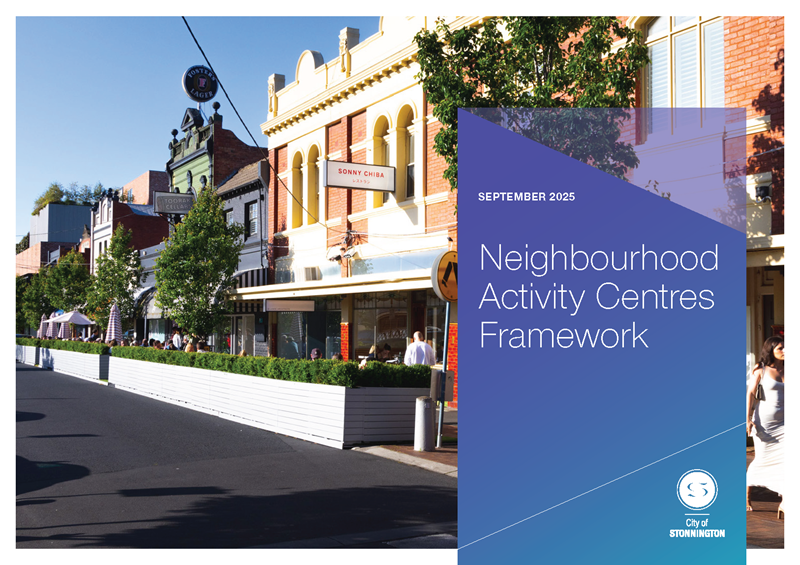
Stonnington has prepared a Neighbourhood Activity Centres Framework to guide growth and development across 17 of our local centres, anticipated to accommodate a significant share of growth over the next 15+ years.
It introduces clear built form controls (including FARs) to manage height and scale, while also including objectives, strategies and actions to support improved sustainability, walkability and public spaces.
2026 MAVlab Innovation Awards Finalist:
The Thriving Places Award for Design and Planning Excellence, supported by JLT Public Sector

Project goals:
- To guide development in 17 local activity centres in Stonnington, which did not have existing specific built form controls.
- To support conveniently located, high-amenity developments, that accommodate population and economic growth while contributing positively to local character and sense of place.
- Ensure that strategic directions for the centres were developed from a strong evidence base, robust methodology and community input.
- Adopt a typology approach – grouping built form controls into typologies based on contextual factors and place-based visions – crucially enabling a context-responsive outcome, while also being scalable to multiple centres across the municipality.
- Position Stonnington proactively to collaborate with (and advocate to) the State Government, enabling local insights to inform a broader program of work that is aligned in supporting growth close to transport, shops, services and employment.
Project team:
The project leads: (Jane Hanna and Tamara Lowen), Statutory Planning and Urban Design (Anthony DePasquale, Amanda Connolly, James Mackness, Emily Blyth-Jones), Transport (Nuno Pires, Douglas Rowland) Climate and Sustainability (Alice Trumble) and social planning (Lisa Stafford).
The NAC Framework is an example of integrated planning, tying in expertise covering planning, economic impacts and analysis, transport and parking, capacity modelling, urban design and engagement. A team of consultants had input to these areas:
- Jane Hanna (strategic planning)
- Tamara Lowen (strategic planning)
- Lynette MacLennan (strategic planning)
- Hannah McBride-Burgess (strategic planning)
- James Mackness (urban design)
- Anthony DePasquale (statutory planning)
- Amanda Connolly (statutory planning)
- Douglas Rowland (transport planning)
- Nuno Pires (transport planning)
- Georgina Hagger (landscape projects)
- Lisa Stafford (social planning)
- Goran Babusku (smart cities)
- Ali Whelan (Breathe Architects)
- Jeremy McLeod (Breathe Architects)
- Leanne Hodyl (Hodyl and Co)
- Ripley Callahan (Hodyl and Co)
- Jim Gard’ner (GJM Heritage)
- Alex Hrelja (Hill PDA)
- Andrew Spencer (SGS Economics and Planning)
- Jan Qing (SGS Economics and Planning)
- Knowles Tivendale (Movement and Place)
- Caitlin Mulvogue-Pasquale (Movement and Place)
- Amy Hubbard (Capire)
- Athalia Zwartz (Capire)
- Eliza Knox (Capire).
Project duration:
This iteration of the NAC Framework began in 2021/22 and was completed in 2025 (four years later).
Challenge and context:
Stonnington's 17 neighbourhood activity centres lacked specific controls leaving statutory planners without clear direction and creating uncertainty for landowners, developers and the community in these centres.
The opportunity to identify context-responsive, yet scalable built form guidance across 17 centres, each with its own character, heritage context, land use mix, and community expectations was critical. This was flagged as an issue by our statutory planners as an issue they encountered assessing applications in these areas.
This work also seized the opportunity to undertake an integrated approach to planning, exploring more than housing growth, the NAC Framework also sought to support housing diversity, employment growth and economic activity, transport, public realm upgrades, infrastructure needs and improved sustainability outcomes.
Overlaying this was the need to respond to the critical need for more housing and employment space and respond proactively to the State Government's Train and Tram Activity Centres Program, which directly intersects with several of Stonnington's centres. Without a locally-informed framework already in place, there was a real risk that state-led controls would be applied without the nuance and on-the-ground knowledge that a council-led process can deliver.
Developing a framework that was simultaneously contextual and scalable, evidence-based and community-informed, locally specific yet transferable — all within a rapidly shifting policy environment — was the core challenge this work set out to solve.
Solution and innovation:
The key element that sets this work apart is the typology-based approach at this scale — what we believe is a Victorian first at a local level. While Victoria has maintained an activity centre hierarchy since Melbourne 2030, guidance has historically focused on principal, metropolitan and major centres. Neighbourhood activity centres — the local shopping strips and community hubs vital to daily life — have been largely overlooked, despite differing widely in scale, function, character and strategic role.
The Framework's typology approach responds to this gap. Crucially, it is both context-responsive and scalable across all 17 centres. The methodology considers heritage, environmental features, land use, interfaces, transport and the strategic vision for each centre. Five typologies were identified: one for heritage-affected areas using building envelope controls (heights and setbacks); and four for non-heritage areas utilising Floor Area Ratios (FARs), ranging from lower mandatory heights in heritage-rich Type A centres to greater density and flexibility in Type B+ to C+ centres. The methodology was co-created through collaborative workshops with planning, urban design and heritage specialists.
The Framework extends well beyond built form. Streetscape upgrades incorporate universal design principles, improved pedestrian infrastructure, wayfinding improvements, cycling infrastructure and public transport enhancements — ensuring centres are accessible and welcoming for people of all abilities. Objectives and strategies also support affordable housing opportunities and a diversity of dwelling types close to transport, services and employment.
Community engagement was central to the Framework's development. A multi-channel program — combining Stonnington's online platform, an interactive map, online survey, webinar and in-person community forums — reached residents, businesses and targeted community groups across all 17 centres, ensuring local knowledge and community aspirations were embedded in the final Framework.
Together, these elements position the Framework as a replicable, evidence-based model for neighbourhood activity centre planning across metropolitan Melbourne.
Developing a framework that was simultaneously contextual and scalable, evidence-based and community-informed, locally specific yet transferable — all within a rapidly shifting policy environment — was the core challenge this work set out to solve.
Project impacts and short-term outcomes:
The Framework is geared towards implementation and has immediate practical value. The built form controls within the Framework will be implemented through a planning scheme amendment, filling a void of planning guidance to ensure clear, consistent decision making for applications in activity centres, providing greater clarity and certainty to landowners, developers and the community.
It also identifies key public realm upgrades, transport improvements and further work for supporting community infrastructure that can be progressed across multiple teams across Council, and in partnership with other stakeholders resulting in coordinated and thoroughly integrated planning. A collaborative and integrated approach has benefits for inclusion, access and equity across the municipality by ensuring these elements are not overlooked in planning for growth.
Capacity analysis from SGS also shows that this work, along with Stonnington’s housing strategy can provide capacity for an additional 67,000 dwellings within Stonnington – exceeding the State Government target of 50,000 new dwellings by 2051.
This work framed Stonnington proactively to respond to the State Government Train and Tram Zone Activity Centre Program and Housing reforms. It signalled a change in the way Councillors use our communicate with State Government and their communities – drawing on our work as a solid evidence-base to frame their conversations.
Capability and long-term impacts:
A distinctive strength of the Framework is its integration of private and public realm outcomes. By aligning built form expectations with Council's capital works program, transport initiatives and public space upgrades, it creates an integrated planning environment where private investment and public infrastructure are aligned. This integrated approach reduces ad hoc decision-making and ensures that growth in centres is matched by improvements to the streets, footpaths and spaces that serve them.
Internally, the project strengthened cross-council relationships and ways of working. The co-design methodology — built around collaborative workshops with planning, urban design and heritage specialists — embedded shared ownership of the Framework across teams and built up capacity of staff. This has improved coordination between strategic planning, urban design and capital works functions, and created a more coordinated approach to managing growth and change that will outlast the project itself.
Beyond the organisation, the project has built meaningful connections through undertaking a ‘roadshow’ of presentations and discussions with other councils grappling with similar challenges, as well as with State Government bodies engaged in activity centre reform. These relationships position Stonnington as a leader in neighbourhood-scale planning and create ongoing opportunities for knowledge exchange and policy influence.
Collectively, the Framework has not only delivered a planning product — it has strengthened the systems, relationships and institutional knowledge that underpin good planning for the long term.
Scalability and transferability:
The Framework is exceptionally transferable and scalable. Its typology approach allows built form controls to be developed for multiple centres within a single strategic document — an approach with significant potential impact given that neighbourhood activity centres comprise the vast majority of activity centres across metropolitan Melbourne.
The benefits of scaling this approach are considerable. It drives context-responsive outcomes grounded in a strong evidence base and meaningful community engagement, while providing clarity and consistency across multiple centres simultaneously. It is also time and cost efficient. Traditional structure planning is resource-intensive and complex, placing considerable pressure on council budgets — particularly where multiple centres require planning within a short timeframe. The cost can be prohibitive, creating a vacuum of clear policy guidance. The typology methodology draws on economies of scale, reducing expenditure on technical studies, internal resourcing, engagement and planning panel processes.
Other local governments across Melbourne that have lacked capacity to undertake structure planning for smaller neighbourhood centres could readily adopt a typology approach — combining locally adapted built form controls with built form testing and community-informed design outcomes.
The approach is also particularly timely given the State Government's Train and Tram Activity Centres Program, which has prompted many Victorian councils to seek locally informed frameworks for managing growth. Stonnington's Framework offers a proven, replicable model for councils navigating this rapidly shifting policy environment.
Interest from other local governments has been substantial. Stonnington has shared the Framework through a roadshow of presentations with councils across Victoria and beyond. Recognition at the 2025 PIA Awards for Planning Excellence further elevated the Framework's profile, prompting direct enquiries from several councils seeking to advance similar work — a testament to the genuine transferability and relevance of this approach.