
Innovation Case Study: ngurrak-ba wurrung balit (Country Voice Strong) - Indigenous Design and Engagement Protocols
Yarra Ranges Shire Council
Guidelines for respectful Indigenous engagement in design and planning
The Indigenous Design and Engagement Protocols set out a respectful, collaborative framework for working with Wurundjeri Woi‑wurrung Traditional Owners. They embed cultural protocols, Indigenous knowledge and early partnership into planning and design, ensuring projects honour Country, support self‑determination, and deliver meaningful, culturally grounded outcomes for community, place, and future generations.
2026 MAVlab Innovation Awards Finalist:
The Thriving Places Award for Design and Planning Excellence, supported by JLT Public Sector

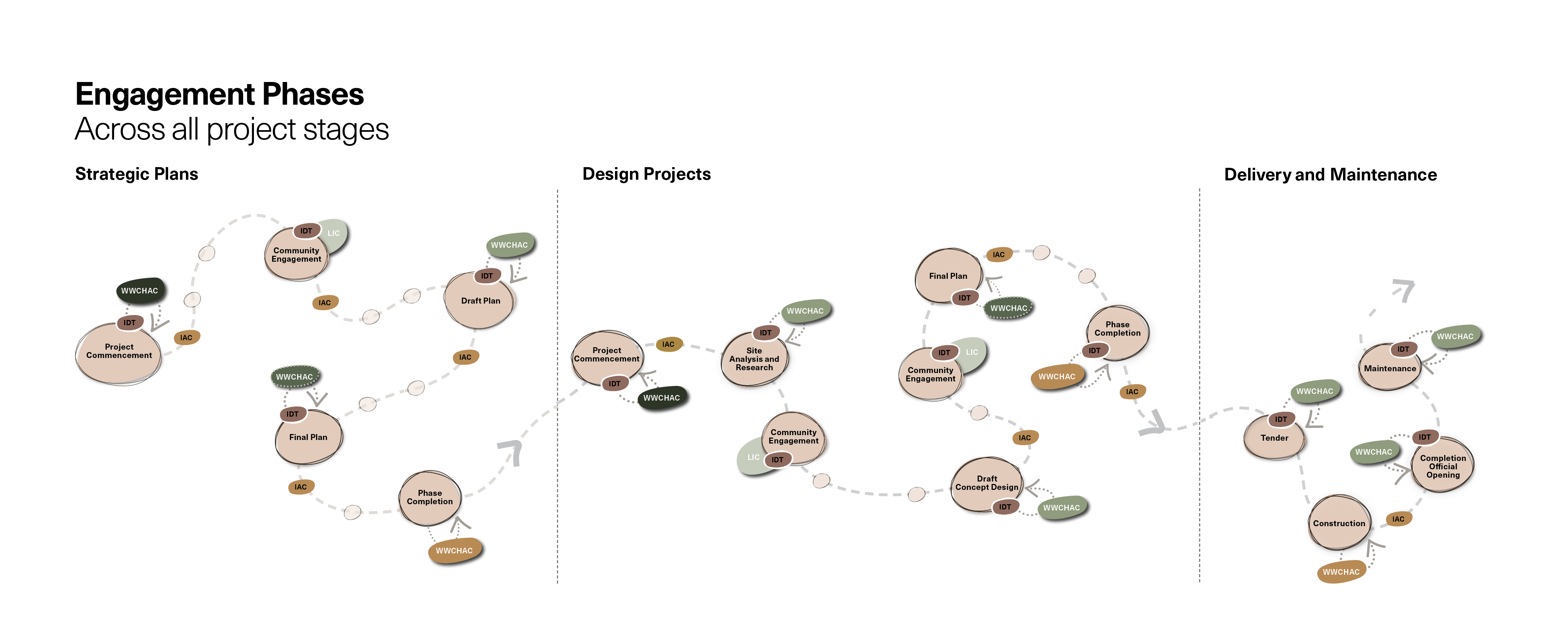
[Click on image to open larger version]
Project goals:
- Establish a clear, culturally respectful framework for engaging with Wurundjeri Woi‑wurrung Traditional Owners across the Yarra Ranges
- Embed Indigenous knowledge, values, and perspectives into every stage of planning and design
- Support genuine partnerships built on trust, early engagement, and shared decision making
- Ensure all projects prioritise caring for Country, including land, waterways, as well as cultural heritage
- Promote self-determination by enabling Traditional Owners to guide outcomes affecting their Country
- Provide practical tools, principles, and processes for consistent, meaningful engagement
- Strengthen cultural safety, respect for Indigenous Cultural and Intellectual Property, and accountability
- Improve project outcomes by integrating cultural insight, storytelling, and long-term community benefit.
Project team:
4 people. Including Council staff and ASPECT Studios. However, the protocols were developed in partnership with Wurundjeri Woi-wurrung Cultural Heritage Aboriginal Corporation (WWCHAC).
Contributors:
- Christa Cowell – Landscape Architect (Yarra Ranges Council)
- Anne-Marie Pisani - First Peoples' Partnerships and Design Lead (ASPECT Studios)
- Nathan Islip – Manager Design and Place (Yarra Ranges Council)
- Garry Detez - Indigenous Development Coordinator (Yarra Ranges Council)
- Wurundjeri Woi-wurrung Cultural Heritage Aboriginal Corporation.
Project duration:
12 months.
Challenge and context:
The development of the Indigenous Design and Engagement Protocols (ngurrak‑ba wurrung balit) responded to a fundamentally complex challenge: transforming how Council approaches planning and design to genuinely embed Wurundjeri Woi-wurrung protocols, knowledge, authority, and self-determination.
The problem was identified through lived experience across projects, where conventional planning processes, often time-constrained and linear in structure, were not equipped to support meaningful, culturally safe engagement. This created risks of tokenistic consultation, misrepresentation of cultural knowledge, lack of protocol understanding and missed opportunities to design with Country. There was also increasing recognition that existing processes did not adequately respect Indigenous Cultural and Intellectual Property (ICIP), nor provide clear pathways for consent, shared decision making, or cultural authority.
This challenge was difficult due to several intersecting factors. First, there was a structural constraint. Council systems, procurement processes, and project timelines were not designed to accommodate iterative, relationship-based engagement. Second, there was a knowledge gap, many practitioners lacked confidence or understanding of cultural protocols, creating reliance on Traditional Owners to educate while also participating, placing an unfair burden and load on community.
Stakeholder complexity further intensified the challenge. The protocols needed to align Council teams, Wurundjeri Woi-wurrung Cultural Heritage Aboriginal Corporation, Yarra Ranges Council’s Indigenous Advisory Committee, and broader community, each with different roles, expectations, and levels of influence.
The challenge was also shaped by the need to create culturally safe engagement for Wurundjeri Woi-wurrung people, acknowledging cultural values, consultation fatigue, and the risks of cultural knowledge being misused or commodified. It also required us to work in ways that respected cultural protocols, taking the time to listen, to build trust, and to ensure the right people were involved at the right moments. These constraints made the task both sensitive and complex, requiring an innovative approach that could shift systems, not just tweak processes.
Solution and innovation:
Our Indigenous Design and Engagement Protocols (ngurrak‑ba wurrung balit) is innovative because it fundamentally reset how Council undertakes planning and design; from ad hoc project-based consultation to relationship-based, Indigenous-led collaboration.
Rather than adapting a standard engagement process, the methodology was rebuilt from the ground up, starting with Wurundjeri Woi-wurrung values as foundation and designing the framework around them. Grounding the framework in values of truth telling, self-determination, and caring for Country, reframed Country as a living system and primary stakeholder, challenging traditional site-based design approaches and positioning cultural protocols and Indigenous knowledge as essential to decision-making, not optional add-ons. This shifted from transactional, project-by-project consultation to relationship-based and indigenous-led.
The methodology was iterative and co-developed. Key stages included early relationship building and cultural learning, testing concepts with Indigenous Advisory Committee and Wurundjeri Woi-wurrung. This included on Country workshops at Karwarra Australian Plant Garden to shape scope, and ongoing refinement through feedback, culminating in formal sign-off by Traditional Owners.
Establishment of clear engagement principles and a scalable engagement approach, from informing through to Indigenous led projects and decision making was groundbreaking, providing Council with its first consistent yet flexible model for application across strategic planning, design, and delivery projects.
Pivotal decisions included making early engagement non-negotiable, elevating Traditional Owners into shared decision-making roles, and formalising Indigenous Cultural and Intellectual Property protections and consent processes. Reform of internal systems such as procurement and timelines enabled culturally safe delivery. Inclusion and accessibility were embedded throughout. The protocols prioritise culturally safe, diverse engagement formats like On Country walks, deep listening and yarning circles. They emphasise equitable participation, ensuring Wurundjeri Woi-wurrung voices shape outcomes throughout the project lifecycle.
Our Indigenous Design Protocol moves Council beyond piecemeal Indigenous engagement to structurally embedded Indigenous voice, genuinely equal participation in how projects are conceived, governed and delivered.
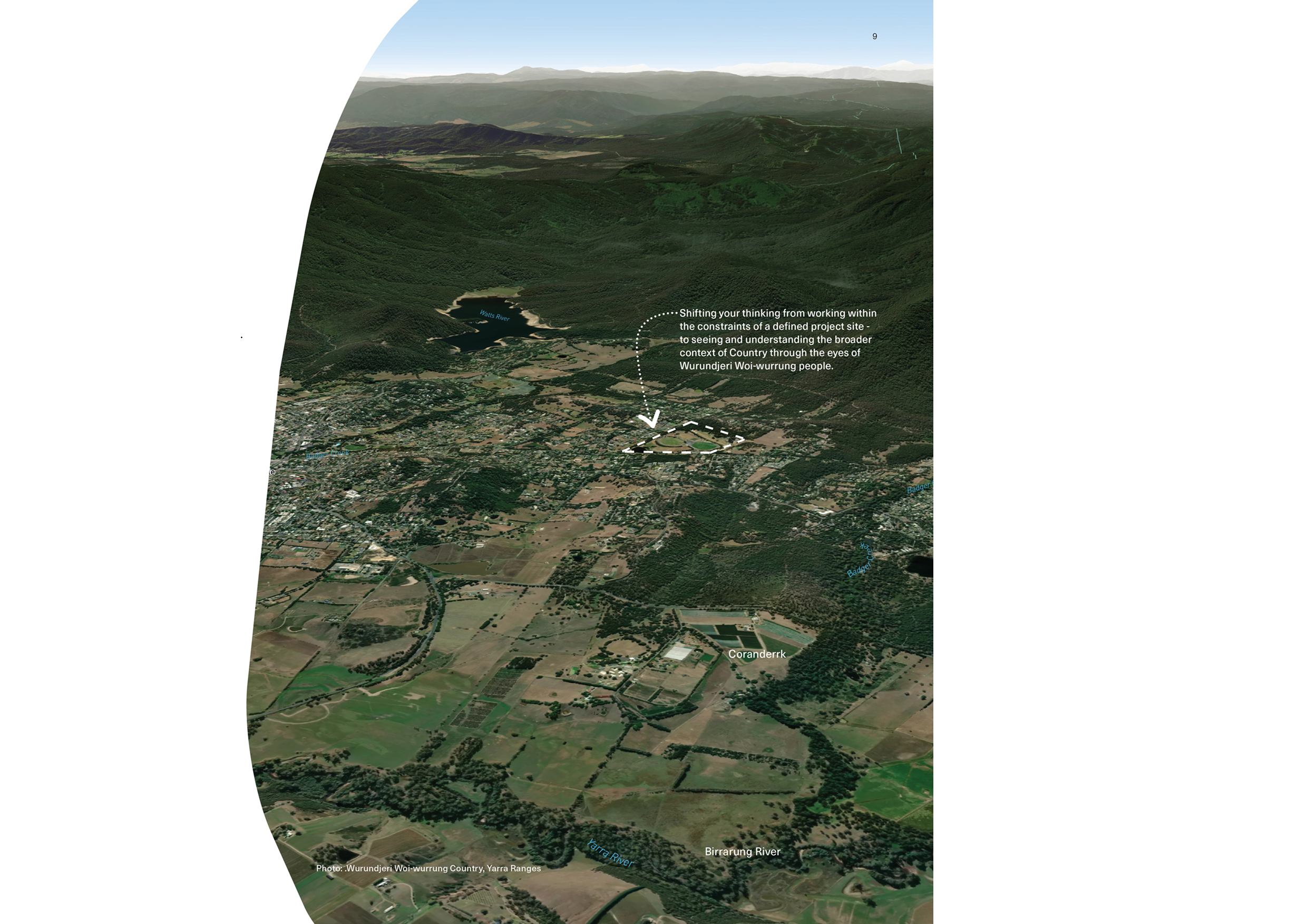
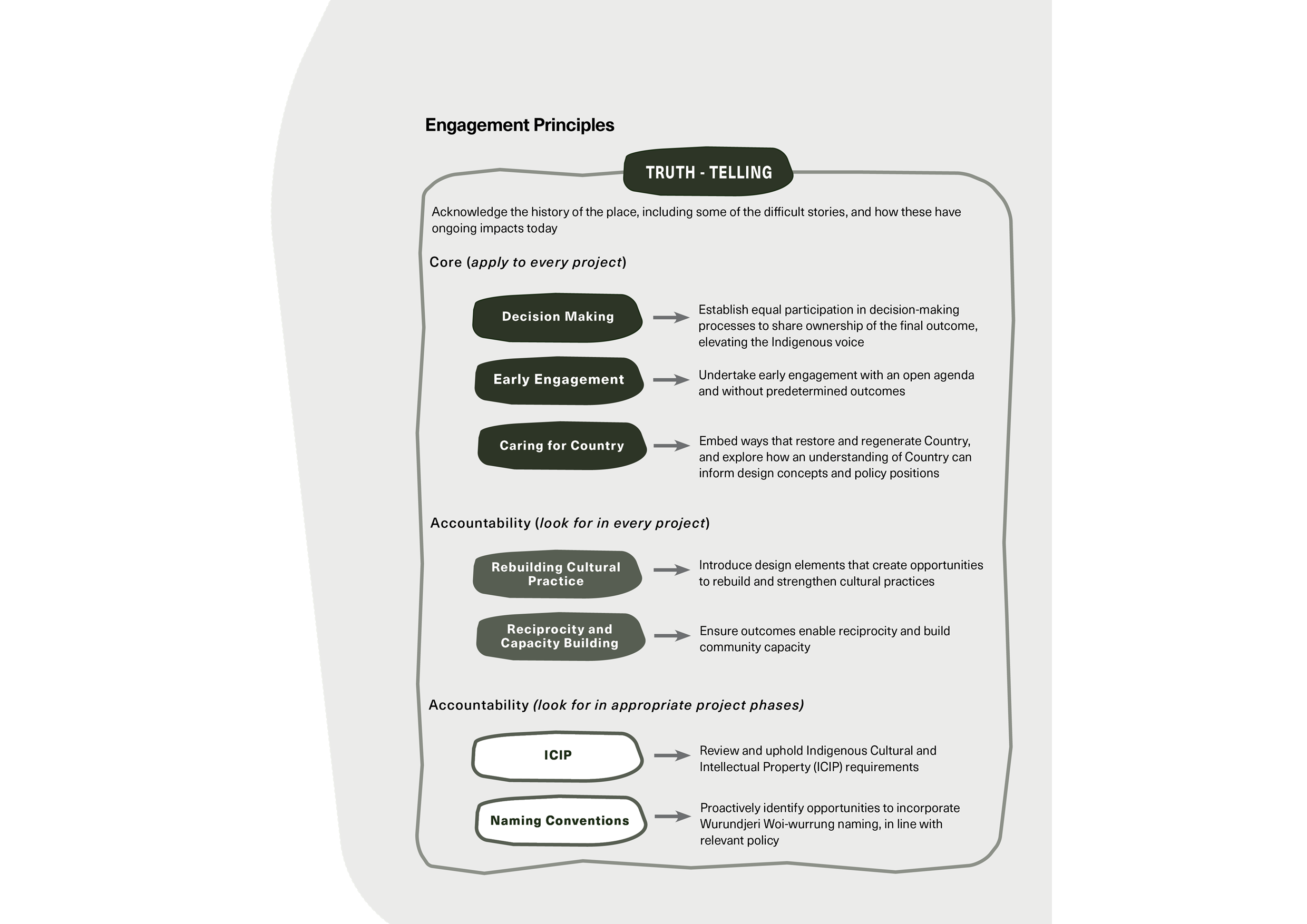
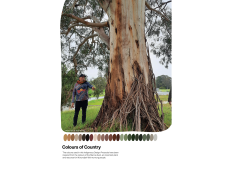
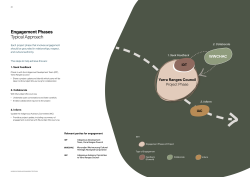
[Click on any image for larger version]
The protocol demonstrates what can be achieved when there is genuine collaboration, open communication, and a willingness to listen. It provides a strong example of how organisations can work respectfully with Elders to ensure their voices are not only heard but actively shape outcomes."
- Margaret Parisi, Project Manager, Wurundjeri Woi-wurrung Cultural Heritage Aboriginal Corporation.
Project impacts and short-term outcomes:
The development of the Indigenous Design and Engagement Protocols (ngurrak‑ba wurrung balit) delivered clear, measurable and project-specific outcomes that directly improved how planning and design projects engage with Wurundjeri Woi-wurrung Traditional Owners.
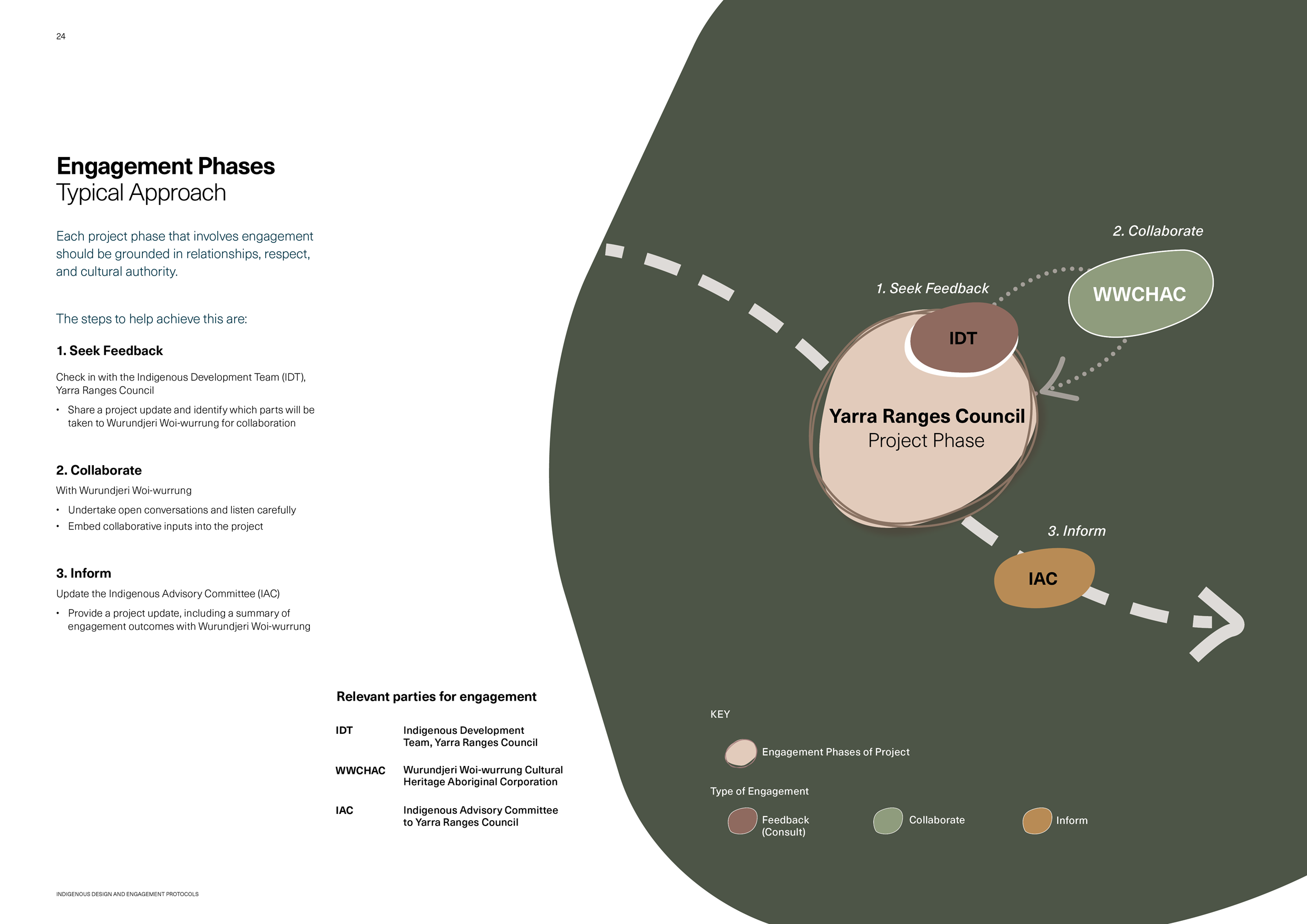
A major outcome was the creation of a formalised, end to end engagement framework that clearly defined project phases, decision points, and respective roles of WWCHAC, the Indigenous Development Team, and Council. This replaced previously inconsistent or ad hoc engagement approaches with a structured, repeatable process that can be applied immediately across live projects. The project also delivered a practical continuum of engagement depth - from inform, to consult, collaborate, co-design, and lastly Indigenous led - enabling projects to align the depth of engagement with community preference and capacity, ensuring participation is meaningful rather than tokenistic.
A key measurable outcome was formalising early engagement and defining key decision-making milestones, including Project Commencement and Final Plan sign-off. These requirements ensure Traditional Owners influence project direction from the outset and retain authority over final outcomes. The protocols also established clear safeguards, requiring consent for the use of cultural knowledge and ensuring attribution and control remain with Wurundjeri Woi-wurrung. This addressed a critical gap in previous project delivery and provides a measurable compliance standard for cultural safety.
Finally, the project produced a fully co-designed practical, guidance document endorsed by Wurundjeri Woi-wurrung. It includes tools, templates and step-by-step processes that support consistent delivery across planning and design projects. This document is now being piloted across real projects, demonstrating immediate, tangible change in project delivery capability.
“This Engagement and Design protocol, ngurrak-ba wurrung balit, is exactly what Wurundjeri have been striving for, and Yarra Ranges Council are the first to get it right!
"This protocol is now the five-star version that other LGA's can benefit from, using it as a benchmark to develop their own protocols and, importantly, to understand and learn from what has worked so well.
"Throughout the entire process, the Elders were listened to, engaged in meaningful conversations, and genuinely included in the decision-making process.
"Their knowledge, experience and perspectives were respected and valued, rather than simply being acknowledged as part of a consultation process.
"The protocol demonstrates what can be achieved when there is genuine collaboration, open communication, and a willingness to listen. It provides a strong example of how organisations can work respectfully with Elders to ensure their voices are not only heard but actively shape outcomes.
"This is the standard that other LGA's should aspire to."
Margaret Parisi, Project Manager, Wurundjeri Woi-wurrung Cultural Heritage Aboriginal Corporation.
Capability and long-term impacts:
The Indigenous Design and Engagement Protocols (ngurrak‑ba wurrung balit) have strengthened Council’s long‑term systems, capabilities and ways of working by establishing a clear, repeatable model for culturally responsive planning and design that extends well beyond the life of the project.
A key outcome is the introduction of a standardised, Council engagement framework that can be consistently applied across all project types within strategic planning, design, and delivery. This replaces fragmented approaches with a shared methodology, improving internal coordination between teams and ensuring cultural considerations are embedded from project inception through to delivery. The project is strengthened internally with capability and confidence by providing practical tools, templates and guidance on cultural protocols, engagement methods, and responsibilities. This reduces reliance on informed knowledge or individual experiences alone, supporting staff to engage respectfully and effectively with Traditional Owners, building organisational trust over time.
Importantly, the protocols reshape governance by embedding structured decision-making points and early engagement as standard practice. This enables Council to better anticipate project risks, such as time pressures, cultural sensitivities, and align project direction early. It strengthens organisational resilience and reduces likelihood of rework, misalignment or cultural harm, whilst also improving project quality by ensuring Traditional Owner input can inform key decisions, not just final outputs.
Developing this guide has strengthened partnerships and relational infrastructure, formalising how Council collaborates with Wurundjeri Woi-wurrung Cultural Heritage Aboriginal Corporation (WWCHAC), the Indigenous Development Team, and Indigenous Advisory Committee. This creates a stable, predictable foundation for long term collaboration, improving continuity across projects and reducing duplication of effort.
The protocols embed a culture of learning, reflection, adaptability, and commitment to ongoing review, reflection and refinement. This ensures responsiveness to community needs and evolving best practice, rather than remaining static. Collectively, this strengthens Council’s ability to deliver culturally grounded, inclusive and well-governed outcomes that endure.
Scalability and transferability:
The Indigenous Design and Engagement Protocols (ngurrak‑ba wurrung balit) have been intentionally designed to be a transferable model, providing a scalable approach that other councils can use as a starting point when developing similar guidelines within their own local Traditional Owner contexts.
The project offers a replicable framework built around engagement principles, a defined engagement continuum, and clear project stage guidance. This model is values-based rather than site specific. While grounded in Wurundjeri Woi-wurrung knowledge, the approach is adaptable.
The protocols provide practical tools and processes that can be directly shared or adapted, including:
- Governance structures outlining roles for RAPs, advisory groups, and Council teams
- Structured engagement phases across project lifecycles
- Indigenous Cultural and Intellectual Property (ICIP) and consent processes
- Culturally appropriate engagement methods (e.g. On Country engagement, deep listening and yarning circles).
Together these elements form a transferable “operating model” for culturally grounded planning and design.
Importantly, the project captures documented learnings from real case studies, highlighting both successes and challenges. This transparency supports capability building through knowledge sharing across the Local Government sector, helping other Councils avoid common pitfalls such as late engagement, insufficient resourcing, or inconsistent relationships with Traditional Owners. The protocols demonstrate how self-determination and shared decision-making can be embedded within existing governance systems, a challenge many Councils face.
In terms of global relevance, the protocols align strongly with the UN Sustainable Development Goals, including:
- SDG 11 (Sustainable Cities and Communities): by embedding culturally informed, place-based design
- SDG 10 (Reduced Inequalities): by elevating Indigenous voices in decision-making
- SDG 16 (Peace, Justice and Strong Institutions): through transparent, respectful governance and truth-telling.
By combining a clear methodology with practical tools and real-world application, this project creates lasting value as a scalable, adaptable model for culturally grounded planning across Local Government.