

Innovation Case Study: Service Review Program
Greater Geelong City Council
Applying an evidence-base to the decisions shaping our services
The City of Greater Geelong designed and implemented a whole-of-organisation Service Review Program to fundamentally change how council understands, plans, evaluates and improves its services.
The initiative introduced a common service language, service catalogue, review playbook, design principles and governance framework, enabling evidence-based decision making and sustainable service innovation across 31 council services and more than 120 sub-services.
2026 MAVlab Innovation Awards Finalist:
The Smooth Operator Award for Service and Systems Optimisation and Transformation, supported by Atturra

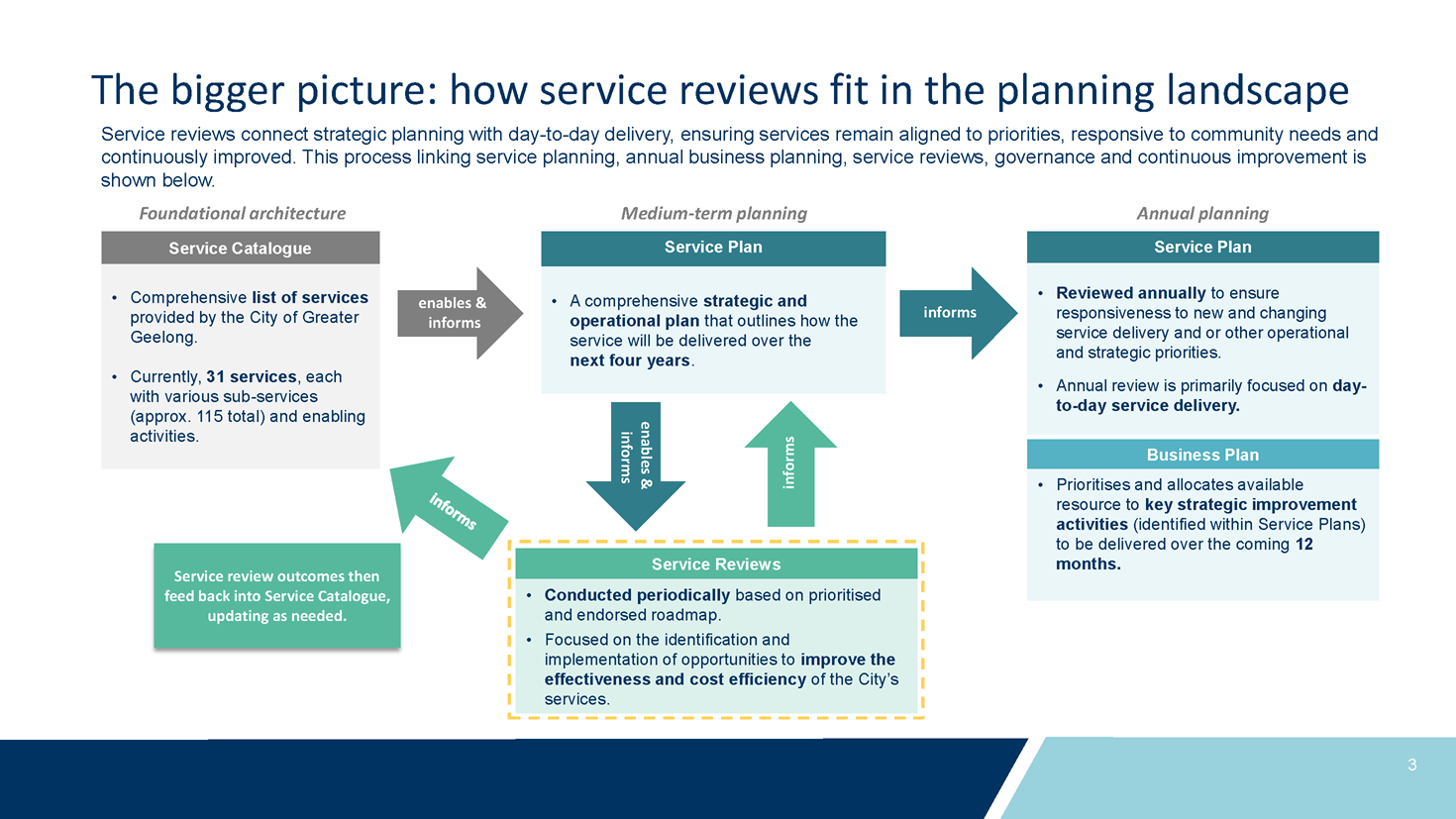
[Click on image for larger version]
Project goals:
- Establish a consistent, organisation-wide approach to service reviews
- Create a shared service language, hierarchy and governance model across Council
- Improve the effectiveness, efficiency and sustainability of council services
- Enable evidence-based decision making through standardised evaluation methods
- Align service delivery with Council Plan priorities and community needs
- Build internal capability to continuously review and improve services
- Introduce structured tools, templates and design principles to support reviews
- Improve strategic planning, prioritisation and resource allocation
- Strengthen cross-functional collaboration and organisational accountability
- Create scalable frameworks that could be reused across all council services and future reviews.
Project team:
The core project team fluctuated throughout delivery, with approximately 8–12 people contributing day-to-day across strategy, organisational performance, change and service design subject matter expertise.
Additional contributors and business partners were engaged at key stages including finance, HR, legal, risk and operational service areas.
The project also relied on executive sponsorship and extensive collaboration across the organisation.
Project duration:
The project was developed over approximately 12 months through multiple iterative phases including design, stakeholder engagement, service catalogue development, service planning integration, governance establishment, pilot reviews, playbook development (with support from Davidson consultants) and operational refinement.
The work continues to evolve through implementation, continuous improvement and integration into annual planning and service review cycles.
Challenge and context:
The City of Greater Geelong delivers 31 services and more than 120 sub-services to a population of around 307,000 across a large and increasingly complex municipality spanning approximately 1,250 square kilometres.
Despite the scale of operations, council historically lacked a consistent organisation-wide methodology for understanding, reviewing and improving services. Services were often planned, evaluated and prioritised differently across departments, creating fragmentation, inconsistent decision-making and limited visibility of service performance, cost and customer value.
At the same time, council faces increasing pressure to respond to rising community expectations, financial sustainability challenges and increasing operational complexity. Many services involve multiple stakeholders, competing priorities, legislative obligations, and varying levels of organisational maturity. Existing approaches to service reviews were often resource-intensive, inconsistent, and difficult to scale across the organisation.
This challenge is compounded by sustained population growth and significant housing demand. Geelong’s population is expected to reach around 500,000 by 2050, reflecting growth of around 2.1% per annum and outpacing Greater Melbourne and other regional cities. The municipality also has the highest housing target in the state, with 129,000 new dwellings required by 2050, effectively doubling current housing stock.
The challenge was not simply improving one service. It was redesigning how the organisation thinks about services altogether. This required creating a common language, shared governance structures, standardised review methods and practical tools that could be adopted by teams with different capabilities and operational realities.
Importantly, the project also needed to balance strategic innovation with operational practicality. The framework had to be rigorous enough to support evidence-based decision making, while remaining accessible and usable for frontline service areas.
Building trust, alignment and organisational buy-in across such a large and diverse organisation was a significant challenge and required extensive collaboration, co-design and iterative refinement.
Solution and innovation:
The City developed an end-to-end Service Review Program and Playbook that fundamentally reimagined how council services are understood, planned, reviewed and improved. Rather than treating reviews as isolated exercises, the project established an integrated organisational system linking service planning, annual business planning, service reviews, governance and continuous improvement.
The innovation centred on creating a scalable and repeatable framework tailored specifically to local government.
Key innovations included:
- A city-wide service catalogue defining our 31 services and more than 120 sub-services
- A common service hierarchy and service-orientated language
- A phased service review methodology covering mobilisation, assessment, reimagination and implementation
- Evidence-based evaluation frameworks including SWOT, benchmarking, service model maturity assessments, financial analysis and value stream mapping
- Organisation-wide service design principles aligned to strategic priorities and community outcomes
- Standardised templates, governance processes and stage gates
- Clearly defined post-review support and implementation pathways enabling service owners to translate decisions into action
- Integration of service reviews into annual planning and budgeting cycles, strengthening ownership and accountability within service areas.
A major innovation was the deliberate focus on internal capability uplift and service-owned decision-making, rather than consultant or corporate-led reviews. The framework ensured ownership and decisions sit with services, allowing those closest to delivery to lead reviews, make informed choices and implement change.
Accessibility and inclusion were embedded through practical language, visual frameworks and flexible methodologies that could scale from small operational reviews to large strategic reviews involving community input and councillor decision-making. Reviews also incorporated Gender Impact Assessments (GIA+) where applicable. The project intentionally balanced governance rigour with usability, ensuring the framework could operate in real-world council environments rather than remaining theoretical.
The project evolved iteratively through testing, stakeholder engagement, pilot activities and continuous refinement, enabling the organisation to progressively mature the approach while maintaining momentum and organisational ownership.
The project also shifted conversations from anecdotal or reactive decision-making toward evidence-based discussions grounded in service data, strategic alignment and community value.
Project impacts and short-term outcomes:
Within the life of the project, the City achieved significant organisational outcomes that immediately improved service planning, review capability and decision making.
Key direct outcomes included:
- Establishment of the City’s first enterprise-wide service catalogue covering all services and sub-services
- Development and adoption of a standardised Service Review Playbook and methodology
- Introduction of common service definitions, governance frameworks and review principles across council
- Integration of service planning and service review processes into annual business planning cycles
- Creation of reusable templates, tools and frameworks to support consistent service analysis
- Increased organisational understanding of service costs, customer groups, risks and operational maturity
- Improved cross-functional collaboration between operational services and enabling functions including finance, governance, strategy and performance, and people & culture
- Redesigning workflows and processes to achieve time savings equivalent to over 4 FTE roles in reviewed services.
- Restructuring teams to reflect workload and task complexity, resulting in renumeration savings of over $600K in Year 1.
- Implementing a revised fee structure, including out-of-hours service fees, to achieve greater cost recovery aligned to operational costs.
- Developing internal service review team capabilities to reduce dependency on external consultants.
- Digitising and automating customer request processes to achieve faster response times and less manual processing.
The project also shifted conversations from anecdotal or reactive decision-making toward evidence-based discussions grounded in service data, strategic alignment and community value.
Importantly, the framework enabled services of varying maturity and complexity to participate in structured reviews for the first time. Teams reported improved clarity around service purpose, responsibilities, customer needs and improvement opportunities.
The project also produced tangible operational artefacts including service plans, review templates, evaluation methods, governance structures and planning frameworks that continue to be actively used across the organisation. These outputs created immediate value by reducing duplication, increasing consistency and improving the quality of service-related decision making.
Capability and long-term impacts:
The project created lasting organisational capability by embedding service review and continuous improvement into the City’s operating model rather than treating it as a one-off initiative.
The most significant long-term impact was the establishment of a shared organisational framework for understanding services. This fundamentally improved how council plans, prioritises, governs and evaluates service delivery. The project created a common language and methodology that now supports strategic planning, operational reviews, budgeting, governance and future transformation initiatives.
The framework strengthened organisational resilience by improving council’s ability to:
- Identify and respond to service risks and pressures
- Prioritise investment and resource allocation
- Evaluate future service delivery models
- Adapt services to changing community needs and growth pressures
- Support evidence-based executive and council decision-making
- Coordinate reviews across interconnected services and business areas.
The project also significantly increased internal capability. Officers across multiple functions developed practical skills in service design, evaluation, stakeholder engagement, operational analysis and continuous improvement. Importantly, capability was distributed across the organisation rather than centralised within a single team.
The Service Review Program also established governance structures, stage gates and prioritisation approaches that support ongoing organisational learning and accountability. Reviews are now designed to continuously inform future planning cycles, creating an enduring improvement loop across council operations. Clear post-review pathways were introduced, providing service owners with defined implementation options, including continuous improvement within business-as-usual, progression of strategic initiatives through existing processes, or escalation for additional investment and support.
The initiative has also strengthened collaboration across directorates and improved the organisation’s ability to work strategically across service boundaries rather than within siloed business units.
Scalability and transferability:
The project was intentionally designed to be scalable, adaptable and transferable across local government. The framework can be applied to operational, strategic, community-facing and internal enablement services of varying size and complexity.
A key strength of the approach is its modular design. Councils or teams can adopt the full methodology or selectively apply tools depending on capability, maturity, risk profile and review objectives. This flexibility makes the model practical for councils with different resources, governance structures and organisational sizes.
Transferable components include:
- Service hierarchy and catalogue structures
- Service review methodologies and stage gates
- Evaluation frameworks and templates
- Governance and prioritisation approaches
- Service design principles
- Stakeholder engagement methods
- Continuous improvement integration into planning cycles.
The project also demonstrates how councils can build sustainable internal capability rather than relying heavily on external consultants. This creates significant value for the broader local government sector, particularly during periods of financial constraint and increasing service complexity.
The initiative strongly aligns with several UN Sustainable Development Goals, including:
- Sustainable Cities and Communities
- Industry, Innovation and Infrastructure
- Decent Work and Economic Growth
- Peace, Justice and Strong Institutions.
By improving how councils understand and deliver services, the project creates stronger foundations for sustainable, equitable and community-centred local government into the future.