

Innovation Case Study: Stand Together: Countering Misinformation
Indigo Shire Council
Empowering rural communities to counter misinformation and protect democracy
Stand Together: Countering Misinformation equipped 75 participants across four Indigo Shire library branches with evidence-based tools to identify, fact-check, and respectfully challenge misinformation. Led by award-winning journalist Lauren Martin and grounded in the UNSW Kaldor Centre's research framework, the program positioned libraries as trusted civic spaces where communities build the media literacy skills essential to healthy democratic participation.
2026 MAVlab Innovation Awards Finalist:
The Community Voice Award for Inclusive Democratic Engagement, supported by the Australian Resilient Democracy Network (ARDN)
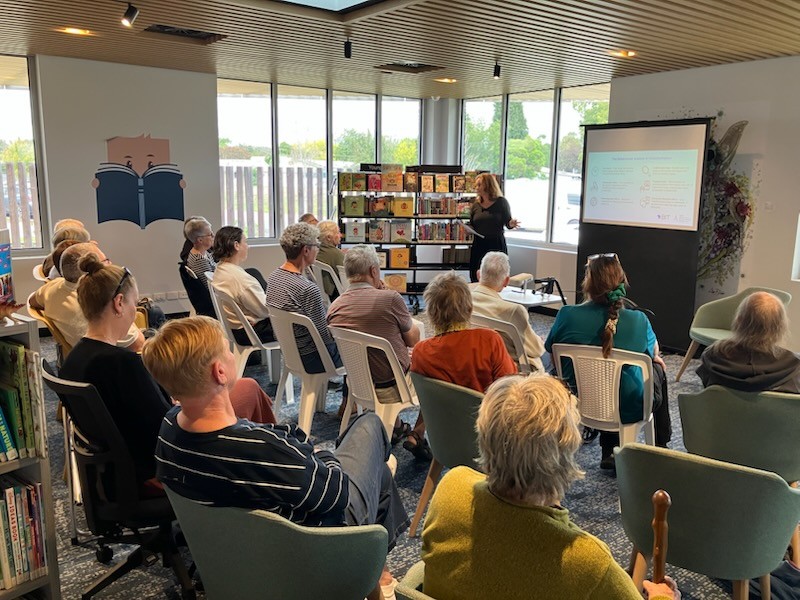
Stand Together session at Chiltern
Project goals:
- Build community media literacy by equipping residents with practical, evidence-based skills to critically evaluate information sources and identify misinformation.
- Strengthen democratic resilience by supporting informed civic participation in a rural community increasingly exposed to online misinformation.
- Position local libraries as trusted, non-partisan civic spaces for democratic education and open dialogue.
- Foster respectful discourse by giving participants strategies to challenge false information while maintaining relationships, critical in small, interconnected rural communities.
- Reach diverse community members, including those at risk of isolation, by delivering free, accessible sessions across four library branches at varied times.
- Create lasting community connections that sustain the conversation beyond the sessions themselves.
Project team:
The project was delivered by a core team of four:
Kellie Sutherland (Creative Communities Officer - Arts and Culture) led project design, communications, logistics, and stakeholder management;
Penelope McGufficke (Creative Communities Coordinator) provided strategic oversight;
Anna Ridgway-Faye (Librarian and Branch Coordinator) supported on-the-ground logistics, led face-to-face community marketing for the events, and served as a vital conduit between the program and the community, carrying ongoing conversations and providing a consistent local touchpoint for participants; and
Lauren Martin (award-winning journalist, UNSW Kaldor Centre) delivered the presentations. Library branch staff at Beechworth, Chiltern, Rutherglen, and Yackandandah provided additional venue and promotional support.
Project duration:
The project was delivered over approximately four months from initial planning to post-event follow-up. Concept development and stakeholder engagement began in January 2026. Communications, ticketing, and community promotion ran from February through early April. The four presentations were delivered across two days on 15–16 April 2026. Post-event follow-up, including participant resources and community connection, continued through late April 2026.
Challenge and context:
Indigo Shire is a small rural council in north-east Victoria with a dispersed population across four townships. Like many regional communities, residents are increasingly exposed to misinformation but have limited access to the media literacy resources more readily available in metropolitan areas. This gap is compounded by the reality that in small communities, misinformation doesn't just circulate online, it surfaces at the dinner table, in the school car park, and at the local football club, making it deeply personal and harder to address without fracturing relationships.
The challenge was identified organically. A library team member shared the UNSW Kaldor Centre's research report on countering misinformation with the Creative Communities team, recognising its relevance to conversations already happening in the community. This grassroots identification of need (a librarian connecting research to local reality) reflects the trusted role libraries play in rural civic life.
The broader context added both urgency and complexity. A rapidly shifting media landscape, the rise of AI-generated content making fabricated news and imagery increasingly difficult to distinguish from the real thing, the amplifying effects of social media algorithms, and growing distrust of traditional information sources meant residents were encountering convincing fakes and algorithmically curated echo chambers daily, often feeling ill-equipped to navigate them. Heightened geopolitical instability and polarising public discourse added further sensitivity. Anecdotal evidence suggested community wariness about engaging with what can feel like a politically charged subject.
Geographically, the shire's spread required the program to be delivered at multiple venues for equitable access. And in a small community where political views are diverse and social networks are tightly woven, the approach needed to empower participants without alienating anyone or implying a particular viewpoint was correct. The goal was to build capability, not direct opinion.
Solution and innovation:
The project's innovation lay in translating a university research framework into an accessible, community-level civic education program delivered through public libraries.
The team partnered with award-winning journalist Lauren Martin, co-author of the UNSW Kaldor Centre's evidence-based framework on countering misinformation, developed in collaboration with the Behavioural Insights Team (the UK government's renowned "Nudge Unit"). This partnership brought rigorous, peer-reviewed methodology into a warm, approachable community setting, a calibre of expertise rarely available in regional areas.
Inclusion and accessibility were embedded structurally: four identical sessions across all four townships at alternating daytime and evening times ensured geographic and scheduling equity. Sessions were free, open to ages 15 and over, and deliberately framed around preserving relationships while challenging misinformation, a design choice that made participation feel safe for people across the political spectrum in a tightly connected rural community. A key decision was choosing libraries as venues. Unlike council chambers or community halls, libraries are perceived as safe, non-partisan, trusted spaces, essential for a topic that can feel politically charged. This deliberate positioning lowered barriers to participation and signalled openness.
Stakeholder engagement shaped the program throughout. Lauren was engaged early as a genuine collaborator, not just a presenter. While Lauren delivered expert-led content, covering how misinformation spreads, practical fact-checking tools, and strategies for respectful engagement, the sessions were structured to include facilitated Q&A shaped by questions participants submitted in advance. This ensured the content responded to what the community was grappling with, not an external agenda.
A key innovation was framing the program around relationships, not just information. Participants were taught to challenge misinformation in ways that preserve social bonds, a critical consideration in small communities where you run into everyone at the supermarket. This distinguished the program from typical media literacy training, making it genuinely fit-for-purpose in a rural context.
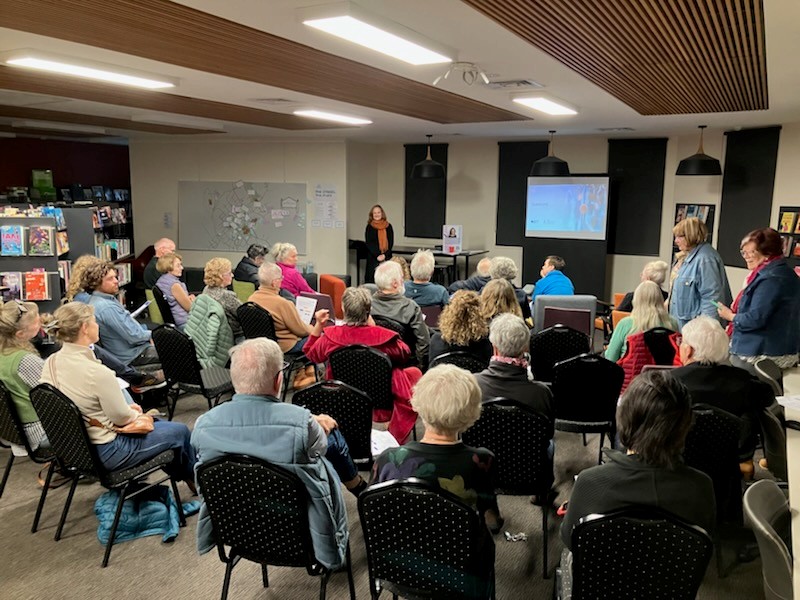
Stand Together session at Beechworth
One Beechworth attendee noted, “I came in feeling overwhelmed by how much misinformation I see, and left feeling like I actually have tools to do something about it - without starting a war at the family dinner.”
Project impacts and short-term outcomes:
The program directly engaged 75 participants across four sessions in two days — a meaningful reach for a small, dispersed rural shire. Outcomes were measured through post-session surveys, facilitator observation, and follow-up communications.
Against the goal of building media literacy, 95% of participants reported learning something new about how misinformation works and how to respond to it. 90% rated the sessions as useful or very useful.
Against the goal of fostering respectful discourse, participants consistently highlighted the relationship-preserving framing as the most valued element. One Beechworth attendee noted, “I came in feeling overwhelmed by how much misinformation I see, and left feeling like I actually have tools to do something about it - without starting a war at the family dinner.” Another reflected, “It was refreshing to have this conversation in a space that didn’t feel political and I was buoyed being in a room with other people who share the same motivation to advocate for facts”
Against the goal of positioning libraries as trusted civic spaces, the choice of venue was validated by participant feedback - multiple attendees cited the library setting as a key reason they felt comfortable attending a session.
Against the goal of creating lasting connections, the most significant outcome was the organic formation of a continuing discussion group in Beechworth, where participants chose to keep meeting to sustain the conversation. This was not part of the original program design, making it a powerful indicator that the sessions met a genuine, unmet need.
On inclusion and equity, the multi-venue, multi-time delivery model ensured access was not limited by geography or schedule. A follow-up email with resources and further reading materials extended reach to those unable to attend.
Capability and long-term impacts:
Stand Together has strengthened Indigo Shire Council’s capability in several ways that extend well beyond the project itself.
First, it established a replicable model for library-based civic education. The project demonstrated that public libraries can effectively serve as platforms for democratic engagement programming, not just as information repositories, but as active civic spaces where communities build the skills needed for informed participation. This reinforces the role of the library within the council’s broader community development strategy.
Second, the partnership with the UNSW Kaldor Centre and Lauren Martin created a relationship that positions Indigo Shire Libraries to access future research-to-community translation opportunities. The rapport developed during the project opens the door for ongoing collaboration as the Kaldor Centre continues its work on misinformation and civic resilience.
Third, the project built internal staff capability. The Creative Communities team developed skills in designing and delivering civic education programming, managing expert presenter partnerships, navigating politically sensitive content in a community setting, and developing communications strategies for topics that require careful, non-partisan framing. These are transferable skills that strengthen the team’s capacity to respond to emerging community needs.
Fourth, the project contributed to a broader shift in how Indigo Shire Libraries understands its role in community resilience. Delivered as part of the Stronger Together initiative (which also included programs for families, young people, First Nations communities, and environmental connection) Stand Together demonstrated that libraries can address complex, systemic challenges like misinformation while remaining trusted, welcoming spaces for all community members.
The organic formation of an ongoing discussion group in Beechworth signals a lasting community-level impact: participants are not waiting for the next program to be delivered to them but are sustaining civic engagement independently. This shift from passive consumption to active community ownership is a meaningful long-term outcome.
Scalability and transferability:
Stand Together was intentionally designed around a model that is highly transferable to other councils and library services.
The core approach. partnering with an established research institution (the UNSW Kaldor Centre), engaging an expert presenter, and delivering through existing library infrastructure, is replicable without requiring councils to develop specialist content or expertise internally. The Kaldor Centre’s framework is publicly available, and the Behavioural Insights Team methodology that underpins it is well-documented, meaning other councils can access the same evidence base.
The multi-venue, multi-session delivery model is particularly transferable to other rural and regional councils facing similar challenges of geographic dispersal. By offering identical sessions at different locations and times, the project demonstrated how to maximise access across a large geographic area without requiring participants to travel significant distances, a common barrier in regional local government.
The program’s positioning within libraries is also transferable. Libraries exist in virtually every local government area in Australia and are consistently rated among the most trusted community institutions. Any council with a public library service has the venue infrastructure and community trust needed to deliver this type of programming.
Key learnings that would benefit other councils include the importance of non-partisan framing (critical for community trust), the value of allowing participants to submit questions in advance (ensuring relevance), and the deliberate focus on relationship-preserving strategies for challenging misinformation (especially important in small communities).
The project aligns with several UN Sustainable Development Goals, including SDG 16 (Peace, Justice and Strong Institutions) through its focus on strengthening democratic participation and access to information, and SDG 4 (Quality Education) through its community-based media literacy education. It also supports SDG 11 (Sustainable Cities and Communities) by building inclusive, resilient community infrastructure through libraries.