
Innovation Case Study: Upper Yarra Local Economic Development Strategy
Yarra Ranges Shire Council
Unlocking Upper Yarra: Empowering community enterprise to drive economic transition
The Upper Yarra Local Development Strategy innovates traditional council economic development by functioning as a community-led investment framework. Facilitated by Council, it directs State Government funding into Innovation Working Groups. This model has established 11 seed-funded projects to drive long-term regional prosperity, create local jobs, and strengthen local industry outcomes.
2026 MAVlab Innovation Awards Finalist:
The Dollars and Sense Award for Impactful and Innovative Business Operations, supported by SenSen Networks
Project goals:
- Support the economic transition of Upper Yarra communities affected by the Victorian forestry transition.
- Create sustainable local employment opportunities and pathways to new industries.
- Strengthen the resilience, diversity and long-term viability of the Upper Yarra economy.
- Identify and develop locally driven projects that respond to community priorities and regional strengths.
- Foster collaboration between community organisations, businesses, government agencies, education providers and industry partners.
- Attract investment and external funding to support economic development and community-led initiatives.
- Build local skills, leadership and capacity.
Project team:
Two Council staff members employed by the project (both 0.8 FTE) working within the Economic Development & Investment team at Yarra Ranges Council:
- Julian Guess, Upper Yarra Local Development Strategy Project Lead.
- Simone Lawrence, Project Support Officer.
Additional Council Officer participation in community led Innovation Working Groups that included community members, business owners, tertiary researchers and other government officers.
Project duration:
Three years. The development of the project strategy took approximately 2 years using the Smart Specialisation Strategy methodology.
The past 12 months have focused entirely on implementation: forming Innovation Working Groups to refine business ideas and applying for seed funding via the Forestry Transition’s Community Development Fund.
Challenge and context:
The ending of native timber harvesting in Victoria had a direct and profound economic impact on the Upper Yarra region. Forestry had long been a source of local employment and economic stability, and its closure created uncertainty and heightened community sensitivity.
The core challenge for Yarra Ranges Council was twofold: how to prevent rapid economic decline in geographically dispersed, vulnerable communities, and how to fundamentally rethink local economic development when traditional, top-down investment attraction models were failing to resonate.
Engagement fatigue was prevalent across the region's small townships. Displaced timber workers and small business owners held varying views about the region's future, and the scale of the transition required a bespoke, place-based approach rather than a standardised model.
To deliver meaningful economic impact, Council needed an innovative business operation model. We needed to shift away from standard consultative practices and instead create a framework that directly supported local industries, generated revenue streams, and created tangible pathways to new employment. The situation underscored the need for an approach that built local capability and directed transition funding straight into the hands of the community to rebuild their local economy from the ground up.
Solution and innovation:
To address the economic gap left by the timber transition, Council innovated its approach to economic development by establishing a community-led investment vehicle. Moving away from traditional service delivery, the Upper Yarra Local Development Strategy introduced an engagement model grounded in the Smart Specialisation and Quadruple Helix frameworks.
The true innovation over the last 12 months has been the operationalisation of 5 community-led Innovation Working Groups (IWGs). Rather than Council procuring external consultants to dictate economic solutions, we repositioned the community as active co-creators alongside industry, academia, and government. These IWGs effectively functioned as proto enterprises, supported by Council to produce business plans and secure seed funding directly from the State Government.
This flexible and inclusive model allowed us to test hypotheses for innovation through the Entrepreneurial Discovery Process. By focusing heavily on the region's unique assets and capabilities, the IWGs developed investment-ready projects aligned to actual community priorities. The solution embedded equity by combining targeted outreach to underrepresented groups with multiple participation formats, ensuring that those most impacted by the transition were front and centre in designing the region's new economic pillars.
The solution embedded equity by combining targeted outreach to underrepresented groups with multiple participation formats, ensuring that those most impacted by the transition were front and centre in designing the region's new economic pillars.
Project impacts and short-term outcomes:
The focus of the last 12 months has been strict implementation, shifting the LDS from a conceptual strategy into an active economic engine. The direct outcome of this innovative operational model is a pipeline of 11 distinct projects currently being assessed or receiving seed funding from the Forestry Transition’s Community Development Fund.
By empowering the Innovation Working Groups, we successfully secured an additional $500,000 in 2025 to fund the establishment and upskilling of these groups. The tangible, revenue-generating, and industry-strengthening outcomes of this funding include:
Artisanal Agriculture: Advancing a foundational project for a multi-species community-scale abattoir and a Farmers Incubator Feasibility Study to upskill prospective farmers.
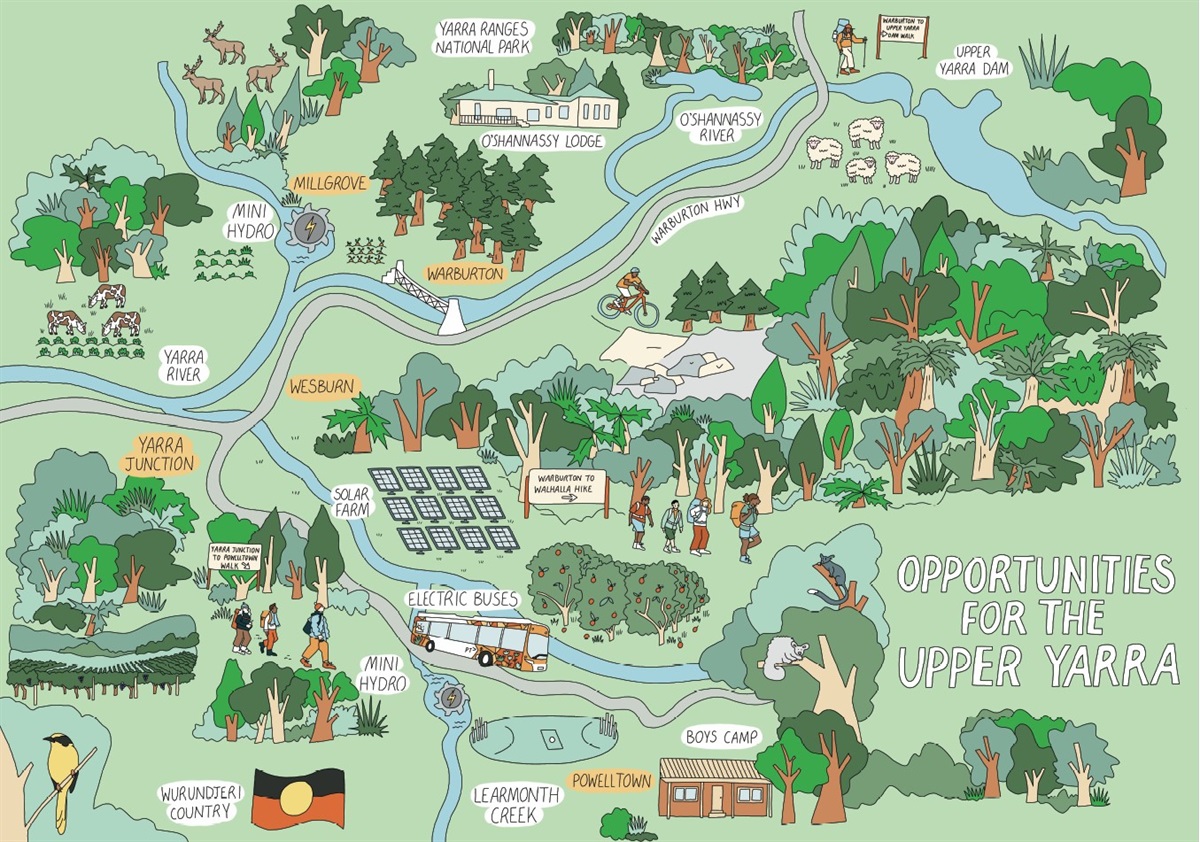
Energy Resilience: Progressing a small-scale solar farm and battery project, delivering alternative local energy infrastructure.
Eco-Tourism: Conducting feasibility studies for Walk into History improvements and an Upper Yarra Walks platform, capitalising on the walking economy.
Repurposing Abandoned Places: Initiating base build works to reactivate the Launching Place General Store as a providore and café, alongside conservation plans for O’Shannassy Lodge.
Crucially, these efforts have culminated in the Upper Yarra Opportunities Roadmap, a comprehensive investment blueprint for the region, and the Upper Yarra Innovation and Transitions Centre Feasibility, with a focus on supporting future regional innovations and backed by a Community Foundation. These direct results prove that community-led business models successfully attract investment, build local capacity, and create actionable pathways to long-term financial sustainability.
Capability and long-term impacts:
The LDS has transformed core systems within Yarra Ranges Council, embedding a highly adaptable approach to economic disruption. By shifting away from a traditional service delivery mindset, staff have developed robust capabilities in facilitating capacity-building approaches. Council now operates as an enabler of community-led development, designing processes that build agency rather than simply gathering input.
For the Upper Yarra community, the long-term impact is a profound increase in their capacity to drive innovation. Structured upskilling activities have provided participants with a clear understanding of how to leverage economic, social, natural, cultural, and human capital to drive local development. Rather than waiting for top-down direction during the forestry transition, the community is now equipped to identify pathways, secure funding, and sustain local enterprises.
This project has solidified long-term networks between the community, industry, and Council, culminating in the feasibility work for an Upper Yarra Innovation and Transitions Centre backed by a Community Foundation. This ensures that the region will continue to anticipate, respond to, and manage future economic challenges long after the initial strategy timeline concludes.
Scalability and transferability:
The LDS provides a highly transferable blueprint for place-based economic transition that creates value far beyond municipal boundaries. While designed in response to the Victorian forestry transition, this framework for identifying local opportunities and testing ideas through Innovation Working Groups is completely adaptable for councils facing manufacturing decline, agricultural transformation, or climate-related impacts.
The project demonstrates how councils can leverage cross-sector partnerships to become facilitators of locally led innovation. We have generated a suite of transferable tools encompassing collaborative governance, project prioritisation, and economic transition planning. By empowering communities to co-design business solutions, the model creates stronger local ownership and a higher likelihood of successful financial implementation.
The approach actively scales value by contributing directly to the UN Sustainable Development Goals, specifically SDG 8 (Decent Work and Economic Growth) and SDG 9 (Industry, Innovation and Infrastructure) through the creation of new employment pathways and energy systems. It also supports SDG 11 (Sustainable Cities and Communities) and SDG 17 (Partnerships for the Goals). By sharing these learnings, other councils can readily replicate this investment-driven approach to build enduring community capability and economic resilience.