
Innovation Case Study: Worms at Work
City of Melbourne
Public composting benches turning food waste into shared local value
Worms at Work tested whether public furniture could help divert food waste, grow compost and support local stewardship in Fishermans Bend. Delivered through the Digital Innovation Challenge, the pilot brought Council teams, residents, businesses, designers, composting experts, researchers and technology specialists together to trial visible, community-supported composting infrastructure in everyday urban space.
2026 MAVlab Innovation Awards Finalist:
The Stronger Together Award for Council Collaboration, supported by Davidson

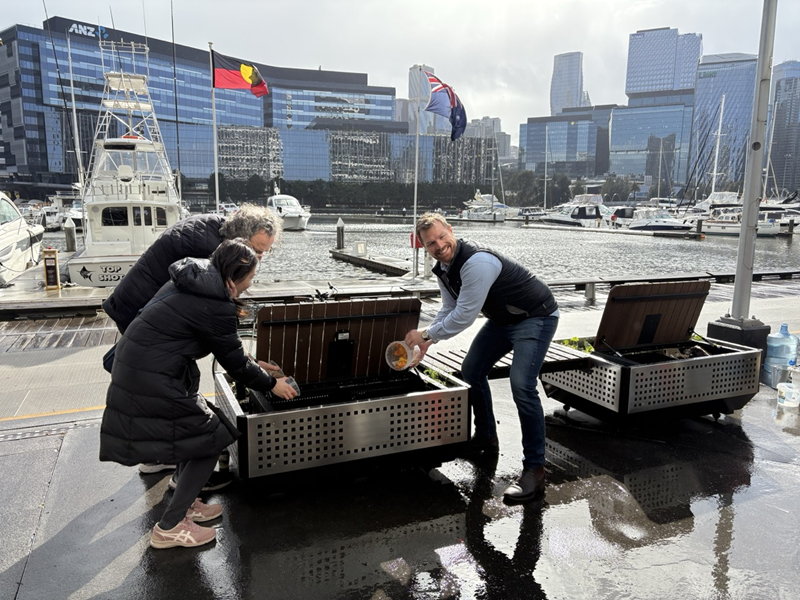
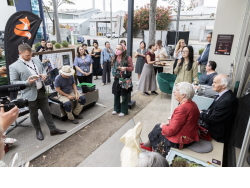
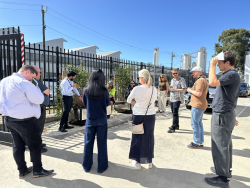
Worms at Work - Yarra's Edge bench installation day with community and councillor
Project goals:
- Test whether public furniture can support local food-waste diversion by integrating composting, seating, greening and community use in public urban spaces.
- Create a local innovation testbed where residents, businesses, Council and delivery partners could explore new responses to complex local challenges.
- Activate Fishermans Bend through hands-on experimentation using technology, data and community insight.
- Support participatory innovation by giving the community agency to propose, vote for and stay involved in a place-based pilot.
- Build Council’s capability for testing, trialling and reflection by prototyping a solution in a real-world setting.
- Refine a Smart City delivery model that can respond to precinct-level opportunities alongside longer Council Plan programs, while generating evidence and partnerships to inform future work.
Project team:
The project was delivered by the Smart City Incubator team.
One full-time Pilot and Trial Specialist managed the project end to end, including delivery coordination, stakeholder management, budget management and event organisation.
An Urban Technology Specialist supported key phases, particularly sensor deployment, dashboard development, maintenance and troubleshooting.
A Content and Communications Coordinator provided ad hoc support for public communications and event promotion.
The Head of Smart City Incubator provided ad hoc oversight and strategic guidance.
| Internal | External |
|---|---|
Nicky Stecca – Pilot and Trial Specialist, Smart City Incubator Mandy O’Toole – Acting Head of Smart City Incubator Laura Pfiester – Head of Smart City Incubator Dev Patel – Urban Technology Specialist, Smart City Incubator Brodie Pledge – Content & Communications Coordinator, Enterprise Planning and Insights Melanie Thewlis – Front End Developer, City Data Experience Sixto Tantiongco – Front end Designer, City Data Experience Rhys Male – (Acting) Principal Strategic Planner, City Strategy Chaitali Bhanushali – Acting Senior Strategic Planner, City Design Albin Pluche - Senior Industrial Designer, City Design Alex Cross – Program Lead Zero Waste City, Waste and Recycling Maureen Pillon – (Acting) Senior Coordinator, Economic Dev Int & Invest Nancy Pierorazio – Senior Policy Officer Diversity and Equality, Community Development Nicholas Pecipajkovski – Neighbourhood Partner, Community Development Fadi Qunqar – Neighbourhood Partner, Community Development Giuliana Leslie – (Acting) Project Officer Green Infrastructure, Parks and City Greening Rebecca White – (Acting) Senior Green Infrastructure Officer, Parks and City Greening Emily Wobcke – Senior Strategic Planner, City Strategy Lisa Soccio – Health Projects Coordinator, Community Wellbeing Laura Templeton – Digital Placemaking Lead, Community Development Wenhui Zheng – Advisor Creative Services, Communications Sophie Dargan – Senior Advisor City Communications, Communications Mojo Abidi – Senior Advisor Social Media, Communications Kylie Kitchen – (Acting) Manager City Communications, Communications Evgeniy Perfilyev – Business Intelligence Developer, Enterprise Tech services Lachie Macgree – Climate Change Adaptation Officer, Climate Change and City Resilience Ian Fisher – Senior Park Operations Officer, Open Space and Trees Geoff Barden – Team Leader Infrastructure Development, City Infrastructure. | Zoe Wang – Project collaborator and designer, Upsoil Collective Michael Mobbs – Project collaborator and designer, Sustainable House / Coolseats Ciro Giuliani – Bench manufacturer, Mrfoxinabox Polynova production team – bench manufacturers and modular design support, Polynova Dave Goodman – Composting and operational support, Compostcare and Kensington Compost Volunteers from Kensignton Town Hall Composting Hub and Footscray Community Garden and Learning Place – Support and knowledge on composting in urban settings Byron Fisher – Technology support, International STEAM Education Alexis Pang – Technology concept support, University of Melbourne Kate Spencer – Introductions and promotion support for activities in Fishermans Bend, FB Ideas Nikki Palun and team – Business site host and bench stewards, Susuro Urban Winery Lucy Ward and team – Business site host and bench stewards, St Ali Coffee Roasters Andrew Ligdopoulos – Community engagement venue and project supporter, Eighteen Pence Lane Café Yarra’s Edge Compost Champions – Residents named “Community champions”, informed decisions at all stages of the pilot, bench stewards in Yarra’s Edge Robert Lundberg – Research fellow, Formal interviews with pilot supporters and partners, Monash University FUTURES Hub Ruby Tucker – Senior Consultant, peer review of closing report, Delos Delta Bec Jones – Associate Director of Design, coordination of design for Worms at Work visual project summary, Delos Delta Gabrielle Henley – Design and Communications Officer, graphic project for Worms at Work visual project summary, Delos Delta. |
Project duration:
The Worms at Work pilot was implemented across 2025 and 2026.
The winning concept was selected through the 2024 Fishermans Bend Digital Innovation Challenge, with pilot delivery effectively commencing in 2025.
Key implementation stages included site scoping, community and business engagement, design refinement, fabrication, installation, training, public launch, monitoring and evaluation.
Bench operation, maintenance, data collection and post-pilot arrangements continued into early 2026 to strengthen confidence in the results.
Challenge and context:
Worms at Work emerged through the Fishermans Bend Digital Innovation Challenge, a Smart City program asking how technology and data could help city spaces become more sustainable, resilient and healthy, with a focus on Fishermans Bend, one of Australia’s largest urban renewal precincts.
The Challenge required Council to work differently and build trust. Instead of defining a solution internally and procuring it through standard pathways, the process opened the problem to the community and local organisations. People could propose ideas, vote for the solution they wanted tested, and stay involved as the winning concept was implemented. This created a more democratic and place-based model of innovation, but it also meant Council had to work with genuine uncertainty.
At the start, the Smart City Incubator team did not know what the winning pilot would be. This made the project harder than a standard Council-led initiative. Usually, Council would define the problem, map affected teams, engage relevant stakeholders early, and develop a delivery pathway around a known solution. In this case, the community had real agency to shape the outcome, so the internal collaboration model had to form quickly once Worms at Work was selected.
The project also had practical constraints. The pilot had a total budget of $90,000 for one year of delivery, with most funds allocated to selected delivery partners and a smaller portion available for capital and operational costs. It required project leadership, technical support and input from representatives across 11 Council departments.
Delivering in Fishermans Bend also proved challenging. On the City of Melbourne side, the area is largely industrial, with no residents, limited night-time activity, disconnected office and warehouse spaces, and emerging businesses still establishing themselves. Worms at Work had to build trust, relevance and stewardship in a place where everyday community rhythms were still forming.
Solution and innovation:
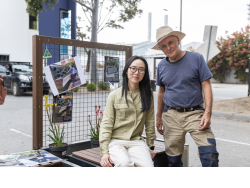
Worms at Work was pitched by an unlikely team: Zoe Wang, a local and emerging landscape architect and Michael Mobbs, a long-time composting advocate celebrating 30 years living in the off-grid house he built. Their partnership captured what the Challenge was designed to enable: fresh thinking, lived experience, technical skill and local knowledge coming together around a practical urban problem.
They pitched to community members, Council staff, researchers and sustainability experts, and won through public voting. This mattered because it showed the idea resonated with the people it was intended to serve and gave the project immediate momentum.
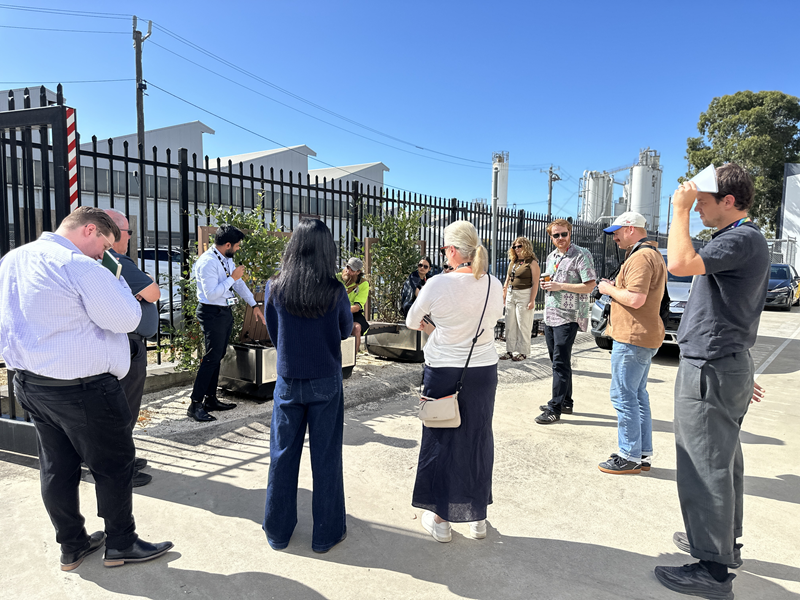
Fishermans Bend quickly tested the project team and partners’ assumptions. The original proposal relied on residents contributing household food waste, but the City of Melbourne side of the precinct still has no residential buildings and is largely occupied by offices, industrial spaces and a small number of hospitality businesses. After site visits and discussions with the Department of Transport and Planning, two benches were installed with hospitality businesses, and one in nearby Yarra’s Edge, where engaged residents became community champions and bench stewards.
The design was refined through site observation, interviews, workshops, community events and ongoing conversations with hosts and community champions. These interactions helped the project team and partners understand operating constraints, accessibility needs, safety considerations and how people would realistically use and care for the benches.
The same engagement informed the approach for public signage, user manuals, educational content, and interaction points for passers-by. Installation days, the official launch event, and a final walking tour provided opportunities for collaborators to share insights and continue refining the project.
Finally, community and volunteer insights helped define the smart sensor requirements, including moisture, pH, food-waste diversion, and estimated CO₂e avoided, ensuring the technology responded to both operational and community needs.
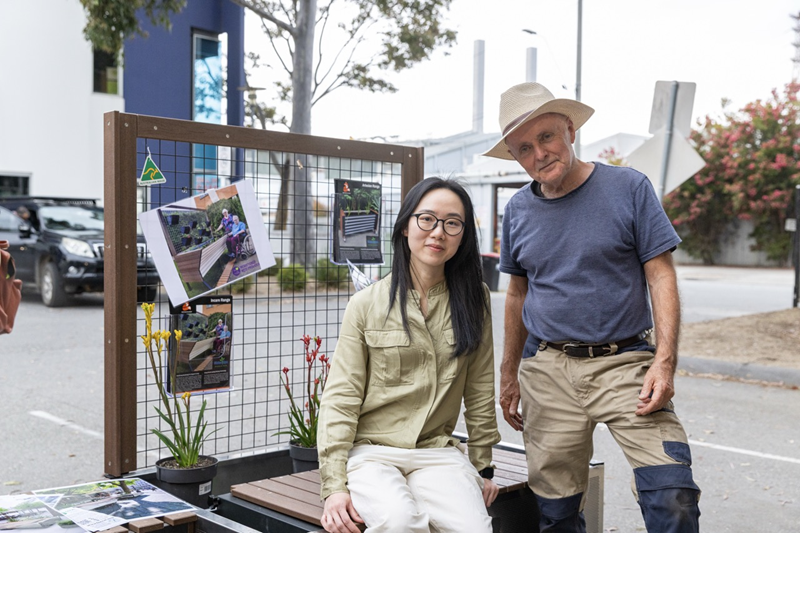

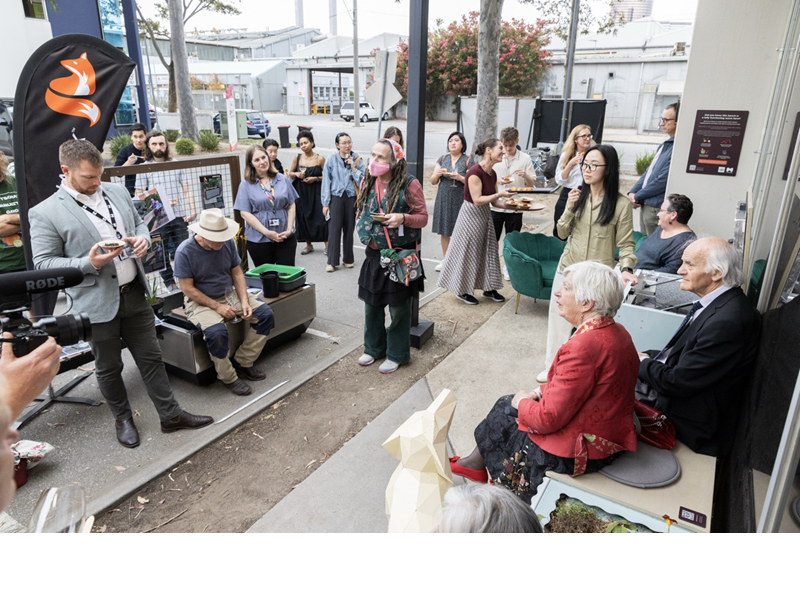
The pilot diverted 435kg of compostable material from landfill, including 305kg of food waste, avoiding an estimated 653kg CO₂e emissions, roughly equivalent to preventing the emissions from driving 3,608km.
Project impacts and short-term outcomes:
Worms at Work set out to demonstrate tangible outcomes within the pilot period, using quantitative data, qualitative research and community response.
Three composting benches were installed across Fishermans Bend and Yarra’s Edge. The pilot diverted 435kg of compostable material from landfill, including 305kg of food waste, avoiding an estimated 653kg CO₂e emissions, roughly equivalent to preventing the emissions from driving 3,608km. The benches also captured an estimated 497.25 litres of rainfall, equivalent to more than three baths of water, and recorded 13,770 seat uses across the three sites. Compost produced through the pilot helped nourish herbs and edible plantings at business sites, and flowers at Yarra’s Edge.
Food-waste diversion, CO₂e avoided, seat usage and compost-health metrics were captured through host logs and sensors, and communicated through a public dashboard. Compost metrics such as moisture and pH helped identify when conditions moved outside the preferred range, requiring maintenance or troubleshooting. Indicative modelling suggests one bench operating for a year could divert around 500kg of organic material, avoid 750kg CO₂e and generate 125kg of compost.
Communications activity generated over 100,000 social media impressions and positive community responses.
Qualitatively, the project changed how composting was experienced in public space. Monash University FUTURES Hub research found that success depended on managing the everyday sensory experience of the bench, including location, comfort, ease of use, pests, smell and cleanliness.
A key outcome was the shift from interest to stewardship. Hospitality businesses in Fishermans Bend became site hosts and bench stewards, while Yarra’s Edge residents became community champions, actively using and caring for the benches. The pilot brought together businesses, residents, delivery partners and Council around a shared environmental goal, creating new relationships and demonstrating how local partnerships can contribute to environmental outcomes, public education and care of community infrastructure.
Capability and long-term impacts:
Worms at Work strengthened Council capability to take a community idea and turn it into an evidence-based pilot.
The project required Council to work differently. Rather than defining the solution internally, the idea emerged through a public challenge and community voting process. This required the project team to work across Council, with businesses, residents and delivery partners, to understand how a community-selected initiative could support existing priorities, manage risks and deliver measurable outcomes. The approach provides a model that can be applied whenever Council seeks to test community-led innovation.
The pilot also tested a different approach to stewardship. Rather than relying on Council-led maintenance, business hosts and community champions took responsibility for day-to-day operation and care of the benches, supported by project partners and Council. This demonstrated how community stewardship can complement Council resources while maintaining appropriate oversight, support and accountability.
The project further highlighted opportunities to simplify pathways for community-led greening initiatives. As Council progresses Community Greening Guidelines, Worms at Work provided a practical test case that cut across existing approval and permit processes. The pilot strengthened the case for clearer and more flexible assessment pathways that reduce barriers to participation and make emerging community initiatives easier to support.
Finally, dashboards, sensors, food-waste logs, site observations, engagement and ethnographic research helped assess environmental performance and community experience together. This gives City of Melbourne a stronger method for testing new initiatives, adapting during delivery and informing future greening, circular economy, place-based and community-led projects.
Scalability and transferability:
While the bench itself can be adapted for other locations, the most transferable outcome of Worms at Work is its delivery model.
The pilot demonstrated how councils can move from a community-identified opportunity to a tangible initiative, bringing together residents, businesses, delivery partners and Council around a shared goal. Rather than relying solely on Council resources, the project combined community participation with practical support structures that enabled people to contribute to delivery and ongoing care.
A key lesson was the value of shared stewardship. Business hosts and community champions took responsibility for day-to-day operation and care of the benches, supported by project partners and Council. This reduced the operational and maintenance burden on Council while building local ownership, making the model more sustainable and scalable over time.
The project also highlighted the importance of connecting community ideas with organisational priorities, ensuring there is sufficient support from Council departments and elected representatives to deliver and evaluate new approaches. These lessons are relevant beyond composting and can inform a wide range of place-based and community-led projects.
Worms at Work reinforced the importance of treating implementation as a two-way conversation. Rather than delivering a fixed solution, residents, businesses, partners and Council continued to shape the project after installation through observation, feedback and adaptation. This created stronger relationships and helped ensure the project responded to local needs as they emerged.
The broader lesson is that stewardship models are a key factor in whether community infrastructure succeeds. Physical assets can be replicated, but long-term value depends on the people and partnerships around them, and on how Council supports shared responsibility for use, care and adaptation.