
Innovation Case Study: Yering Billabongs Project
Yarra Ranges Shire Council
Yering Billabongs : Restoring Country through partnership, culture and nature-led innovation
The Yering Billabongs Project restores 60 hectares of Birrarung floodplain through a multi-agency partnership led by Yarra Ranges Council, embedding Wurundjeri leadership. Using nature-based water diversion, cultural land management and adaptive governance, it reconnects Olinda Creek, improves water quality and habitat, strengthens cultural stewardship, and delivers a scalable model for integrated environmental, cultural and community outcomes across Victoria for communities.
2026 MAVlab Innovation Awards Winner:
The Stronger Together Award for Council Collaboration, supported by Davidson

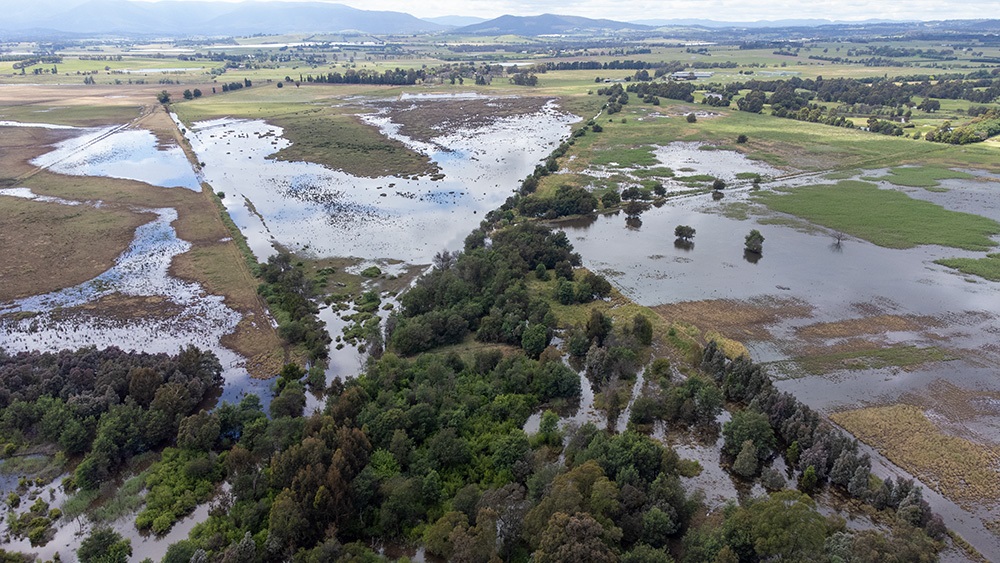
Yering Billabongs - flooded area back in 2022
Project goals:
- Restore floodplain hydrology and reconnect Olinda Creek to the Birrarung using nature-based diversion systems.
- Embed Traditional Owner leadership through Wurundjeri partnership, enabling Narrap Rangers to lead cultural land management practices.
- Implement cultural burning, ecological monitoring and knowledge sharing to strengthen connection to Country.
- Improve water quality, biodiversity and habitat for native flora and fauna across the floodplain landscape.
- Establish integrated governance, shared funding and adaptive decision-making across partner agencies.
- Overcome land tenure complexity and hydrological uncertainty through collaborative planning and innovative design solutions.
- Support self-determined land management and employment pathways for Traditional Owners in ongoing site stewardship.
- Engage community through education, participation and awareness of cultural and environmental values of the site.
- Secure ongoing investment and resources to maintain restoration outcomes and long-term collaborative management.
- Deliver a scalable, replicable model for integrated land, water and cultural management across Victoria.
- Align with Yarra Strategic Plan strengthening cross-sector partnerships for future projects.
Project team:
A working group of twelve.
Team and Contributors:
- Yarra Ranges Council
- Melbourne Water
- Wurundjeri
- Zoos Victoria
- Melbourne University
- Ecology and Restoration Australia.
Project duration:
2021 to 2025.
Challenge and context:
The Yering Billabongs Project responded to a complex and multi-layered challenge: restoring a degraded 60-hectare floodplain along the Birrarung while honouring its deep cultural significance to the Wurundjeri Woi-wurrung people.
For Traditional Owners, the challenge extended beyond ecological restoration to the need to heal Country and re-establish cultural connection to a landscape that had been significantly altered. Delivering this required a collaborative approach grounded in trust, shared understanding and long-term commitment.
No single organisation held the authority, expertise or resources to deliver this outcome. It required the integration of cultural leadership, technical expertise, land management and policy alignment across multiple partners, each operating within different mandates and systems.
The challenge was amplified by significant constraints. Fragmented land tenure and complex, ultimately unsuccessful land swap negotiations limited site consolidation. The project scope evolved substantially, shifting from engineered solutions to a passive regeneration model aligned with natural hydrology. Governance arrangements also changed during delivery, requiring the redesign of partnership structures as formal agreements evolved. At the same time, community concerns about flooding impacts had to be carefully managed, alongside the limitations of short-term funding cycles that constrained deep engagement.
Navigating these competing priorities, expectations and systems meant the project was fundamentally a collaboration challenge. Success depended not only on technical outcomes, but on the ability of multiple organisations to work together in new and adaptive ways.
Solution and innovation:
The Yering Billabongs Project established an adaptive, multi-agency collaboration model that embedded shared decision-making and Traditional Owner leadership in governance, design and delivery.
A defining feature was the embedding of Traditional Owner governance. Wurundjeri Woi-wurrung Cultural Heritage Aboriginal Corporation representatives participated in both Working Group and Steering Committee structures, ensuring cultural authority in all decision-making forums. A Cultural Values Assessment directly informed project priorities, while Narrap Rangers led on-ground land management through a self-determined model.
This was supported by a layered governance structure spanning Council, Melbourne Water, DEECA, Ecology and Restoration Australia, Zoos Victoria and others. These arrangements enabled coordinated decision-making while remaining flexible as partnership pathways and governance evolved during delivery.
The project also implemented an integrated funding and resource model, leveraging over $1.1 million in core funding alongside additional investment from Melbourne Water and significant Council in-kind contributions. Funding was actively managed throughout delivery to prioritise cultural outcomes and support a shift toward passive regeneration.
Innovation was evident in the co-design of technical and cultural solutions. Hydrological modelling informed the introduction of a water gate to restore seasonal inundation, while cultural knowledge reshaped land management toward a “light touch” approach aligned with Country. The Firesticks program further embedded cultural burning as a core practice.
Crucially, the project operated through continuous adaptive collaboration. Major design decisions, including moving away from large-scale earthworks, were jointly agreed by partners in response to emerging evidence, environmental conditions and cultural priorities.
This approach represents a shift from transactional engagement to genuine partnership. Traditional Owners were not consulted on decisions, they shaped them, creating an opportunity to work together to heal Country through combined cultural knowledge and contemporary science.
Critically, the project has shifted collaboration from project-based engagement to enduring partnership. Care for Country is no longer tied to a single project lifecycle, it is ongoing, shared and embedded across organisations.
Project impacts and short-term outcomes:
The Yering Billabongs Project has delivered strong, measurable outcomes across environmental, cultural and community domains, all enabled through collaboration.
The project restored 60 hectares of floodplain and reconnected it to natural hydrology through the installation of a water gate enabling seasonal inundation. Over 3,000 plants have been established, with 35 hectares actively managed for weed control, contributing to improved water quality entering the Birrarung system.
Equally significant are the cultural outcomes. The Cultural Values Assessment was fully implemented, guiding the restoration process and embedding Wurundjeri knowledge throughout. The site has been co-named using Woi-wurrung language, Dhurran Reserve and Yurna Ngarret Billabongs, and the first cultural burn since colonisation was delivered, with an ongoing program now established. Narrap Rangers continue to lead land management and monitoring activities.
Community outcomes include engagement of more than 150 students through planting and cultural learning programs, alongside ongoing “Walk and Talk” events that build environmental stewardship and awareness.
Importantly, the project has delivered clear collaboration outcomes. Over $700,000 in additional funding has been secured to continue joint delivery, and pathways have been established for a shared Committee of Management model. Relationships between Council, Traditional Owners and partner agencies have been significantly strengthened, alongside the ability to align funding streams, policies and delivery frameworks.
These outcomes were only possible through deep collaboration. Beyond physical restoration, the project has reconnected people, culture and place, creating a shared story of Country, stewardship and renewal.
Capability and long-term impacts:
The Yering Billabongs Project has fundamentally strengthened how Council and partners approach complex, cross-agency initiatives.
Within Council, the project has built capability in cultural governance, co-design and multi-agency coordination, alongside strengthening adaptive project management in complex and uncertain environments. It has also directly influenced policy, including updates to support cultural burning through Council’s “Fire as a Land Management Tool” framework.
At a system level, the project has established a replicable governance model for delivering priorities under the Yarra Strategic Plan. It has strengthened integration between local government, Traditional Owners and water authorities, while demonstrating how Traditional Owner leadership can be meaningfully embedded in environmental programs.
The long-term impacts are already evident. Ongoing funding has been secured to support Narrap Ranger-led land management through to 2027, with the project integrated into broader programs including Melbourne Water capital works and the Birrarung Rangers monitoring program. Long-term monitoring, governance and partnership frameworks are now in place.
Critically, the project has shifted collaboration from project-based engagement to enduring partnership. Care for Country is no longer tied to a single project lifecycle, it is ongoing, shared and embedded across organisations.
Scalability and transferability:
The Yering Billabongs Project provides a replicable model for multi-agency collaboration in environmental and cultural land management.
Key elements of this model include the use of Cultural Values Assessments as a foundation for design, embedded Traditional Owner governance, multi-tiered collaboration structures and an adaptive delivery approach that integrates cultural knowledge with scientific practice.
The approach is highly transferable across waterway restoration, floodplain management and broader environmental programs, particularly in contexts where multiple agencies and land tenures intersect.
As a flagship project under the Yarra Strategic Plan (Burndap Birrarung Burndap Umarkoo), it demonstrates how councils can lead integrated, cross-sector collaboration to deliver shared outcomes for Country and community. It also aligns with broader state and global priorities, including climate resilience, biodiversity restoration and reconciliation.
Ultimately, as articulated by the Narrap Rangers, the project is about healing Country. By bringing together Traditional Owners, Council and partner agencies in a shared model of care, Yering Billabongs shows how collaboration can restore not only landscapes, but relationships, knowledge and connection, for the long term.