

Innovation Case Study: Banyule’s Continuous Improvement Team
Banyule City Council
Delivering Strategic Change Through Collaboration and Creative Thinking
Banyule’s Continuous Improvement Team drives innovation, collaboration, and problem-solving across the organisation. By leading cross-organisational projects and creating efficiencies, the team helps foster staff engagement and a sense of shared ownership. Their approach has contributed to a culture of continuous improvement and delivered measurable outcomes.
2025 MAVlab Innovation Awards Finalist
The Thrive Award for Leadership in Change Management, supported by Swinburne University of Technology.
Team details:
- Kirsten Farrell – Continuous Improvement Coordinator
- Kate Chapell – Senior CI Process and Engagement Lead
- Rob Trajcevski – Senior CI Process and Benefits Lead.
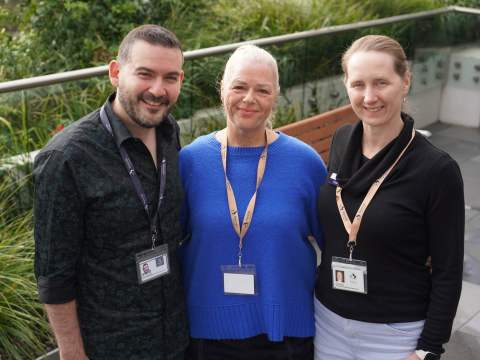
The Banyule CI Team: Rob Trajcevski; Kirsten Farrell; Kate Chapell
Leadership and excellence:
Over the past six years, the Continuous Improvement (CI) Team at Banyule City Council has exemplified courageous leadership and operational excellence, embedding a culture of innovation and ideation despite ongoing challenges such as limited staff capacity and competing priorities. Recognising that time is one of the biggest barriers to change, the team has led by example, championing small, achievable improvements that make everyday work easier and more efficient.
By driving bottom-up change, the CI team empowers staff to get involved, ask questions like “Why do we do it this way?” and explore better ways of working. They have developed practical ideation tools, frameworks, and safe spaces that make it easier for teams to engage in improvement. The team also continuously seeks creative ways to build engagement, from storytelling to staff-led videos showcasing real improvements.
The CI team is actively reshaping the narrative around continuous improvement. Rather than focusing on fear of job loss due to efficiency gains, the emphasis is on adding value, streamlining processes, and removing waste. By building capability within teams, they reduce reliance on the CI team itself and empower staff to lead their own improvements. This approach fosters ownership, confidence, and momentum for change across the organisation.
The CI team promotes a simple but powerful message: meaningful change doesn’t have to be a major project. Small, thoughtful shifts in process can lead to significant improvements. By supporting staff to lead these changes, the team is creating a culture of problem-solving. It is this kind of brave, adaptive leadership that continues to drive better outcomes for both staff and the community.
The CI team promotes a simple but powerful message: meaningful change doesn’t have to be a major project. Small, thoughtful shifts in process can lead to significant improvements.
Impact and legacy:
The CI Team created an Ideation Framework, aligned with Council’s priority of Ideas and Improvement, providing a structured way for staff to generate, share, and implement ideas, making innovation part of everyday work.
In 2023, the team launched the Ideas Hub, enabling staff to submit ideas to improve their work. Council-wide idea challenges, including “What would make your job easier?”, “How can we exceed customer expectations?”, and “How can we integrate environmental sustainability into our daily practices?” have generated 123 ideas so far. With oversight from the newly formed Ideas Committee, 88 ideas (75% of those submitted) were selected for action, with 72% (62 ideas) already implemented, delivering tangible improvements across the organisation.
Ideas Harvesting Workshops have surfaced more than 620 ideas across the Council, identifying pain points, collaboration opportunities, and practical solutions. Staff are empowered to lead implementation, fostering ownership and frontline innovation.
To further support local-led improvement and build capability, the team delivers a Continuous Improvement (CI) training program. Over 600 staff have attended one or more of 50 sessions on CI. A program highlight is the “How to Get Started” program with coaching, which has supported over 70 local improvement projects, some of which have earned a Certificate IV or Diploma in Competitive Systems and Practices.
The CI Outdoor Program brings continuous improvement into the field, engaging Parks & Operations staff in a hands-on, “go see” approach. It has already documented over 40 improvements, with the next phase focused on safety-based training and problem-solving skills for operational leaders. These efforts are shifting culture from reactive to proactive, building momentum and capability for continuous improvement at all levels.
To monitor CI progress and culture, the team runs an annual survey assessing staff sentiment and CI maturity. Results show growing confidence in applying CI tools and increased engagement in improvement activities.
Collaboration:
The Continuous Improvement (CI) Team at Banyule City Council has been instrumental in fostering a more collaborative and empowering workplace by embedding CI into the organisation’s culture and everyday practice.
They introduced a CI awareness eLearning module into staff induction and embedded CI responsibilities into position descriptions, ensuring every new employee understands their role in driving improvement from day one.
To break down silos, the team has facilitated and led 16 major cross-organisational initiatives, bringing teams together to address shared pain points and strengthen internal working relationships.
To further promote collaboration and shared learning, the team launched a Lunch & Learn series and championed tools like Process Manager to support collaborative process mapping across departments. These initiatives help teams visualise systems, improve transparency, and work together to identify inefficiencies and opportunities.
The team’s Ideas Harvesting program empowers staff to contribute and lead local-level improvements within their own teams. Supported by an ideas tracker, staff can update and progress their ideas independently, shifting ownership from the CI team to those closest to the work.
They also implemented a CI dashboard and benefits realisation framework, increasing visibility and showing the value of improvement across the organisation. A dedicated SharePoint-based benefits portal and Power BI dashboards provide easy access to progress data, reinforcing transparency and accountability.
A targeted CI Communications and Engagement Plan supports momentum, highlights improvement stories, and celebrates staff successes, further building a culture of collaboration and empowerment.
Through a practical, systems-based approach and a focus on trust, capability-building, and ownership, the CI team has significantly enhanced workplace cohesion, helping Banyule City Council become a more connected, innovative, and agile organisation.