

Innovation Case Study: BayBot
Bayside City Council
Making Council Information and Services Easier to Access
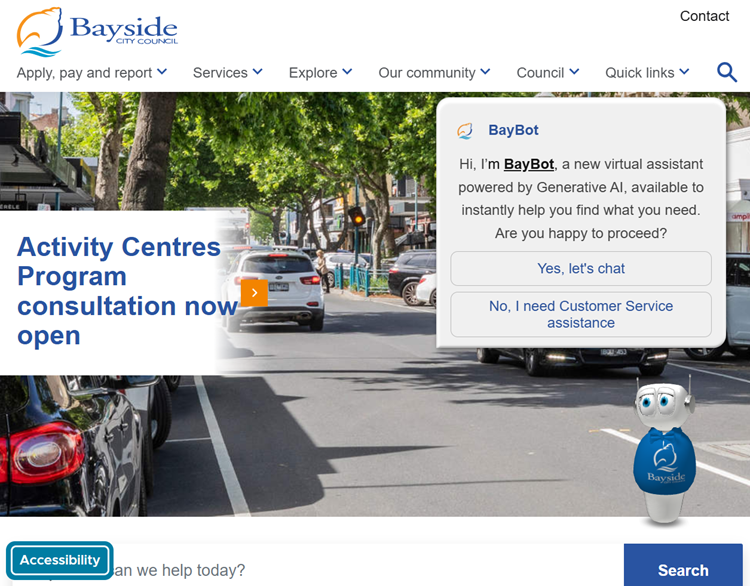
BayBot is an innovative generative AI chatbot launched by Bayside City Council to improve online navigation for council customers. It draws solely from council website content to ensure accuracy and cites sources. Designed with safeguards aligned to business rules, BayBot supports customer self-service, helping enhance user experience and contribute to organisational efficiency.
2025 MAVlab Innovation Awards Finalist:
The Engage Award for Impactful and Inclusive Storytelling, supported by Fireside Agency and The Smooth Sailing Award for Service Optimisation and CX, supported by LANDATA® operated by SERV.


Project statistics:
- 1 council staff
- Project duration: 6 months in development before launch.
Project goals:
- Support customers in self-serving through efficient channels
- Offer out-of-hours support to digital visitors
- Adapt to meet customers’ changing needs.
Challenge and context:
Website navigation has consistently ranked as the number one pain point for Bayside City Council’s website users in customer experience surveys. A previous chatbot attempted to address this, but with a satisfaction rating of just 1.6 out of 5, it often added to customer frustration. It was also resource-intensive to maintain, pushing many users to the general Contact Us form — submissions that required manual triaging and frequently lacked the detail needed for fast resolution.
The emergence of ChatGPT presented a promising solution. However, no government agency in Australia had yet demonstrated how this rapidly evolving technology could be implemented safely, accurately, and without reputational risk. The challenge was not only technical — it was also ethical, operational, and perceptual. Generative AI’s potential was counterbalanced by its tendency to produce inaccurate information (“hallucinations”), its complexity, and community concerns around trust and transparency.
We faced significant hurdles in configuring the AI to consistently deliver concise, accurate, and context-aware responses. At multiple points, the risks nearly outweighed the benefits — but we persisted, driven by a clear user need and a vision to pioneer safe use of this technology in local government.
Launching BayBot amid growing public concern about AI adoption required transparency, ethical guardrails, and thoughtful stakeholder engagement. The innovation emerged from a blend of frustration, urgency, and ambition — addressing a local challenge while stepping confidently into a global technological shift.
Innovation and solution:
When Powerfront approached us with the opportunity to explore Generative AI, we scoped its risks and benefits from first principles.
With website navigation being the number one customer issue, we focused on building a tool that could help users find what they needed — instantly and in plain language.
We began by analysing anonymised live chat data and testing BayBot’s responses against real queries. Over a three-month iterative cycle, we refined the tool’s guardrails and tone, rating every response as if it came from a knowledgeable staff member without access to internal systems. Once the AI outperformed live agents in this context, we progressed to in-person testing with our website testing team. Feedback was overwhelmingly positive and informed final refinements before launch.
Initially, we monitored every response and collected user contact details in case follow-up was needed. However, this requirement created friction for users, especially those just seeking basic information. Confident in BayBot’s accuracy, we removed this barrier — improving trust and accessibility for all users, including those with lower digital confidence.
We have not received a single complaint about the accuracy of BayBot’s content. The only negative sentiment has come from customers who prefer not to engage with bots, a challenge we mitigated through clear communication and human-centred design.
Every department across Council was engaged throughout development, from content authors to the Executive Team, and continues to provide feedback. This wasn’t just a tech deployment — it was a cultural and service transformation. BayBot demonstrates how Generative AI can be used safely, inclusively, and effectively in local government.
For customers, the impact has been transformative. BayBot handled over 11,965 interactions in the last financial year, with an average satisfaction rating nearing 4 out of 5 — up from just 1.7 for our previous chatbot.
Impact and outcomes:
One of the most powerful outcomes of BayBot has been internal. Staff now use it to build their knowledge of Council services and processes — empowering faster, more consistent support across channels. We are now developing an internal version, integrated with our knowledge base and intranet, to further streamline service delivery and boost organisational capability.
For customers, the impact has been transformative. BayBot handled over 11,965 interactions in the last financial year, with an average satisfaction rating nearing 4 out of 5 — up from just 1.7 for our previous chatbot. Importantly, this feedback is supported by internal audits showing high levels of response accuracy and relevance.
With constant human oversight, issues with BayBot are rare and usually trace back to missing content. To improve coverage, we have begun documenting “infrequently asked questions” in collaboration with our Customer Service team, aiming to never fail to answer the same question twice.
Accessibility and inclusion have been central to our approach. BayBot’s plain yet multilingual language and natural conversation style help overcome literacy and confidence barriers. We have removed contact requirements for information-only queries and introduced a friendly avatar to increase engagement and signal advanced functionality — especially for customers who may not otherwise recognise its capabilities.
To cater to all needs, we ensure a customer service agent is available on live chat during business hours, so BayBot can escalate more complex enquiries.
BayBot is now a valued channel in our digital service offering — and a blueprint for responsible AI adoption in the sector.
Scalability:
We are already scaling the benefits of BayBot. A new internal version is in development, integrating with our CRM and intranet to support staff across all service channels. We’ve also created a “Search Assist” version and will soon redirect users from our outdated search function to this improved tool.
Beyond Bayside, the model is gaining traction. Mornington Peninsula Shire has launched its own version based on BayBot’s core architecture, and another council is in advanced development. We’ve directly consulted with over 10 local governments on responsible Generative AI adoption.
We’ve also shared our journey across the sector — presenting to the LGPro CX SIG, The Customer Show, and the inaugural LGA AI Summit. BayBot is to be featured in the August edition of Council Magazine, and we’ve provided advice to Salesforce on successful implementation.
By demonstrating that this technology can be safe, accurate, and citizen-focused, we’re helping councils navigate uncertainty and unlock new value from digital services. In doing so, we support the UN Sustainable Development Goals — particularly SDG 9 (Industry, Innovation and Infrastructure), SDG 10 (Reduced Inequalities), and SDG 16 (Peace, Justice and Strong Institutions) — through better access to information and more inclusive service delivery.
BayBot is more than a product — it’s a repeatable framework for ethical AI adoption, designed for scale.