
Innovation Case Study: Knowledge Bank Working Group
City of Melbourne
Knowledge Bank Team Transforms Community Feedback into Strategic Insights
The Knowledge Bank Technical Working Group develops and maintains the City of Melbourne’s sector-leading community feedback analytics platform. Using custom-built NLP and machine learning, the Knowledge Bank makes it easy for staff to understand community insights across topics, themes, and past engagement projects.
2025 MAVlab Innovation Awards Winner:
The Insights Award for Data-driven Decision-making, supported by SenSen Networks
Current Working Group Members:
- Chris Asistio – Senior Data Analyst
- Eden Baker – Manager, Strategy and Projects (Community Development)
- Ank Chaturvedi – Analytics Lead
- Matthew Conquest – Business Analyst
- Sophie Herman – City Data Analyst
- Eliza McDonald – Knowledge Bank Lead
- Maria Mizzi – Scrum Master & Business Analyst
- Evgeniy Perfilyev – Business Intelligence Developer
- Simon Terry – City Analytics Specialist
- Nithin Venkat – City Analytics Specialist
- Rahul Vivek – Data Engineer
- Jon Wright – Manager, Data Governance.
Previous Working Group Members:
- Elliot Anderson – Former Manager, Strategy and Projects (Community Development)
- Lanie Berka – Former Manager, Strategy and Projects (Community Development)
- Mei-Ling Cadle – Former Data Architect
- Remi Cattier – Former Manager, Data Operations
- Heather Sherlock – Former Knowledge Bank Lead
- Lachlan Moody – Former City Analytics Specialist
- Diana Sepulveda Navarrete – Former City Data Analyst
- Idris Syed – Former Business Intelligence Specialist.
Leadership and excellence:
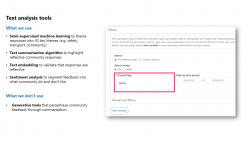
Through their work on the Knowledge Bank, the Knowledge Bank Technical Working Group has transformed community engagement analysis at the City of Melbourne. The Group has demonstrated leadership and excellence by addressing a longstanding sector-wide challenge: the difficulty of aggregating community engagement insights over time and across multiple consultations. While councils regularly consult on a wide range of topics, synthesising this feedback into actionable insights has traditionally been complex. The Knowledge Bank fills this gap by enabling staff to view all feedback in one place and using natural language processing to automatically categorise responses into themes such as transport, parks, and community safety.
The team also chose to build sophisticated text analytics and machine learning capabilities in-house rather than outsourcing. This strategic decision ensures full accountability for the model, supports ongoing improvement, and builds valuable organisational expertise that can be applied to future data and innovation projects.
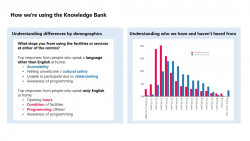
The Group has also set exemplary standards for data ethics and integrity. Automatic redaction protects community privacy by removing personal information. Feedback is presented in contributors’ original words, without editing or sanitisation, preserving authentic community voices. In addition, demographic benchmarking against ABS Census data provides transparent representation analysis, clearly highlighting any over- or under-representation across age, gender, and other diversity indicators. These practices ensure that decision-makers understand both the content and the context of community input.


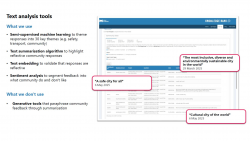
The Group has demonstrated leadership and excellence by addressing a longstanding sector-wide challenge: the difficulty of aggregating community engagement insights over time and across multiple consultations.
Impact and legacy:
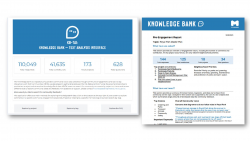
The Knowledge Bank is already having a significant impact on how the City of Melbourne uses community feedback, and this legacy will continue for years to come. The platform brings together feedback collected through our digital engagement platform, Participate Melbourne, as well as insights submitted by our community-facing staff. It currently aggregates more than 106,000 pieces of feedback from over 167 engagement projects, with this number growing every day. Feedback is categorised and tagged by sentiment, enabling teams to easily understand how the community feels about particular issues. Importantly, the platform allows users to filter results by neighbourhood and demographic cohorts to see how perspectives differ across the municipality.
The Knowledge Bank is now used by 13 branches across the organisation. Members of the Technical Working Group deliver training sessions approximately once a fortnight to support staff in using the tool and to ensure new team members are onboarded effectively. The Group has also produced more than 100 bespoke research reports for project leads, helping ensure community insights meaningfully inform decision-making across the organisation.
Below is a summary of common Knowledge Bank use cases:
Pre-community engagement insights: Before the Knowledge Bank, project teams found it difficult to understand what the community had previously shared with the organisation. The platform now gives teams access to past feedback and provides visibility into which voices have or haven’t been heard. This ensures existing insights are considered before new engagement begins, helps shape key messages that show the City of Melbourne is listening, and supports targeted engagement with underrepresented groups.
Internal strategic decision-making: The Knowledge Bank has supported Executive Leadership Team and Councillor decision-making on major strategic initiatives, including the annual budget, community infrastructure planning, place-based infrastructure design projects, and mental health research.
Advocacy for community to external groups: The platform has been used to identify advocacy priorities, including calls to the Victorian Government for more schools and improved accessible public transport. It has also informed conversations with private sector partners developing public open space, ensuring new spaces reflect the needs and expectations of the community.
Collaboration:
The Knowledge Bank Technical Working Group demonstrates strong cross-functional collaboration. The Group brings together multidisciplinary staff from three branches—Community Development, Enterprise Technology Services, and Enterprise Planning and Insights. They meet fortnightly to support rapid decision-making, early issue identification, and consistent progress. Each member is responsible for a different component of the platform, and the meetings provide an opportunity to share updates and collaboratively troubleshoot challenges. This diverse mix of skills has enabled the Group to drive the project forward independently and efficiently.
By centralising community data, the Knowledge Bank has also helped break down silos across the organisation. The platform is now widely used by teams across the City of Melbourne, including strategic and design branches, frontline teams, and core service delivery areas such as parking services, parks and greening, and community wellbeing. Staff can either request a custom report or work directly within the tool, empowering them to access insights in a way that suits their needs and skillsets.
Ultimately, the platform has enabled staff to more easily access and understand community insights, helping to embed a more community-oriented approach to the City of Melbourne’s work.