

Innovation Case Study: Learning and Development Team, City of Melbourne
City of Melbourne
Empowering Growth Through Data, Collaboration, and Meaningful Development
The Learning and Development Team drives meaningful growth at the City of Melbourne by connecting staff with the right development at the right time. Grounded in business needs and strong partnerships, the team translates goals into impactful, inclusive learning aligned with strategic and community outcomes.
2025 MAVlab Innovation Awards Finalist:
The Insights Award for Data-driven Decision-making, supported by SenSen Networks
Team details:
- Lisa Curran, L&D Partner
- Reda Keddad, L&D Partner
- Nadia Diab, L&D Coordinator.
Leadership and excellence:
In 2023, the City of Melbourne’s Learning and Development (L&D) team set out to shift the organisation’s view of learning from a compliance requirement to a capability-building asset. The team now leads with intent, embedding live data and strategic collaboration into its operating model. Over two years, it has reshaped perceptions — moving from being seen as compliance administrators to trusted partners in workforce capability, supporting the organisation to meet evolving community needs.
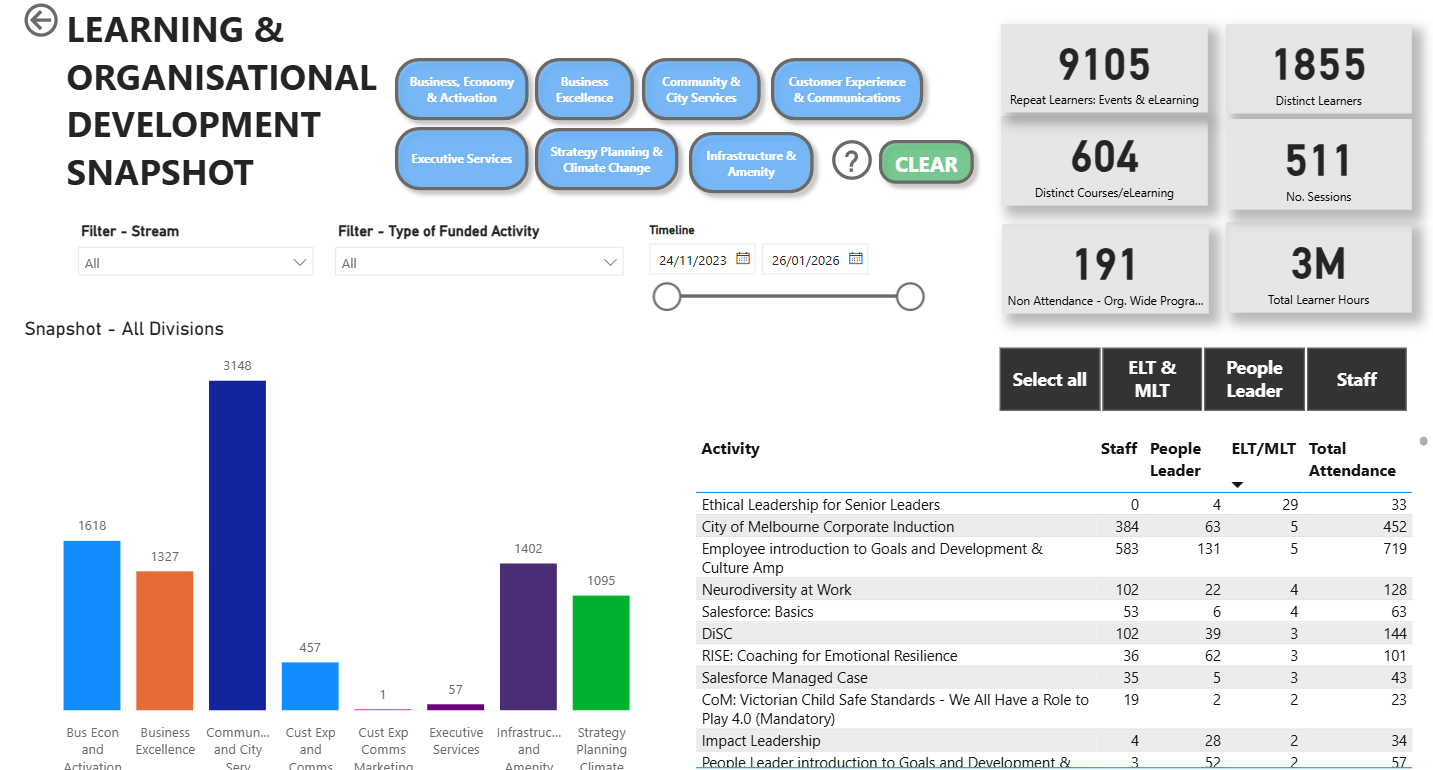
The team initially trialled manually curated data with a small number of branches. While the approach worked well, it needed to be scalable. This led to the introduction of Power BI to generate whole-of-organisation insights. The curated data brings together LMS activity, development plans, workshop attendance, GPA outcomes, course evaluations, and workforce planning information. These real-time insights help determine whether programs should be scaled, paused, or retired, enabling targeted investment and timely, inclusive delivery.
L&D Business Partners now coach people leaders in using these insights to guide development conversations, helping build data capability at all levels of the organisation. Programs are aligned to strategic priorities such as the Reconciliation Action Plan (RAP), Diversity, Equity and Inclusion (DEI), and broader cultural uplift initiatives. The team also runs pilots with subject-matter experts across the organisation to test content, gather feedback, and validate impact before wider rollout, ensuring offerings are relevant, inclusive, and evidence-informed.
The result is a high-performing function that enables others. L&D is now recognised as a strategic partner — not only for mandatory training, but for shaping workforce capability and supporting organisational culture. Their work shows what becomes possible when data is shared, interpreted, and owned by the people who use it.
This scalable model could be replicated by other councils using accessible tools such as Power BI, strengthened cross-organisational relationships, and a focus on coaching teams to build confidence in using data.
This model, grounded in visibility, partnership, and empowerment, is adaptable across the sector, offering a blueprint for collaborative, insight-driven capability uplift.
Impact and legacy:
All City of Melbourne staff contribute to community outcomes, and L&D aims to ensure every employee has access to relevant, high-impact development. Where a clear service delivery need exists, the team prioritises funding and support—particularly for frontline and high-impact roles. Branch-level learning plans, developed collaboratively with L&D, are supported by real-time Power BI reports. People leaders use these insights during GPA and one-on-one conversations to identify skill gaps, career goals, future training needs, and to link learning directly to outcomes.
The impact is clear:
- In 2023–24, 690 staff participated in development.
- In 2024–25, participation surged to more than 6,500 repeat learners (1,608 individuals) across 536 learning offerings — a 133% increase in unique learner participation.
- Internally and externally run sessions engaged 3,302 repeat learners (up 219%), and the Self-Directed Learning Hub saw 2,783 repeat learners (206% growth).
- A 17% improvement in the employee experience survey confirmed that more staff felt supported in accessing learning.
Data-led design ensures programs remain relevant and impactful.
- The Maternal and Child Health people leader identified a need to strengthen responses to family violence. L&D partnered to enrol staff in the internationally recognised Safe & Together training, building confidence in documentation and embedding a consistent, trauma-informed approach. This model has since been scaled to other family service teams.
- Enrolment trends and feedback are continuously monitored to identify when programs reach saturation. For example, when demand for Gender Impact Assessment workshops declined, the final session was replaced with an Unconscious Bias workshop — which filled immediately.
L&D’s approach is both replicable and embedded. Teams now expect evidence-based offerings, and learning is viewed as a shared responsibility. New data sources — such as 70:20 development insights, attendance versus no-shows, and the cost of non-attendance — are being explored to strengthen advice and maximise return on investment.
Collaboration:
At the City of Melbourne, collaboration and live data sit at the heart of the L&D model. Learning plans are co-designed with branches using GPA themes, workforce plans, evaluation data, and operational priorities, ensuring that development is role-relevant, timely, and strongly supported by leaders.
Each branch is partnered with a dedicated L&D Business Partner who provides contextual advice and responsive delivery. These relationships are essential for identifying emerging needs, building trust, and co-creating programs that genuinely matter to staff. Strategic partnerships with branches such as Aboriginal Melbourne, Community Wellbeing, Libraries, Recreation and Waterways, and Governance and Legal have shaped capability uplift across the organisation. Programs including Cultural Awareness with Uncle Bill, Psychological Safety, Leading with Ethical Practice, Women in Leadership, Disability Inclusion, and LGBTIQA+ Allyship were co-designed and/or co-delivered with internal and external subject-matter experts to ensure relevance, authenticity, and impact.
In 2024–25, the DEI program expanded in response to participation data, evaluation feedback, and staff input from across the organisation. A broader and more inclusive offering was co-developed to reflect a wide range of identities and experiences, including cultural background, gender, disability, age, and neurodiversity. This attracted 794 staff across 22 DEI events, delivered in formats that supported both frontline and office-based participation. L&D also convened a working group of Inclusion, Equity and Diversity subject-matter experts to guide program direction, ensuring lived experience was embedded throughout design and delivery. This collaborative approach strengthened psychological safety, contextual relevance, and engagement across the organisation.
Collaboration extends beyond program delivery. People leaders use Power BI dashboards to explore trends and co-decide priorities. This shared approach ensures programs are informed not only by data, but by people. Learning becomes an iterative and collaborative process — co-designed, continuously refined through feedback, and delivered in partnership with those it supports.
This model, grounded in visibility, partnership, and empowerment, is adaptable across the sector, offering a blueprint for collaborative, insight-driven capability uplift.