Innovation Case Study: Make Room
City of Melbourne
Adaptive Reuse, Delivering Housing, Dignity and Hope
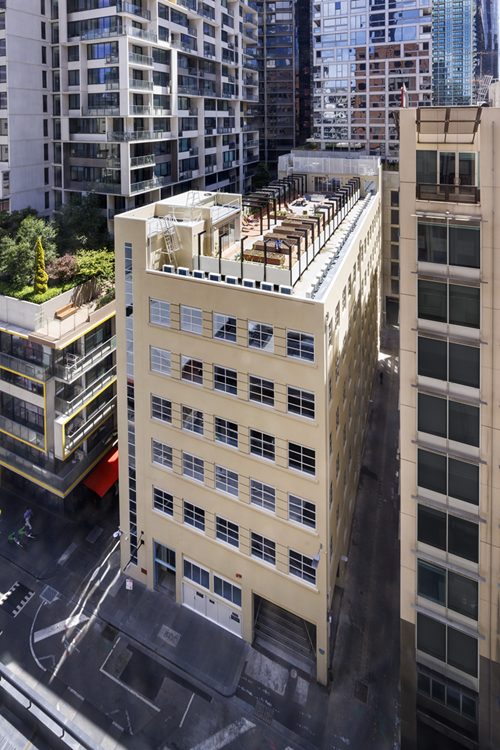
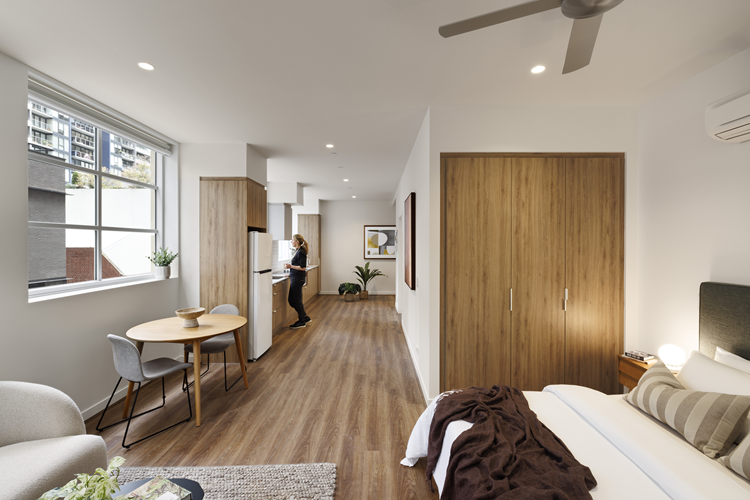
This transformation of a heritage-listed, council-owned building on Little Bourke Street into 50 studio apartments for people experience chronic homelessness is based on Housing First principles. This highly collaborative project provides residents with integrated support and pathways into sustainable long-term housing.
2025 MAVlab Innovation Awards Winner:
The Refuge Award for Innovation in Housing and Safe Spaces for Community, supported by Neighbourhood Houses Victoria
Project statistics:
- 8 key members on the project team (4 internal and 4 external) who were also members of the project control group
- Refurbishment timeline: 24 May 2022 – 30 September 2024 (2 years, 8 months)
- Key project milestones:
- Town Planning Application lodged — November 2022
- Internal demolition and fit-out commenced — March 2023
- Construction commenced on site — July 2023
- Construction completed — September 2024
- Phased tenanting commenced — January 2025
- Site fully tenanted — June 2025.
Project goals:
- Repurpose a Council-owned asset into safe, secure housing to support people experiencing long-term homelessness, serious health issues, and trauma.
- Set a new standard for scalable transitional housing by demonstrating how culturally safe spaces with integrated support services can create effective pathways into long-term housing.
- Apply an adaptive-reuse approach based on the Housing First model, focusing on tenant stability, personal recovery, cultural safety, and harm reduction.
- Implement a Passive House approach to reduce lifecycle and utility costs, ensuring long-term sustainability through partnerships between the City of Melbourne, Victorian Government, Unison Housing, cohealth, Ngwala Willumbong, and key philanthropic organisations.
Challenge and context:
In 2018, more than 300 people were sleeping rough in the City of Melbourne (CoM) each night. Recognising the urgency of the situation, CoM decided to repurpose a council-owned asset to demonstrate how local government can lead in delivering housing responses and addressing the critical needs of people experiencing chronic homelessness. This initiative showed that, with the right support and infrastructure, local government can create real pathways out of homelessness and increase the availability of safe, secure housing.
This work led to the development of Make Room, a partnership between CoM, Unison Housing, the Victorian Government, and the philanthropic sector to respond to the needs of people experiencing homelessness.
Make Room adopted an innovative funding approach. CoM provided a building valued at $12 million to Unison for a 20-year period. Refurbishment funding was sourced from $9 million from the Victorian Government, more than $7.2 million in philanthropic support, and contributions from corporate and philanthropic partners. The Lord Mayor’s Charitable Fund contributed $1 million in direct funding and established a financial vehicle to enable further philanthropic donations.
Despite these efforts, the project faced a significant budget shortfall after funding from the Australian Government was not secured. CoM underwrote the remaining costs, covering an $8.8 million gap. An independent quantity surveyor determined that approximately $8.9 million of the total costs could be capitalised, meaning the entire net gap of $8.2 million would be capitalised.
The project’s leadership and partnership structure were grounded in a collective impact approach, with a focus on delivering high-quality outcomes across every stage. This included innovative architectural design, strong construction partnerships, and the development of an integrated service model. Stakeholder complexity was managed through a Project Control Group with delegated authority and representation from all key partners, enabling timely and collaborative decision-making. This structure was critical to delivering Make Room on time and within budget.
Solution and innovation:
Gradual tenanting of Make Room began in January 2025, and by June 2025 all properties were successfully tenanted. This is significant, considering 60% of tenants were previously entrenched in homelessness and disengaged from services. Additionally, 10% of residents were considered “long shots” due to anticipated difficulties in supporting them through the referral and sign-up process. Despite these barriers, all tenants have settled into their properties and are actively engaging with onsite supports. Two individuals relinquished their properties to pursue alternative accommodation options.
There is an equal gender split among tenants at Make Room. A women-only floor of 10 units provides a dedicated safe and affirming space for women who have experienced family violence and/or sexual assault.
Recognising the overrepresentation of First Nations people experiencing homelessness, a KPI was set to allocate 10% of Make Room tenancies to Aboriginal and Torres Strait Islander peoples. This KPI has been exceeded, with current tenancy at 46%.
An extensive 18-month evaluation program, led by consultants from the Australian Housing and Urban Research Institute (AHURI), is underway. The evaluation has been designed to inform future projects and provide actionable insights. The project has generated interest locally, nationally, and internationally. A publicly available evaluation report will be released upon completion.
The evaluation focuses on three key research areas:
- Lived experience and post-occupancy experience of residents
- Built form performance
- Neighbourhood impact.
Phase one, including ethics approval and the establishment of baseline data, is complete, and phase two is currently underway.
The first 18 months of Make Room’s evaluation are strategically important. The findings will capture deep insights about the project to support continuous improvement, reflective practice, service replication, and future business case development. The evaluation will provide an objective appraisal of the project’s impact and performance, identifying key areas of strength and opportunities for improvement.
Designed with and for people experiencing homelessness, it directly responds to unmet need in inner Melbourne, particularly for those facing multiple and complex challenges.
Impact and outcomes:
Make Room is Australia’s first purpose-built, supportive housing initiative designed to break the cycle of chronic homelessness. Unlike commercial or build-to-rent models, it is mission-led and prioritises dignity, healing, and long-term housing stability. Designed with and for people experiencing homelessness, it directly responds to unmet need in inner Melbourne, particularly for those facing multiple and complex challenges.
A key innovation of Make Room is the adaptive reuse of a Council-owned building, transforming it into safe, self-contained homes. The project applies an adapted Housing First approach, with onsite wraparound support and trauma-informed, culturally safe design embedded in both the built form and service model. It was co-designed with Aboriginal leaders and people with lived experience, ensuring inclusion, accessibility, and cultural safety are central, not afterthoughts. The Phoenix Floor, a secure level for women — including many First Nations people and survivors of family violence — exemplifies this approach.
The staged rollout, delivered in collaboration with partners, enabled safe and coordinated transitions. Seventy-five percent of referrals came from the Melbourne Homelessness Service Coordination Program’s By-Name List, a live record of people experiencing street homelessness. By June 2025, 46% of Make Room tenants identified as Aboriginal and Torres Strait Islander peoples — an exceptional outcome reflecting trust in the culturally embedded model and addressing their overrepresentation in homelessness statistics.
Stakeholder engagement was pivotal. The City of Melbourne partnered with Unison Housing, cohealth, Ngwala Willumbong, the Victorian Government, and philanthropic leaders. Each contributed to a service model that elevated lived experience and Indigenous leadership in both design and operations.
Unlike previous housing responses, Make Room offers a replicable, scalable model that integrates sustainability (through Passive House principles), strong tenancy support, and local partnerships. It advances local government practice by demonstrating that councils can play a catalytic role in delivering inclusive, dignified housing solutions, setting a new benchmark for municipal leadership in addressing homelessness.
Scalability:
Make Room meets immediate acute housing needs and is designed to be replicable, potentially benefiting other councils and communities nationwide. An extensive 18-month evaluation program, led by the Australian Housing and Urban Research Institute (AHURI), is underway to inform future projects and will be publicly available once completed.
The project fills a critical gap in the provision of specialist supportive housing for people who have experienced chronic homelessness and offers a unique opportunity to reduce street homelessness. It is the first known adaptive reuse project in Australia to use a council asset to deliver supported housing for people experiencing chronic homelessness. As a pilot project for the City of Melbourne’s Adaptive Reuse Guidelines, Make Room has far-reaching impacts.
Leaving no one behind is a key theme of the United Nations Sustainable Development Goals (SDGs), and the City of Melbourne demonstrates its commitment to this framework through initiatives such as its 2022 Voluntary Local Review. The SDGs provide a strategic context for local action and an opportunity to use a homelessness initiative as a catalyst for change.
Make Room’s evaluation program supports this approach and will measure progress against eight identified goals. The evaluation prioritises the lived experience of tenants, the performance of the adaptive reuse of the built form, and the broader experience of the local neighbourhood.
Make Room directly contributes to 11 localised targets:
- Goals 1 and 11 – Supports pathways to housing for people experiencing homelessness
- Goals 10 and 13 – Embeds Housing First and Cultural Safety principles
- Goals 8 and 9 – Catalyses investment from corporate and philanthropic sectors
- Goal 10 – Responds to community and neighbourhood feedback
- Goal 9 – Demonstrates best practice in adaptive reuse
- Goals 9, 10, and 15 – Activates the City of Melbourne’s Little Streets initiative
- Goal 15 – Implements the Urban Forest Strategy.
Learn more:
- Make Room Opening (Video)
- Make Room Project (City of Melbourne)
- MAVlab Innovation Talks: Building Homes Strengthening Communities, featuring Make Room (Video)