

Innovation Case Study: Merri-bek Democracy Lab
Merri-bek City Council
Empowering Community Voices, Shaping Merri-bek's Future Together
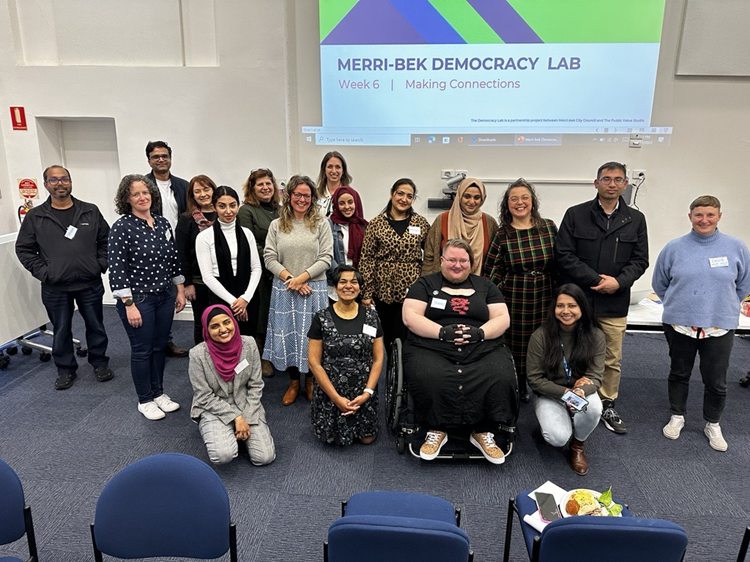
Launched in 2019, the Merri-bek Democracy Lab — a partnership between Merri-bek City Council and The Public Value Studio — empowers diverse community members to engage in civic life. Through an 8-week skill-building program, participants gain confidence, build connections, and lead community projects. Outcomes include 88% reporting increased civic awareness and 92% stronger social ties.
2025 MAVlab Innovation Awards Winner:
The Connector Award for Community Inclusion and Cohesion, supported by NBN Local
Project statistics:
- Project Team: 6 people including Merri-bek's Social Cohesion Officer, The Public Value Studio's Director and Community Reference Group members who are also past Democracy Lab participants.
- Timing: The project has run every year since 2019, except in 2024 when it paused due to caretaker period. Each project cycle runs for five months and includes:
- 1 month of project planning
- 1 month of promotion and expressions of interest
- 2 weeks of participant recruitment
- 2 months to deliver 8 Lab sessions
- 2 weeks for evaluation and reporting.
Project goals:
- Increase civic participation by supporting people to volunteer, join community committees, or lead their own community projects.
- Strengthen Council’s capacity to deliver programs by drawing on the diverse strengths and needs of the community, allowing programs to grow and adapt.
- Improve participation of priority groups (as identified in Council’s Human Rights Policy) in Council consultation and decision-making processes.
- Increase community involvement in social, political, advocacy, and leadership activities.
- Ensure the program is co-designed with a Community Reference Group made up of past participants, who also contribute as co-facilitators.
Challenge and context:
The Merri-bek Democracy Lab was created to address low civic participation and limited engagement among diverse and marginalised communities in Merri-bek, a region known for its cultural diversity. The core challenge was to empower community members — especially those new to leadership or from underrepresented backgrounds — to play a meaningful role in local decision-making. Key barriers included mistrust of local government, language and cultural differences, limited networks, and practical constraints such as time, caregiving responsibilities, and transport.
Responding to these challenges required a holistic, community-led approach. The program was co-designed with a Community Reference Group to ensure it was relevant, accessible, and culturally safe. Recruitment focused on areas and groups with historically low engagement, using community meetings, word of mouth, and targeted local outreach. To support participation, the program offered free childcare, flexible session times (including evenings and online), culturally appropriate food, accessible venues, and the option for participants to bring support persons. Individual follow-ups helped address specific needs.
For marginalised cohorts — including newly arrived migrants, refugees, faith communities, people with disabilities, women, LGBTQIA+ community members, and First Nations people — the program built trust through culturally safe practices, First Nations-led sessions, and a strong emphasis on inclusion. Ongoing mentorship and an active alumni network helped participants stay engaged beyond the initial program.
We've made the most of our existing assets by cultivating an environment of shared ownership where people genuinely want to contribute. Past participants are involved across many facets of the Lab - as part of Community Reference Group, as speakers in the program, organising alumni events - either for small honorariums or on a voluntary basis. This happens because the Lab's success feels collectively owned, making people willing to invest their time in sustaining something they helped build.
Solution and innovation:
The Merri-bek Democracy Lab adopted a co-design and empowerment approach that was fundamentally different from traditional council-led engagement. Instead of setting a fixed agenda, the project invited community members — especially those from diverse and underrepresented backgrounds — to shape both the program and their own civic initiatives.
Main steps included:
- Co-design with a Community Reference Group of past participants, who acted as co-facilitators and mentors, ensuring the program was relevant and accessible.
- Targeted outreach to priority groups (including newly arrived migrants, refugees, faith communities, people with disabilities, women, LGBTQIA+ people, and First Nations communities) using community meetings, word-of-mouth, and local networks.
- Flexible delivery: Sessions were held in the evenings, online, and at accessible venues. Free childcare, culturally appropriate food, and transport support were provided.
- Individual support: Each participant received tailored follow-ups to address specific needs, and could bring a support person if required.
- First Nations First approach: Every program began with a First Nations speaker, embedding self-determination and cultural safety from the outset.
Why this was innovative:
- Shifted power dynamics: Unlike previous council programs, the Lab let community members set priorities and develop solutions, fostering genuine ownership and empowerment.
- Sustained engagement: Alumni became mentors and co-facilitators, building a cycle of community leadership and knowledge sharing.
- Accessibility and inclusion: Every aspect — from timing, location, food, childcare, travel — was designed to remove barriers for diverse and marginalised cohorts, enabling participation from those often excluded from civic processes.


Since 2019, participants have launched new community groups, initiated local projects, and stepped into leadership roles, directly influencing Council processes and decisions.
Impact and outcomes:
The Merri-bek Democracy Lab has delivered significant, measurable impacts in civic participation, social cohesion, and inclusion. Since 2019, participants have launched new community groups, initiated local projects, and stepped into leadership roles, directly influencing Council processes and decisions. The program’s innovative, co-designed approach has fostered a sense of ownership and trust between the community and Council.
Key outcomes include:
- Empowerment and Leadership: 88% of participants report increased confidence in leading community initiatives, and many have gone on to create or lead local projects.
- Increased Civic Awareness: 88% of participants are now more aware of opportunities to engage with Council and influence local issues.
- Enhanced Social Capital: 92% report stronger social connections and networks, and 76% have increased links to local services and organisations.
- Accessibility and Inclusion: Over 60% of participants are women, nearly 60% are from newly arrived or faith communities, 20% identify as LGBTQIA+, and 18% are people with disabilities. Free childcare, flexible session times, accessible venues, and culturally appropriate food ensured broad participation.
Outcomes were measured through participant surveys, feedback, and tracking involvement in Council and community activities. The program’s impacts are expected to grow as alumni take on greater leadership, mentor new participants, and drive ongoing community-led initiatives.
By prioritising accessibility and inclusion, the Lab has set a new standard for local government engagement, demonstrating that tailored, community-driven approaches can create lasting, positive change.
Scalability:
The Merri-bek Democracy Lab offers a highly adaptable model for scaling civic participation and inclusion across councils and networks. The program’s core design, community co-design, flexible delivery, and sustained support can be replicated or integrated by other local governments to foster similar outcomes.
Key factors supporting scalability:
- Transferable Co-Design Framework: The Lab’s co-design methodology, which involves participants and alumni in shaping and delivering the program, is not location-specific and can be adopted by other councils. This ensures relevance and ownership in any community context.
- Flexible, Inclusive Delivery: The use of accessible venues, online options, free childcare, and culturally appropriate food can be tailored to meet the needs of diverse populations in different municipalities.
- Alumni-Led Mentorship: Training participants to become future facilitators and mentors creates a self-sustaining leadership pipeline that can be embedded within council structures or scaled regionally.
- Partnerships and Knowledge Sharing: The program’s partnership approach — between council, community, and expert facilitators — can be replicated through inter-council collaborations, resource sharing, and joint training initiatives.
- Evidence-Based Practice: The program’s robust measurement of outcomes and ongoing evaluation provide a blueprint for other councils to track impact and refine their own initiatives.
Advancing Local Government Practice:
This approach moves beyond traditional consultation by empowering communities to set agendas and lead change. By integrating the Lab’s principles into council-wide engagement strategies — or sharing resources and learnings through networks like the MAV or VLGA — councils can collectively build capacity, amplify impact, and foster inclusive civic participation at scale.