

Innovation Case Study: Open Data Exchange Insights Pages
Casey City Council
Storytelling That Drives Trust and Accountability for Community
The Open Data Exchange shares council data with the Casey community. Since 2023, the Insights Page has been enhanced with more user-friendly visualisations and storytelling, focusing on accessibility for residents with limited data literacy. Featuring topics like emissions and council transparency, it’s mobile-friendly and inclusive. Value is measured by analytics, feedback, and engagement, with traffic up 82% and increased internal collaboration.
2025 MAVlab Innovation Awards Finalist:
The Engage Award for Impactful and Inclusive Storytelling, supported by Fireside Agency.

Project statistics:
- Team: 2 staff
- Timing: Insights page development has been between 2023 and 2025.
Project goals:
- Identify datasets to be publicly available that are important to the community, researchers, developers, educators, and business owners
- Identify and publish datasets that track Council activities, deliverables, and accountabilities to foster community trust
- Use insights pages to present the data the community needs about Council services, while maintaining access to raw data for full transparency
- Support and highlight council programs that deliver strong results, and share outcomes with the community in an easy-to-interpret format.
Challenge and context:
The Open Data Exchange was launched in 2021 to increase the transparency and accessibility of council data. At the outset, the City of Casey identified and published dozens of datasets on the platform, anticipating strong community engagement. However, by 2023, a comprehensive review revealed that many of these datasets were underutilised and offered limited value to the community. This highlighted a significant challenge: despite the availability of open data, it was not meeting the needs or expectations of users.
Further investigation found that the majority of users were everyday community members — not data analysts or researchers — who found raw datasets difficult to interpret. Instead, they were seeking meaningful insights and narratives to help them better understand local issues and trends. This insight prompted a shift in focus, from simply publishing data to creating accessible, user-friendly visualisations and summaries.
The challenge was compounded by several factors, including limited resources, the need to rebuild trust and engagement, and the imperative to ensure inclusivity for diverse and vulnerable cohorts. Many users lacked digital literacy or reliable access to technology, making it essential to design solutions that were intuitive, mobile-friendly, and easy to navigate. At the same time, internal stakeholders needed to be re-engaged to support a new direction for the platform.
This pivot required innovation not only in technology, but also in approach. The team adopted a human-centred design process, collaborated closely with community groups, and introduced interactive dashboards tailored to local interests. By reframing the platform around insights rather than raw data, the Open Data Exchange evolved into a more valuable, inclusive, and effective tool for civic engagement.
Solution and innovation:
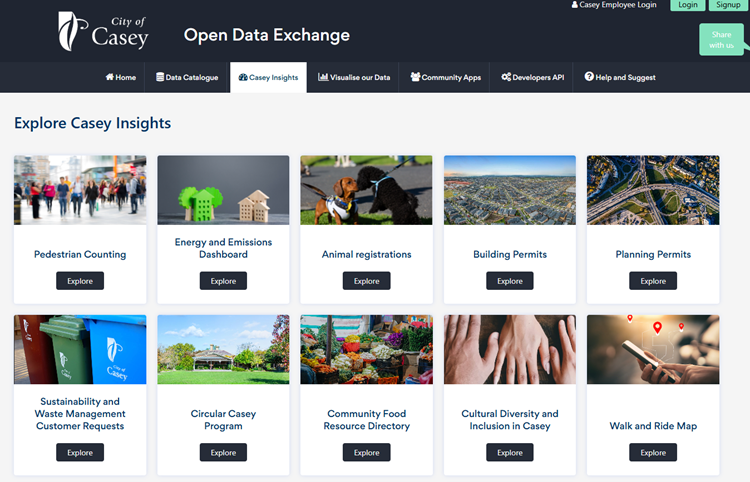
To address the challenge of low engagement with raw datasets, we shifted our approach to focus on delivering meaningful insights tailored to community interests. This pivot was validated by the launch of our first insights page — the Energy Emissions Dashboard — which quickly became the most visited page on the Open Data Exchange at that time.
Building on this success, we developed a suite of insights pages covering diverse topics, including animal registrations, building and planning permits, waste management requests, Circular Economy Living Lab outcomes, the Food Resource Directory, cultural diversity, Explore Casey, Explore Kindergarten, graffiti removal requests, and most recently, the Councillor Transparency Dashboard. Each page translates complex data into accessible narratives, visualisations, and summaries that reflect community priorities, council decisions, and program outcomes.
This approach was innovative in several ways:
- User-Centred Design — prioritising accessibility through mobile-friendly, intuitive dashboards informed by user feedback and analytics
- Inclusive Engagement — collaborating with community groups, including culturally diverse and vulnerable populations, to ensure content is relevant and accessible
- Data Storytelling — crafting stories that resonate with residents rather than simply presenting raw data, making civic information more relatable and actionable.
The impact has been significant. In 2025 (to date), insights pages account for approximately 45% of total web traffic, with over 4,000 combined visitors — an 82% increase compared to the same period in 2024. This demonstrates a clear shift in how the community engages with open data.
By reimagining data presentation and prioritising inclusivity, this initiative sets a new benchmark for local government transparency and digital engagement.
A major milestone was the launch of the Councillor Transparency Hub, which empowers residents to understand council decision-making and assess whether elected officials are acting in their best interests. This initiative has strengthened civic trust and engagement by demystifying council processes.
Impact and outcomes:
The Open Data Exchange has delivered measurable value to the Casey community, evidenced by an 82% year-over-year increase in web traffic, primarily driven by visits to insights pages. This surge reflects a growing public appetite for accessible, meaningful information, validating our shift from raw data to community-focused insights.
Key outcomes include the popularity of pages highlighting essential resources such as kindergartens and food support services. These pages revealed previously unmet needs, particularly among vulnerable and diverse cohorts, and have helped residents better navigate available services. The platform’s inclusive design — featuring mobile responsiveness, plain language, and visual storytelling — has made data more approachable for users with varying levels of digital literacy.
A major milestone was the launch of the Councillor Transparency Hub, which empowers residents to understand council decision-making and assess whether elected officials are acting in their best interests. This initiative has strengthened civic trust and engagement by demystifying council processes.
Internally, the project has catalysed a cultural shift. Multiple teams across the council have proactively approached the Open Data Development Team to contribute new datasets, recognising the platform’s growing value and reach. This collaborative momentum is expanding the Exchange’s offerings and reinforcing its role as a central hub for community insight.
We continue to monitor engagement through analytics, user feedback, and stakeholder input, ensuring the platform evolves in response to community needs. As more datasets are transformed into accessible insights, we anticipate sustained growth in usage, deeper community engagement, and broader inclusion — setting a new standard for open data in local government.
Scalability:
The scalability of our insights-driven approach is significant and highly transferable across councils and sectors. While data is essential for informed decision-making, most community members lack the time, expertise, or tools to extract meaningful insights from raw datasets. By transforming complex data into accessible, visual, and narrative-driven insights, we have created a model that can be replicated to meet diverse community needs.
Future expansion opportunities include simplifying and visualising results from community trust surveys, health and wellbeing assessments, safety perception studies, community centre performance metrics, and annual budgets. These are all areas where transparency and accessibility can directly improve civic engagement and service delivery.
Our approach is designed to be modular and adaptable. It can be easily integrated with platforms like .id (informed decisions) to contextualise local data with broader demographic and economic trends. Additionally, there is strong potential for cross-council collaboration, including the sharing of methodologies, co-development of dashboards, and integration of datasets to provide regional insights that transcend municipal boundaries.
Internally, the model is already gaining traction, with multiple teams contributing new datasets and requesting insights development. This momentum can be leveraged across departments and replicated in other councils through knowledge sharing, templates, and open-source tools.
This initiative supports several United Nations Sustainable Development Goals (SDGs):
- Goal 11: Sustainable Cities and Communities — by promoting inclusive, safe, and participatory urban development
- Goal 16: Peace, Justice and Strong Institutions — by enhancing transparency, accountability, and public access to information
- Goal 17: Partnerships for the Goals — through collaboration across councils and data-sharing networks.
By scaling this approach, we can collectively build smarter, more inclusive, and more transparent local governments.