
Innovation Case Study: Private Electric Vehicle Kerbside Charging Project
Port Phillip City Council
Unique Solution Enabling On-street Private Electric Vehicle Charging
In 2022, Port Phillip City Council piloted kerbside EV charging for residents without off-street parking, partnering with a provider to install home-powered units on council land. Starting with 10 units, the project established safe, equitable permitting for private use of public space. The pilot has now expanded allowing for up to 100 installations and is open to other technologies. Impact is measured through uptake, resident feedback, and progress toward climate resilience goals.
2025 MAVlab Innovation Awards Finalist:
The Energiser Award for Climate Resilience and Adaptation, supported by Clean Energy Council.

Project statistics:
- Team: 7 Council staff and 4 service provider staff
- Duration: 4 years and 10 months.
- Milestones: The trial to install 10 chargers was endorsed in 2021. This was extended in June 2024 for a period of a further 4 years or the installation of 100 chargers.
Project goals:
- Accelerate climate resilience by promoting the adoption of electric vehicles (EVs) in urban communities
- Enable equitable access to EV charging for residents without off-street parking
- Deliver a practical, low-cost kerbside charging solution linked directly to residents’ homes, removing a key barrier to EV uptake
- Foster community collaboration and innovation to support sustainable transport and reduce carbon emissions.
Challenge and context:
Transport accounts for 13% of Port Phillip’s community greenhouse gas emissions — more than 172,000 tonnes of CO₂ annually. The Act and Adapt Sustainable Environment Strategy (2023–2028) prioritises accelerating electric vehicle (EV) uptake to reduce these emissions. However, approximately 90% of local dwellings face barriers to home EV charging due to limited off-street parking and undersized garages that are incompatible with modern EVs.
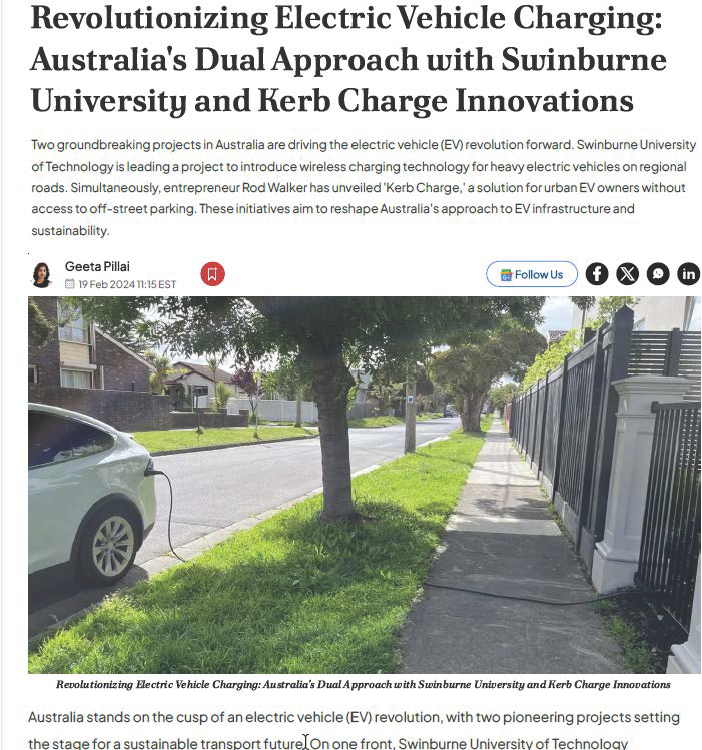
Since 2019, residents have sought Council support to enable EV charging near their homes. In the absence of viable alternatives, some residents resorted to unsafe practices — such as running power leads across footpaths — creating trip hazards and undermining trust in Council’s climate leadership.
Fast-charging infrastructure was not feasible for widespread deployment due to cost, space, and power constraints. A new solution was urgently needed — one that was safe, equitable, low-cost, and scalable.
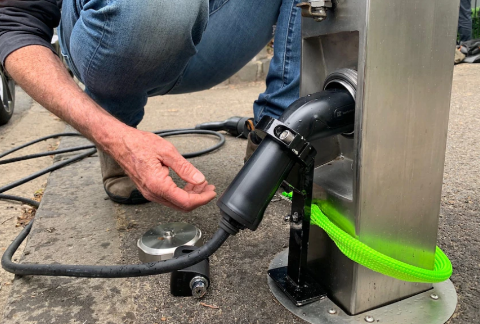
Addressing this challenge required cross-departmental innovation, involving local laws, permits, assets, vegetation, and drainage teams. The solution needed to be flood-proof, contain no electronics, and eliminate trip hazards, while enabling residents to charge EVs directly from their homes via kerbside units on public land.
This initiative directly supports diverse and vulnerable cohorts — particularly renters and residents in heritage or older buildings — by removing structural barriers to sustainable transport and ensuring inclusive access to climate solutions.
Solution and innovation:
To address the lack of EV charging options for residents without off-street parking, Council partnered with local innovator Kerb Charge to trial a first-of-its-kind solution in Australia — kerbside EV chargers powered from private homes but installed on Council-managed land. This required Council endorsement and the creation of a new “Kerb Charging Permit” system, which was approved in September 2021.
Council collaborated across departments — including local laws, permits, assets, vegetation, and drainage — to design a safe, inclusive, and replicable process. The device needed to be flood-proof, non-electronic, and installed using non-destructive methods. A bond system was introduced to ensure the restoration of public assets following installation.
Kerb Charge met rigorous safety and compliance requirements, consulting with Energy Safe Victoria, Melbourne Water, and MAV Insurance. The solution was certified by international testing laboratories and aligned with relevant Australian Standards.
This approach differs from traditional fast-charging infrastructure, which is costly, space-intensive, and often inaccessible to many residents. Instead, it empowers individuals to charge EVs at home, even without driveways or garages, making sustainable transport more inclusive — particularly for renters and residents of heritage buildings.
Community engagement was central to the trial, with permit conditions evolving in response to feedback and safety considerations. The success of the pilot led to a four-year extension, or up to 100 installations, positioning Port Phillip as a leader in local government innovation for climate resilience.
Accessibility and inclusion have been central to the program’s design. The solution supports renters and residents of heritage buildings — groups often left behind in the EV transition. Permit conditions have evolved in response to community feedback, balancing safety with expanded access.
Impact and outcomes:
Since the pilot began, 20 kerbside EV chargers have been installed, each enabling the transition from internal combustion engines to electric vehicles. Based on US EPA estimates, this equates to approximately 59.8 tonnes of CO₂ emissions avoided — an impact that will continue to grow as installations increase.
Critically, 80% of trial participants reported that they would not have purchased an EV without access to a Kerb Charge unit, highlighting the initiative’s direct influence on behaviour change. With up to 90% of Port Phillip residents lacking off-street parking, this model unlocks EV adoption for a large cohort that has previously been excluded.
The project has also strengthened Council’s internal capabilities, establishing new permitting and asset management processes that support the safe and equitable use of public land. It complements broader sustainable transport initiatives, including active transport and e-mobility infrastructure.
Accessibility and inclusion have been central to the program’s design. The solution supports renters and residents of heritage buildings — groups often left behind in the EV transition. Permit conditions have evolved in response to community feedback, balancing safety with expanded access.
The program’s success has attracted interest from local governments across Australia, positioning Port Phillip as a leader in scalable, community-driven climate solutions. With the program now extended to up to 100 installations over four years, its environmental and social benefits will continue to grow.
Scalability:
The Kerb Charge pilot began with 10 installations and was extended in June 2024 to support up to 100 chargers over four years. Locally invented, manufactured, and installed in Melbourne using local trades and materials, the model is highly scalable — ready to meet increased demand with minimal supply chain constraints.
This innovation offers a complementary approach to public EV infrastructure by enabling private, home-based charging on Council-managed land. It provides residents with convenience, cost savings, and the ability to use excess solar energy — benefits unique to home charging and increasingly important for future technologies such as vehicle-to-home and vehicle-to-grid integration.
The model is particularly impactful for residents without off-street parking, including renters, making EV adoption more inclusive. Its success has already attracted interest from councils across Australia, demonstrating strong potential for replication and knowledge sharing across the local government network.
Council has developed robust permitting, safety, and asset protection processes that can be adopted by other municipalities. The initiative aligns with several United Nations Sustainable Development Goals, including SDG 11 (Sustainable Cities and Communities), SDG 13 (Climate Action), SDG 7 (Affordable and Clean Energy), and SDG 9 (Industry, Innovation and Infrastructure).
By enabling scalable, community-driven climate solutions, this project leverages the collective power of local government to accelerate the transition to low-emission transport and resilient urban infrastructure.
Learn more: