

Innovation Case Study: Queen Victoria Market Circular Economy Precinct
City of Melbourne
Circular Economy in Action
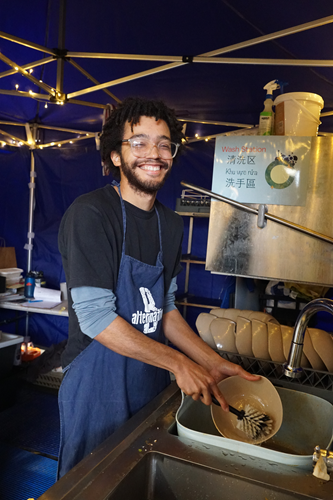 Running from 10 July to 30 September, the Queen Victoria Market Circular Economy Precinct engages local and international visitors in sustainable practices. It features a reusable packaging pilot, circular food processing with the Moving Feast Kitchen to address food-insecurity for local university students, and public events for community education — demonstrating regenerative design and measuring impact through waste reduction, savings, and social outcomes.
2025 MAVlab Innovation Awards Finalist:
The Systems and Cycles Award for Regenerative Design, supported by RMIT University.

Project statistics:
- Team: Approximately 6 staff from Council, STREAT and B-Alternative as well as B-Alternative volunteers (3-5 daily)
- Timings:
- Project design and scope - 5 months
- Project delivery - 3 months
- Project evaluation - 1 month.
Project goals:
- Avoid over 60,000 single-use packaging items by introducing reusable alternatives for 20 food vendors at Queen Victoria Market (June–September 2025).
- Reduce landfill output in this precinct by 50% and increase resource recovery through four-stream waste separation, including a public organic waste collection — a first for Queen Victoria Market.
- Scaling Circular Food Processing: Develop retail products and meals from rescued market produce.
- Circular Education & Events: Educate the community on the circular economy and its principles through innovative, place-based events.
Challenge and context:
The Queen Victoria Market Circular Economy Precinct addresses the critical challenges of pervasive single-use packaging waste, significant food waste, and a general lack of public understanding of the value and opportunities of the circular economy.
Earlier attempts to engage businesses for previous program iterations — through strategic recruitment, face-to-face engagement, and broad promotions — proved largely unsuccessful. Council officers observed that businesses were consistently time-poor and resource-constrained, creating substantial barriers to adopting new circular practices. This challenging context highlighted the need for a more focused approach and a program partner with existing networks. This led to the partnership with STREAT at Queen Victoria Market, leveraging their established expertise and the market's captive audience to drive systemic change.
The innovation required stems from operating in this open market context. For the three-month Reuse Pilot, the challenge lies in testing the feasibility and appetite for reusable containers in an environment lacking the controlled boundaries of a closed, time-limited event. Managing the circulation and return of reusable items with a constantly changing visitor demographic demands novel operational and behavioural strategies. Similarly, addressing food waste required innovating a new process map to divert unspoiled produce directly from independent fruit and vegetable traders before it becomes waste, creating a new supply chain for the Moving Feast Kitchen. This directly tackles food insecurity by transforming rescued produce into meals and retail food products for vulnerable cohorts.
The nature of the market's visitors makes community education and behavioural change particularly challenging, as there isn't a consistent cohort to engage with over time. This project's blend of infrastructure, direct resource recovery, and comprehensive public education in an open, high-traffic setting is unprecedented in Australia, demanding truly innovative approaches to stakeholder engagement, logistical management, and community buy-in.
Solution and innovation:
The Queen Victoria Market Circular Economy Precinct offers a novel approach to waste and regenerative design in a complex, open public environment. Our innovative solution strategically identified the Purpose Precinct, located at F and E sheds in QVM and managed by STREAT, as a pivotal hub for circular economy demonstration, offering a unique opportunity to visibly integrate solutions into daily market operations.
Leveraging STREAT's extensive networks, B-Alternative was subcontracted to deliver the Reuse Pilot and manage all trader engagement. As a social enterprise specialising in reuse systems, B-Alternative’s ‘Reuse Revolution’ experience at events across Australia made them ideally suited for QVM. With support from STREAT and QVM operations, B-Alternative led trader engagement months in advance. This proactive approach allowed vendors to provide feedback, ask questions, and consider operational changes, ultimately ensuring a smooth integration of reusables in the designated zone.
The STREAT partnership explores innovative solutions for on-site circularity, including:
- B-Alternative Reuse Systems: Developing and testing robust reusable packaging systems adaptable to the market's high-traffic, open nature, departing from controlled event environments.
- Scaling Circular Food Processing: Establishing new pathways to divert unspoiled market produce, transforming it into valuable retail products and meals, and creating economic and social value by addressing food insecurity for vulnerable cohorts.
- Engaging Circular Events & Education: Curating a vibrant calendar of place-based events and workshops to informally educate and engage the diverse market community on circular economy principles, fostering mindset shifts through accessible, inclusive interactions.
This integrated approach, centred at the Purpose Precinct and anchored by STREAT, uniquely responds to the challenges of embedding circularity into a bustling urban landmark. By transforming an iconic public space into a visible demonstration of regenerative design, our solution advances local government practices, showcasing a scalable, collaborative model for resource recovery, waste reduction, and community empowerment. It extends beyond traditional waste management to foster a circular economy.


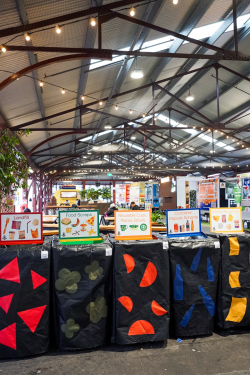
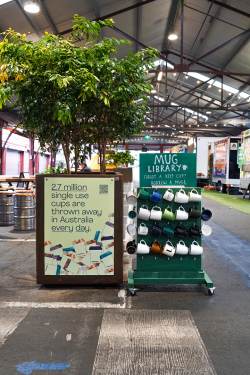
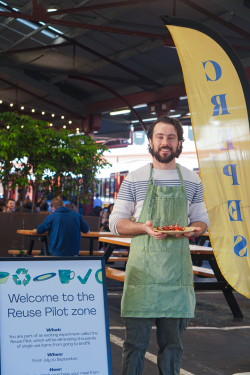
In its first three weeks, the project [Reuse Pilot] successfully recovered 366 kg of uncontaminated FOGO and prevented over 10,000 single-use packaging items from entering landfill.
Impact and outcomes:
Though operational for only three weeks (by July 2025, the time of submitting to the 2025 MAVlab Innovation Awards), the Queen Victoria Market Circular Economy Precinct program already demonstrates tangible impacts, establishing a robust foundation for future growth. Its design ensures continuously compounding contributions towards a sustainable, regenerative, and inclusive community.
The most immediate and quantifiable outcome comes from the Reuse Pilot. In its first three weeks, the project successfully recovered 366 kg of uncontaminated FOGO and prevented over 10,000 single-use packaging items from entering landfill. This directly demonstrates the feasibility and effectiveness of a circular packaging system in a dynamic market environment, despite the constraints outlined above. This early success highlights rapid adoption and positive behavioural shifts among participating vendors and patrons, validating the innovative approach in an open setting and providing a strong baseline for significant future waste reduction.
Looking ahead, the program is poised for profound impacts through its two other core initiatives:
- Circular Food Processing: Currently in planning, this initiative will establish a vital pipeline for unspoiled surplus market produce. In 2024, 48 per cent of City of Melbourne residents reported food insecurity. By directing surplus food to the Moving Feast Kitchen, the program will not only divert significant organic waste but also transform it into nutritious meals for individuals experiencing food insecurity, particularly students. Impact will be measured in tonnes of food diverted and meals provided.
- Circular Events & Education: An upcoming calendar of cooking classes, circular retail experiences, and repair workshops will drive community education and engagement. These events foster informal interactions, helping diverse community members visualize and actively contribute to a circular economy. Anticipated outcomes include increased public awareness, practical skills, and a deeper understanding of circular principles, empowering individuals and local businesses to adopt sustainable practices.
We anticipate these outcomes will escalate dramatically as food recovery and educational initiatives fully launch and scale. The Reuse Pilot’s initial success strongly indicates the program’s potential to position Queen Victoria Market as a leading example of urban regenerative design.
Scalability:
The Queen Victoria Market Circular Economy Precinct is designed for scalability and replication, offering a model for regenerative practices. Its core strength lies in validating circular solutions within an open environment, unlike typical reuse schemes confined to closed events, making it uniquely transferable to other public spaces, markets, and diverse community settings.
The Reuse Pilot at QVM serves as a real-world feasibility study for open-environment reuse. Its success in preventing over 10,000 single-use items from entering circulation in just three weeks provides critical data and a tangible proof-of-concept. We envision future iterations inspired by Aarhus, Denmark’s successful city-wide deposit-return systems. These models feature convenient container collection points that incentivise customers to return reusable items, offering ultimate scalability for a truly city-wide reuse system. Operational learnings will be invaluable for:
- Empowering other City of Melbourne teams (e.g., public events, parks) to integrate similar reuse systems at festivals or local markets.
- Providing a robust blueprint for other councils. The challenges overcome in an open market mirror those faced by many municipalities, making our solutions highly relevant and adaptable.
- The collaboration with STREAT at the Moving Feast Kitchen to divert unspoiled market produce for food insecurity initiatives presents a scalable blueprint for urban food systems. This model can be replicated by connecting other food rescue organisations with local markets, creating decentralised networks of resource recovery and social impact.
The Queen Victoria Market Circular Economy Precinct directly contributes to several critical UN Sustainable Development Goals:
- SDG 12: Responsible Consumption and Production – By reducing single-use waste, promoting reuse, and minimising food waste.
- SDG 2: Zero Hunger – Through the diversion of unspoiled food to address food insecurity for students and other vulnerable cohorts.
- SDG 11: Sustainable Cities and Communities – By transforming an iconic public space into a hub for circularity and community education.
- SDG 17: Partnerships for the Goals – The foundational partnership with STREAT, B-Alternative, other social enterprises, market traders, and universities exemplifies the collaborative spirit required to achieve the SDGs.
This case study was written in July 2025 during the submission period for the 2025 MAVlab Innovation Awards. For updated data or to discuss the project further, please contact Alex Cross - Program Lead Zero Waste, City of Melbourne.