
Innovation Case Study: Renewals for Nature
City of Melbourne
Data-driven Renewal Transforming Garden Beds for Biodiversity
From November 2023 to June 2024, the City of Melbourne and Royal Botanic Gardens Victoria developed a comprehensive methodology to audit all municipal garden beds. Combining asset mapping, condition assessments, and ecological theory, the project supports horticulture, asset management, and biodiversity planning. Outcomes include improved plant survival, reduced renewal costs, and enhanced capacity to meet biodiversity targets.
2025 MAVlab Innovation Awards Finalist:
The Future is Maintenance Award for Asset Management, supported by Matter.

Project statistics:
- Team: 7 members including 4 from City of Melbourne and 3 from Royal Botanic Gardens Victoria in the following roles:
- City of Melbourne Senior Ecologist (Project Manager), Project Officer – Urban Forest and Ecology, Senior Asset Management Officer and Asset Management Officer
- Royal Botanic Gardens Victoria Senior Curator Horticulture, Team Leader of Horticulture and Horticulturalist
- Duration: Total of 8 months from November 2023 till June 2024.
- Milestones:
- July – October 2023: Internal project planning.
- November 2023 – June 2024 (8 months): Project implementation. Pilot data collection tested methodology, followed by a full audit and inventory of all garden beds by Royal Botanic Gardens Victoria (RBGV). Final dataset and report submitted.
- July 2024 – January 2025: Internal review of dataset and findings to guide next steps.
- February 2025 – Present: Development of a prioritisation method for garden bed renewals based on condition and biodiversity needs, feeding into the 2025–26 asset renewal program planning.
Project goals:
- Comprehensive Asset Mapping – Develop a detailed inventory of all 4,135 garden bed assets, documenting their condition, vegetation characteristics, and ecological function.
- Enhance Asset Performance and Longevity – Improve plant health, survival, and overall garden bed quality to extend asset lifespan and reduce renewal costs.
- Implement a Data-Driven Renewal Prioritisation Framework – Use a biodiversity-informed approach to prioritise garden bed renewals, directing resources to areas with the highest strategic and ecological return.
- Embed Biodiversity into Asset Design Standards – Integrate design enhancements that support urban biodiversity and align with the City of Melbourne’s ecological objectives.
Challenge and context:
The Renewals for Nature project emerged in response to growing challenges faced by the City of Melbourne in prioritising and maintaining high-quality, biodiverse garden bed assets within a resource-constrained environment. Key challenges included increasing projected costs for garden bed renewals, inefficient and unclear internal decision-making on when, where, and how garden beds are created, renewed, or decommissioned, and the loss of design integrity over time leading to wasted design and construction resources. Additional concerns were low plant diversity and limited habitat value, community dissatisfaction, and a lack of cultural safety for First Nations people in landscape design and decision-making.
Historically, garden bed condition assessments were conducted internally every four years to inform annual renewal programs. However, these assessments were high-level and did not incorporate biodiversity or cultural values, resulting in missed opportunities to align asset renewal with the City’s broader ecological goals. The Nature in the City Strategy 2017 sets out an ambitious vision to create and maintain healthy ecosystems and thriving biodiversity across Melbourne, including the creation of ecologically connected landscapes and increased understorey habitat on Council-managed land. Garden beds represent a significant yet underutilised opportunity to contribute to these targets.
Recognising this, the City identified the need for a fundamental shift in how garden bed assets are managed — moving beyond traditional, cost- and condition-driven processes. This required rethinking business-as-usual practices and embedding strategic ecological and cultural objectives into the asset management cycle.
Renewals for Nature represents this shift: an innovative, data-led initiative that responds to operational challenges, evolving community expectations, and strategic biodiversity and cultural inclusion goals. It is the first time such a scale and depth of assessment has been undertaken for this asset class, positioning Melbourne as a leader in integrating nature, culture, and infrastructure planning.
Solution and innovation:
Renewals for Nature introduces an interdisciplinary, evidence-based approach to the garden bed asset management cycle. In response to internal inefficiencies and the lack of integration of ecological goals into renewal planning, the project was designed to collect, analyse, and apply ecological data at scale.
The project is innovative in both scope and methodology. The audit developed and applied scientifically derived indicators of habitat quality, providing a replicable monitoring method that can evaluate both asset and biodiversity performance over time. By integrating horticultural, ecological, and asset management expertise, it has created a shared language between disciplines, strengthening collaboration across the City.
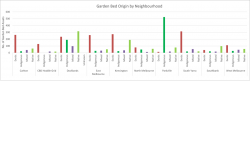
Accessibility and inclusion have been central to the project’s design. Results reveal spatial inequalities in the distribution of nature across the municipality, while plant diversity data allows interrogation of the cultural values shaping landscape management. The dataset will be publicly accessible, promoting transparency and enabling broader community use. First Nations cultural safety concerns, identified early in the process, will inform the next phase of asset renewal planning, including targets and the consideration of indigenous plantings.
Key steps in the project included:
- July–October 2023: Internal project design by the Parks Assets Team and Ecology Team to define the problem and establish a shared vision. A detailed scope was developed that integrated ecological data collection methodologies with asset condition audit standards, forming the basis for engagement with external horticultural partner, Royal Botanic Gardens Victoria (RBGV).
- November 2023–June 2024: RBGV tested the methodology and then completed an audit of 4,135 garden beds. Parameters collected included infrastructure condition, plant species and health, vegetation structure, and habitat features such as rocks and logs.
- July 2024–January 2025: Internal review and synthesis of findings, including integration with the City’s broader data systems.
- February 2025–Ongoing: Development of a decision-making framework to prioritise renewals based on asset condition and biodiversity value, informing planning for the 2025–26 renewal program.


By integrating horticultural, ecological, and asset management expertise, it has created a shared language between disciplines, strengthening collaboration across the City.
Impact and outcomes:
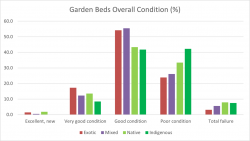
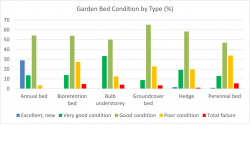
Renewals for Nature delivered the first comprehensive inventory of the City of Melbourne’s 4,135 garden bed assets. Each bed was assessed for species composition, habitat features such as logs and rocks, weeds, plant cover, and the condition of vegetation, mulch, and infrastructure. A standardised condition rating from 1 (failed) to 5 (excellent) was applied, in alignment with ISO 55000:2024.
Key findings include:
- 1,505 garden beds (36%) were rated in poor or failed condition, falling below the threshold for renewal.
- Perennial and bioretention beds had the highest failure rates at 39% and 32% respectively.
- Exotic plantings showed higher plant health (74% mature/healthy) than indigenous beds (52%).
- 19% of garden beds had less than 50% plant cover.
- City gardens are comprised of 58% exotic species, 24% native species, and 18% locally indigenous species.
This data is now directly informing the development of a prioritisation framework to guide the 2025–26 garden bed asset renewal program. Outcomes include improved identification of underperforming assets, alignment of renewal works with biodiversity goals, and proactive planning to improve plant survival, reduce maintenance needs, and extend asset lifespan.
Wider strategic outcomes include:
- Exploration of minimum standards for design, composition, and species diversity.
- A foundation for interrogating the values underlying plant species selection and maintenance, including understanding why indigenous plants are not performing as well as exotic species.
- Development of garden bed typologies and plant procurement lists, including threatened and trial species.
- The ability to plan and order replacement plant stock in advance, creating budget and time efficiencies.
- Evidence-based modelling of long-term renewal costs to meet strategic goals.
- Revised asset classifications based on real-world data.
Importantly, the dataset provides a foundation for embedding accessibility and inclusion principles into design, including culturally safe landscapes for First Nations people. The open publication of data ensures transparency and broad usability across the sector.
Scalability:
Knowledge sharing is a key outcome of the Renewals for Nature project. Internally, findings are being shared across teams, including Ecology, Parks Services, Parks Assets, and Design, to inform operations, strategic planning, evaluation, procurement, and streamline decision-making. Externally, the garden bed inventory dataset and methodology will be made publicly available through the City of Melbourne’s open data portal (data.melbourne.vic.gov.au), supporting transparency, research, and broader uptake.
In September 2024, the City of Melbourne presented the project and early findings at the Melbourne Park Managers Forum, engaging peers from metropolitan councils and creating opportunities for knowledge transfer and collaboration. Further analyses of patterns in these data are being conducted in partnership with the University of Melbourne and will be published in peer-reviewed scientific journals. Findings will also be communicated through teaching, industry publications, and conferences.
The project’s core innovation lies in its use of scientifically derived indicators of habitat quality to assess and monitor garden bed assets. These methods, along with the data collection tool, form a repeatable framework for evaluating both asset condition and biodiversity potential over time. The methodology was designed to be replicable, evidence-based, and adaptable for internal use, while also being suitable for adoption by other councils and across broader urban landscape types. This sets a precedent for applying ecological indicators in urban asset management across local government and other land managers.
Renewals for Nature also aligns with the United Nations Sustainable Development Goals, directly supporting SDG 15: Life on Land. By collecting and applying data on garden bed asset condition, plant diversity, and habitat features, the City of Melbourne can prioritise asset renewal to enhance ecological connectivity and biodiversity, contributing to both local and global environmental goals.