

Innovation Case Study: Smart Start
Casey City Council
Automating Payroll Onboarding for Faster Service and Compliance
Launched in April 2025, this project automated onboarding data transfer from PageUp to iChris (Chris21) via middleware, replacing manual HR and payroll entry. Handling up to 500 records annually, it reduces errors, improves compliance, and speeds up processing. Designed as a low-cost MVP, it enhances employee experience and engagement by enabling timely, seamless onboarding for new starters and their managers.
2025 MAVlab Innovation Awards Finalist:
The Smooth Sailing Award for Service Optimisation and CX, supported by LANDATA® operated by SERV.

Project statistics:
- Team: 5 staff (2 Core / 3 Supports)
- Duration: 6 months from purchase to Production.
Project goals:
- Eliminate manual onboarding delays for both new hires and internal role changes
- Reduce processing time from up to two weeks to just 30 seconds
- Automate secure, API-driven data flows between systems
- Ensure day-one readiness through faster, fully compliant onboarding
- Reduce administrative burden and minimise the risk of errors through standardised workflows
- Guarantee accurate system access, compliance, and payroll setup from day one
- Deliver a seamless onboarding experience that enables staff to hit the ground running.
Challenge and context:
The City of Casey faced a significant challenge in onboarding new employees and managing internal staff transfers due to manual, time-consuming processes. Each year, between 300 and 500 employees required payroll setup across two disconnected SaaS systems: PageUp (Talent Acquisition) and iChris (Chris21 Payroll). The payroll team manually transferred data from PageUp exports into iChris — a process that took up to two weeks, involved double handling, and carried a high risk of data errors. These delays affected staff start times, compliance, and payroll accuracy, ultimately impacting employee experience and operational efficiency.
Key constraints included tight budget limits and timeline pressures, as well as the complexity of integrating two systems without native, cost-effective API connectivity. The initially proposed HRIS API integration was estimated at $40,000 with a six-month delivery timeframe — well beyond available resources and business needs.
This challenge required innovative thinking to significantly reduce costs and delivery time while maintaining accuracy and compliance. An additional complexity was ensuring the solution met the needs of a diverse workforce, including vulnerable cohorts who rely on smooth, error-free onboarding to access pay and entitlements without delay.
Stakeholder engagement was critical. The Payroll, People & Culture, and IT teams needed a reliable, low-risk solution that would not disrupt day-to-day operations. Trust in automation also needed to be built through clear communication and a carefully phased delivery approach.
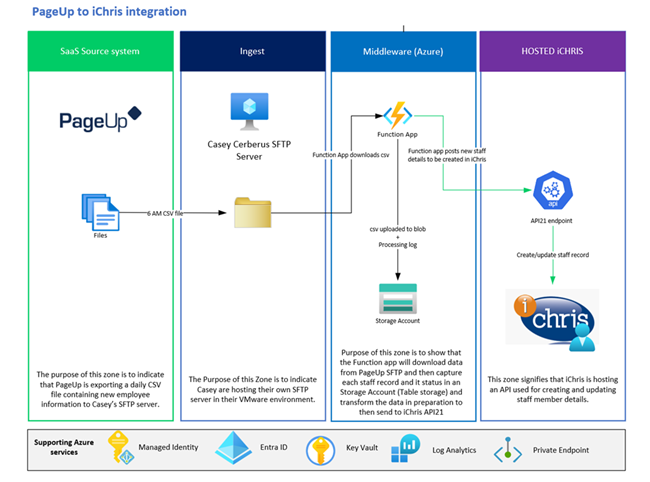
We innovated by leveraging existing infrastructure — using SFTP and middleware to automate data flows between PageUp and iChris. This approach eliminated manual effort, reduced onboarding timeframes, and ensured compliance, all within budget and timeframe constraints. The solution not only improved operational efficiency but also significantly enhanced the onboarding experience across the City of Casey.
Solution and innovation:
Over five years, this project marked the City of Casey’s third attempt to automate payroll onboarding between PageUp (HRIS) and iChris (Payroll). Previous efforts had struggled due to complexity and resource limitations, often delivering partial solutions or stalling altogether. This time, we committed to delivering a full end-to-end automation quickly, exceeding expectations for both scope and timeframe.
The solution was deliberately designed to leverage existing infrastructure, using secure SFTP and middleware to process CSV exports and avoid costly, time-consuming API development. Key steps included detailed data mapping, workflow automation, and rigorous validation processes to ensure compliance, accuracy, and risk reduction.
Stakeholder engagement was critical throughout the project. Close collaboration with Payroll, People & Culture, IT, and Transformation teams ensured operational needs were fully understood and risks associated with delayed compliance and payroll setup were mitigated. This approach differed from previous attempts by delivering a complete, reliable automation in just six weeks from the decision on the delivery approach — a timeframe most would consider ambitious for a project of this nature.
The project demonstrates how local governments can achieve impactful digital transformation by creatively leveraging existing technology and fostering strong cross-team collaboration. It sets a new benchmark for efficient, compliant workforce onboarding and provides a model that can be readily replicated across councils.
The project demonstrates how local governments can achieve impactful digital transformation by creatively leveraging existing technology and fostering strong cross-team collaboration.
Impact and outcomes:
The automated onboarding solution has dramatically transformed the payroll process, reducing manual data entry from up to two weeks to under 30 seconds daily. This acceleration allows new and transferring staff to start their roles promptly with accurate pay, compliance, and access, eliminating costly delays and the risk of non-compliance.
Since implementation in April 2025, the payroll and People & Culture teams have reported significant reductions in administrative workload and errors, enabling them to focus on higher-value activities. Key metrics, including processing time, error rates, and compliance adherence, all show consistent improvement. Weekly complaints regarding missing compliance or lack of system access, previously common, have now dropped to zero, reflecting the reliability and effectiveness of the automated process.
The solution also improves accessibility and inclusion by ensuring all staff, including those in time-sensitive or complex roles, receive timely and compliant payroll setup without manual bottlenecks.
Looking ahead, the automation provides a strong foundation for ongoing innovation and scalability, with plans to expand integration capabilities and enhance reporting. The successful delivery and measurable outcomes demonstrate a replicable model for local governments seeking to optimise workforce onboarding while managing risk and improving service quality. Building on this success, a new automation project has commenced to integrate payroll with ServiceNow, alongside the development of a roadmap for additional system connections, further enhancing operational efficiency and service delivery.
Scalability:
Our middleware-driven onboarding automation offers a highly scalable and replicable model for other councils seeking to modernise payroll and HR processes efficiently and cost-effectively. By leveraging existing infrastructure, including secure SFTP, middleware, and our payroll API, we avoided costly additional API licensing or custom development while accelerating delivery timelines. We are committed to sharing our documentation, lessons learned, and best practices within the local government network to support broader adoption and collective improvement.
This approach can be adapted beyond payroll onboarding to streamline other administrative workflows, such as asset management, compliance tracking, and service requests, unlocking further efficiencies across council operations. Internally, we are expanding automation efforts by integrating payroll with ServiceNow and developing a roadmap to connect additional systems, demonstrating how scalable integration supports holistic digital transformation.
Our initiative contributes to several UN Sustainable Development Goals. By reducing administrative burdens and errors, it promotes decent work and economic growth (SDG 8) through timely and compliant workforce onboarding. The automation also improves institutional efficiency and accountability (SDG 16) by creating transparent, auditable processes that mitigate risk. Furthermore, by ensuring equitable access to payroll and entitlements, it supports reduced inequalities (SDG 10) at the local level.
Overall, our solution embodies a practical, scalable innovation that empowers councils to enhance service delivery, operational resilience, and workforce wellbeing, while advancing global sustainability priorities.