

MAV Innovation Events Partner Showcase
Our sector partners play a vital role in local government. They help strategise, design, evolve, and maintain solutions and services that support the work of Victorian local government.
Whether it's supporting the adoption of emerging technologies, rethinking systems or tackling complex challenges without a clear starting point - our partners are right there with us. They bring insights, ideas, infrastructure and practical expertise to the table, helping us turn possibility into progress.
Dive into the case studies below to learn about how some of our 2026 MAVlab Innovation Award Partners are solving challenges and how you can partner with them to build value in your councils.
See all 2026 MAVlab Innovation Award partners
Join our online event series, We See You Shine Mixtape!, to connect directly with council innovators and award partners and hear their stories. This three-part series kicks off on 9 June with three lunchtime sessions.
 An executive leadership team that looks like Greater Dandenong
Davidson partnered with Greater Dandenong City Council to support the recruitment of a new Executive Leadership Team following an organisational restructure led by CEO Jacqui Weatherill in 2024.
► More information
Greater Dandenong is the most culturally diverse municipality in Victoria and one of the most diverse in Australia, with residents representing more than 150 birthplaces and nearly two-thirds of the population born overseas. The mandate was to build a high-performing executive team that not only demonstrated exceptional leadership capability but also authentically reflected the diversity of the local community.
Led by Senior Partner Vanessa Huxley, the search focused on ensuring strong cultural representation throughout every stage of the recruitment process, from longlists and shortlists through to final appointments. A key objective was to identify and attract both diverse and non-traditional talent, including candidates from outside the local government sector, to bring fresh perspectives, innovation, and new approaches to executive leadership.
Diversity outcomes delivered:
- Davidson implemented a targeted and inclusive search strategy, ensuring diverse representation across all shortlists and embedding equity considerations at every stage of the process.
- The final executive team includes culturally diverse leaders, including two executives from diverse backgrounds, one of whom is of Iranian heritage, bringing perspectives that closely align with the community demographic.
- An out-of-sector appointment was successfully secured, introducing new thinking and innovation into the executive leadership team.
- The overall composition of the executive team reflects a strong alignment with the multicultural profile of Greater Dandenong, supporting more inclusive decision-making and community engagement.
Learn more:

 Closing the insurance protection gap for local government
Councils and their communities are facing rising disaster risks and escalating insurance costs, leaving many underinsured and exposed to significant financial shocks. JLT Public Sector are collaborating with a group of regional councils to design the Community Protection Mutual. A pooled funding model that shares catastrophe risk across members.
► More information
Through a feasibility partnership with the Southwest Queensland Regional Organisation of Councils and other stakeholders, JLT are developing a mutual structure that enables councils to collectively pool high-risk exposures such as flooding. By spreading risk across participating members, the model improves access to affordable coverage while reducing reliance on increasingly volatile commercial insurance markets.
The approach strengthens financial resilience, supports faster recovery following disasters, and provides a scalable framework that can be adapted by other regions facing similar risk and affordability challenges.

 Smoothing the ERP journey: Innovation through partnership
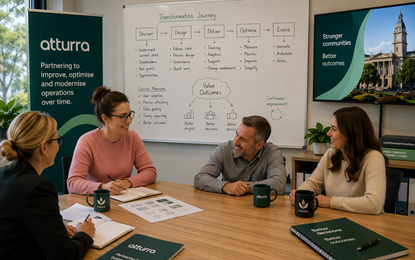
Successful ERP transformation is about more than technology. The real challenge is helping organisations adapt their processes, ways of working, and people to realise long-term value.
► More information
Atturra partners with councils and public sector organisations to make transformation smoother, less disruptive, and more sustainable. Our focus extends beyond implementation to operational adoption, continuous improvement, and helping organisations get the most from their ERP investment.
Innovation often comes through practical improvements rather than only large-scale change. Recent examples include automating user access through integrations, enhancing finance controls and reporting, streamlining procurement workflows, and delivering data-driven insights through Power BI reporting.
By working alongside the business and finance teams, we help organisations reduce manual effort, strengthen governance, improve decision-making, and build internal capability.
The result is not just a successful system implementation, but an organisation that continues to evolve and improve long after go-live.
For Atturra, innovation isn't simply about introducing new technology. It's about creating lasting value through partnership, helping organisations continuously optimise their systems, processes, and operations so transformation becomes an ongoing journey rather than a one-time project.
Learn more:

 Delivering peace of mind and $2M+ in excess refunds to Victoria’s Local Government employees
For more than 15 years, Choosewell Health Link has supported local government employees across Victoria by reducing the financial stress associated with hospital care through the Local Government Employee (LGE) Health Plan.
► More information
When employees or their families require private hospital treatment, upfront inpatient excess costs can create unexpected financial pressure at an already difficult time. Navigating claims and reimbursements can also add complexity during recovery.
Choosewell identified this gap and, working with GMHBA and in partnership with the Municipal Association of Victoria (MAV), established the LGE Health Plan to provide a straightforward and reliable safety net. Choosewell plays a central role in supporting employees to understand their options, review their cover and access the plan, while GMHBA provides trusted insurance infrastructure.
Through this model, employees can submit a claim after paying an inpatient excess, with a clear pathway to reimbursement.
The results demonstrate sustained impact:
- Over $2 million in excess payments refunded to members
- A clear and timely refund pathway, typically within 60 days
- More than 15 years of trusted delivery across Victorian local government.
This initiative strengthens financial wellbeing for council staff and reinforces the sector’s commitment to supporting its workforce.
Learn more:
- Find out more about the LGE Health Plan or Request a Review
 How Moorabool Shire streamlined services and embraced AI with Datascape
Moorabool Shire Council needed to replace an ageing, unsupported rating platform, and used the opportunity to rethink how it serves its 38,000+ residents entirely. Through its partnership with Datacom and the adoption of Datascape, the Council transformed operations across property and rating, customer service and community engagement.
► More information
Rate requests that once took minutes now take seconds, delivering up to a 300% improvement in processing time and recovering weeks of productivity each year.
A unified CRM replaced a tangle of disconnected systems. 60% of applications are now submitted online, and staff spend less time on admin and more time helping people.
To strengthen community connection, Moorabool introduced Antenno, an app that lets residents report issues and stay informed. More than 1,200 residents downloaded it within two months of launch, with minimal marketing effort.
The council is also part of a Datascape AI pilot. Tasks that once took 5-10 minutes are now completed in under a minute, saving an estimated 12 weeks of staff time per year.
For Moorabool, future-ready isn't aspirational. It's operational.
Learn more:
Datascape have created the 2025 Local Government Insights Report which compiles insights from council leaders they spoke with at major sector services events in Australia and New Zealand.
- Get a copy of the report: Redefine the Everyday with Datascape for Councils and Communities
- Book a Datascape demonstration

 Matter's smarter stormwater maintenance with IoT - City of Monash
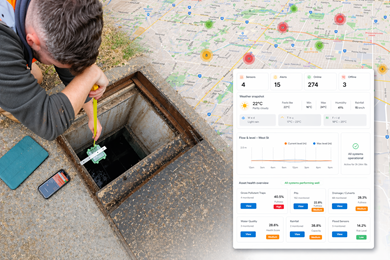
Like most councils, City of Monash manages a stormwater network of over 50,000 pits on fixed inspection schedules that can only cover so many sites per cycle. Some pits need more attention than the schedule allows, others less - and seasonal rainfall shifts the risk profile constantly.
► More information
Outside of scheduled visits, the only other trigger for a crew was a resident complaint, meaning problems had already surfaced before anyone responded. Working with Matter, Monash deployed 300 IoT SensAI devices across their highest-risk pits. Radar level readings are combined with live rainfall and river level data to generate meaningful insights - including calculated debris levels that indicate whether a pit needs a maintenance visit - replacing the need to physically inspect it. Together, this paints a continuous picture of network health, and lays the groundwork for predictive event modelling down the line.
The benefits compound quickly. Fewer blockages mean fewer resident complaints and overflow events, reducing insurance exposure. Maintenance crews are deployed only when and where they're needed, cutting unnecessary visits. The data also helps Monash distinguish between a pit failing due to poor maintenance and one with a fundamental capacity or design problem - a distinction impossible to make without longitudinal data, and one that informs smarter capital investment. Cleaner, less obstructed pits mean less untreated runoff reaching local waterways.
Monash is now extending the program into Gross Pollutant Traps, with sensors planned for approximately 80% of their GPT network, with work order integration with their asset management system already underway.
Learn more:

 Turning street audits into living data across four councils with SenSen
Most councils are flying blind on their own streets. Asset registers fall out of date the moment a manual audit ends, kerbsides drift as assets are added and removed, and crews react to the loudest complaints instead of the worst defects.
► More information
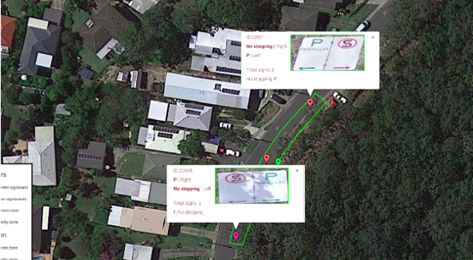
SenSen Networks deployed SenMAP - a street intelligence platform that turns any council vehicle, handheld device, fixed pole, or existing CCTV into accurate, GPS-tagged, council-ready data - across four very different councils.
Wollongong City Council rebuilt its entire sign register, capturing 170 km across four suburbs in a single pass and delivering it in the council's exact GIS specification. Toronto Parking Authority surfaced and validated 5,500 kerbside assets it couldn't previously account for, unlocking a capital business case built on verified inventory. Brisbane City Council moved officers off the footpath, detecting advertising-signage breaches automatically - work that earned national award recognition. Transport for NSW replaced annual surveys with continuous condition data, classifying 54,800+ pavement defects by severity in a single mobilisation, so budget targets the worst defects, not the loudest complaints.
The common thread: every council moved from one-off audits to ongoing access. The platform stays connected, the data keeps refreshing, and there's no fresh procurement each cycle. Setup takes under 10 minutes on any standard vehicle - no new fleet, no new infrastructure.
The result is street data councils can defend in the budget room, and act on every day.Learn more:
 Co-designing a vape-prevention campaign for Gippsland youth, with YLab and six councils
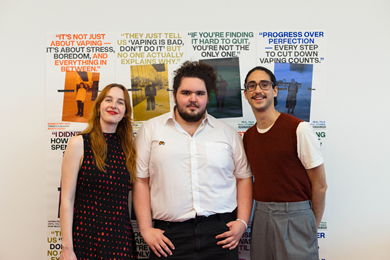
Vaping rates among young people in Gippsland are higher than the state average, but most prevention campaigns are designed by adults and fail to connect. Six Gippsland councils - Bass Coast, Baw Baw, East Gippsland, Latrobe City, South Gippsland, and Wellington - partnered with the Gippsland Region Public Health Unit and YLab to try something different: putting young people in charge.
► More information
Funded through VicHealth's Vaping Prevention Grant, the No Filter: Real Stories Gippsland project used co-design to develop a campaign shaped entirely by the young people it was trying to reach. Over the course of a year, 28 young Gippslandians were recruited across two phases - first a Co-design Committee to surface insights and set campaign direction, then a content creation group to bring it to life through video, photography, illustration, and written storytelling.
The co-design process revealed that young people vape to cope with stress and boredom, feel unsupported when they want to quit, and tune out scare tactics. They wanted peer-led content, relatable stories, and messaging focused on what vaping is doing to them now - not in 30 years. The result is a multifaceted print and digital campaign distributed across all six council areas, featuring 19 youth-made videos, five poster series, illustrated sticker sheets, and written interviews.
Every asset was created by young people from the region. "I've never been involved in a process like this before," said one participant. "It feels very exciting to be working on something for my community."
Learn more

 Building sector capability through the ALGIM Communities of Practice
The ALGIM Australia Communities of Practice (CoPs) were established to create a collaborative environment where local government professionals could connect, share knowledge and solve common challenges together.
► More information
Recognising that councils across Australia and New Zealand often face similar issues but can work in isolation, the Communities of Practice model was designed to break down organisational and geographic barriers and create a stronger, more connected sector.
The Communities of Practice are open to council staff at no cost, and provide a safe, practical and supportive space for members to exchange ideas, discuss emerging trends, showcase projects and learn from real experiences across the sector. Rather than relying solely on formal training or vendor-led presentations, the model focuses on peer-to-peer learning and practical application.
Topics span a range of disciplines including Artificial Intelligence, Data & insights, Cyber Security, Customer Experience and Process Improvement. Communities are supported by volunteer sector leaders and subject matter experts who help shape conversations and ensure discussions remain relevant to current local government priorities.
Within a relatively short period, the Communities of Practice have attracted more than 350 participants across Australia and New Zealand, generating strong engagement and fostering valuable professional networks. The initiative has helped councils share resources, identify opportunities for collaboration and avoid reinventing solutions independently.
The result has been stronger sector capability, greater collaboration and a practical example of local government organisations learning and growing together. #StongerTogether
Learn more:

 Australia's peak body building smarter communities connecting, learning and leading together

Australian councils are delivering smart city projects but too many work in isolation, stall at the pilot stage, or lack the peer network and advocacy backing to scale what works. ASCA is Australia's only not-for-profit peak body dedicated to smart communities, connecting local government, industry, academia and the community sector.
► More information
Our 2030 Strategy is titled Leaving No One Behind. It drives everything we do: growing a national membership, deepening knowledge sharing, strengthening advocacy, and ensuring every community regardless of size or location can participate in the smart communities movement.
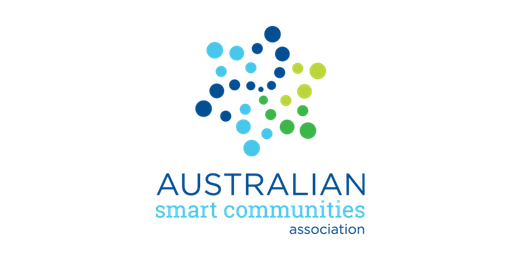
In 2026 this means a program of webinars and city meetups (35+ sessions delivered since 2022 covering AI, digital twins, transport data and international standards), a practitioner-led Reference Working Group co-designing taskforces and thought leadership, and the Australian Smart Communities Summit hosted by the City of Casey on 14-16 October, with four sessions on resilience, scaling impact, inclusive engagement, and the road to 2030. The 2024 Summit drew practitioners from Australia, New Zealand and Singapore, rated 4.7/5, with 100% saying they would recommend it.
For more about the summit see the image of our past event in 2024 (PNG) and please join us for our next one in October 2026.
Learn more
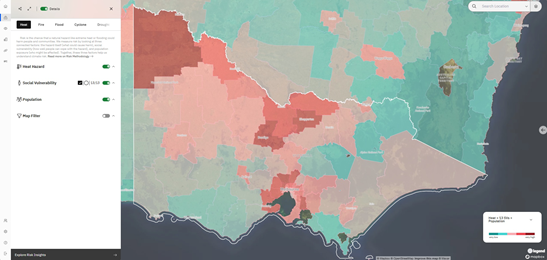 Extreme heat and social vulnerability – a data-driven response to Australia’s deadliest hazard

Extreme heat is Australia’s deadliest climate hazard, yet its impacts are underestimated, normalised, and experienced unequally across communities. Urban populations facing disadvantage — including limited access to resources, information, and systemic inequities — are disproportionately affected, with compounding health, social, and economic consequences over time.
The Urban Climate Resilience Program, run by Australian Red Cross in partnership with the International Federation of Red Cross Red Crescent Societies, Zurich Foundation and Zurich Australia addresses this challenge by working alongside the communities most exposed to climate risk.
► More information
Climasens is a climate intelligence platform enabling a data-driven approach: by triangulating heat risk, social vulnerability, and population data, the program identifies Local Government Areas facing the highest combined risk. This enables targeted interventions and strengthens engagement with local councils by presenting clear, evidence-based risk profiles to inform planning and partnerships.
The program started in Western Sydney and is now expanding into targeted suburbs across Greater Melbourne. It recognises that heat resilience is a systems issue rather than an individual responsibility. Findings to date highlight how repeated heat events create cumulative risks, reinforcing the need for shared understanding of heat impacts to improve decision-making. This includes workplace exposure, which requires stronger regulation, employer awareness, and planning to address sustainably.
Ultimately, the program emphasises collective responsibility. Effective heat risk reduction depends on coordinated action across government, industry, and communities. By combining data insights with community engagement, the program provides practical pathways to strengthen resilience, prevent harm, and reduce long-term impacts of extreme heat.
Learn more:

 Thriving places through smarter subdivision with CASBE
By supporting councils and developers with a consistent, practical way to assess sustainability outcomes early in the planning process, the new BESS subdivisions tool will help drive more resilient, liveable communities.
► More information
Planning and development decisions are often shaped by competing priorities, including timeframes, cost considerations and regulatory requirements. This can result in less focus on long-term wellbeing, sustainability and resilience. Over time, these decisions accumulate - meeting minimum standards while missing opportunities to meaningfully improve community outcomes.
In response, CASBE has launched a new subdivisions module within the Built Environment Sustainability Scorecard (BESS). Expanding the well-established tool beyond individual buildings, it brings a subdivision-scale lens to sustainability. Currently in beta, it supports early consideration of site layout, infrastructure, environmental performance and long-term liveability, embedding these factors into design from the outset.
Developed with councils and informed by practitioner insights, the tool aligns with existing planning processes and policy settings. It translates sustainability objectives into clear, measurable criteria, making expectations easier for applicants to understand and enabling councils to assess proposals more consistently.
By integrating this functionality into the familiar BESS platform, CASBE has created a user-friendly approach that supports better design conversations and provides a more tangible pathway for delivering sustainability in practice. The result is a practical, scalable approach that lifts outcomes across new subdivisions, supporting more resilient, future-ready communities.
Learn more:
 Beyond Block or Allow: How three councils co-designed a safer way to use AI
Victorian councils face a hard problem: lift productivity with AI while meeting sharper privacy obligations. Block AI outright and staff turn to unsanctioned tools; leave it open with policy directions and it requires every staff member doing the right thing every time. Approving a single tool does not help either: new AI tools keep emerging, and staff use whichever suits the task.
► More information
From November 2025 to March 2026, three Victorian councils, Whitehorse, Mornington Peninsula and Moorabool, set out to solve this problem together.
The councils joined vendor Deidentified and governance partner ctrl:cyber in a collaborative co-design project group. The councils quickly provided practical insights, naming the friction in real workflows, proposing solutions, and testing every change in their own operational environments. What was scoped as a software trial became a problem-solving partnership.
That partnership reshaped the technology. Six major council-driven changes were co-designed into Deidentified, moving it from a stand-alone privacy web app into a full AI Privacy Gateway that sits between staff and the public AI tools they already use. It now governs both directions of that exchange: transforming sensitive information before a prompt leaves council systems, and using a new output-assurance layer to check each AI response for accuracy and bias.
The pilot deliberately addressed both sides of the challenge: a technical safeguard, and advisory support for strengthening AI Governance. Each council now carries forward stronger AI privacy capability, and every change to the Deidentified platform that was co-designed during the pilot is available to councils across Australia and NZ.
Learn more

 FinPro Connect: Building a finance community across 79 Councils
Local government finance professionals face increasingly complex, shared challenges while operating in siloed environments; FinPro Connect addresses this by creating a single, statewide digital platform for collaboration and knowledge sharing.
► More information
Professionals in this field manage changing legislation, accounting standards, emergency funding, valuation and revenue challenges, financial sustainability pressures and emerging technologies. While these issues are common across councils, knowledge and solutions often remain fragmented. This is particularly challenging for regional and smaller councils, where access to peer networks and specialist expertise can be limited. As a result, valuable resources are frequently recreated across the sector, leading to duplication and inefficiency.
To address this, FinPro is launching FinPro Connect in June 2026, a secure digital community designed specifically for local government finance professionals across Victoria.
The platform enables members to share templates and tools, ask questions, receive real time peer advice, collaborate on emerging issues and build communities of practice around specialist topics. It also strengthens professional networks and leadership pathways by connecting colleagues across councils and regions. In doing so, it moves knowledge sharing from informal and fragmented channels into a structured and scalable ecosystem.
Community led by design, FinPro Connect brings together professionals from metropolitan, regional, rural and interface councils. Members contribute practical resources, insights and lived experience, supporting cross council learning and stronger connections across the profession.
FinPro Connect is expected to reduce duplication, accelerate problem solving, improve capability and strengthen support for smaller councils, helping build a more connected and resilient finance sector.
Learn more:
 How a leadership program creates catalytic connections across sectors
Leadership development can get sidelined in tough times, but it shouldn’t. Leadership is an accelerator of impact. Strong leadership and connections enhance resilience, enable better decisions in crises and make every other investment more effective and future-focused. Leadership Victoria develops, connects and inspires leaders across sectors to strengthen communities and tackle complex and systemic challenges.
► More information
Through its flagship Williamson Community Leadership Program, experienced leaders take part in a year-long immersive experience that expands their perspectives, deepens their understanding of complex issues and builds enduring relationships with a diverse cohort of leaders.
Unlike programs focused on technical skills or single sectors, Williamson is deeply experiential and cross-sectoral. Participants hear from seasoned leaders, explore adaptive leadership concepts and build a network of generosity, collaboration and influence that spans business, government and public sectors.
With a history of over 35 years and more than 1,400 Williamson Fellows within a wider network of over 7,000 Leadership Victoria Alumni, the program’s impact continues through shared learning, cross-sector collaboration and collective action.
At a time of complexity and uncertainty, programs like Williamson help strengthen the leaders and networks needed to respond to the challenges ahead.
Learn more
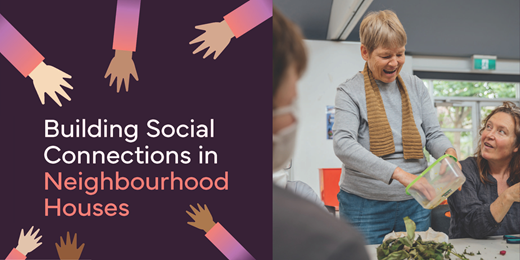 Social Connections Toolkit for Neighbourhood Houses
We were thrilled to work with RMIT to launch the 'Social Connections in Neighbourhood Houses' toolkit. The toolkit is a resource created with and for neighbourhood houses that want to make sure they do what they can to reduce social isolation.
► More information
Neighbourhood houses across Victoria are already doing important work to support social connection. However, this toolkit offers neighbourhood houses opportunities to add new practices to their existing approaches and to refine their ways of working toward supporting more, and more diverse people to develop social connections.
Learn more

 How to start your AI journey - Start simple. Identify a need. Show early success!
Victorian councils are managing rising demand, complex regulation and sustained back-and-forth with applicants. Many are exploring AI, but trust is the constraint: generic desktop tools lack the accuracy, traceability and governance required for statutory environments.
► More information
Spero-ai has co-designed with councils a practical, low-risk entry point: a connected Local Laws and Complaints Management solution that reduces administrative burden while improving service quality.
Councils typically receive 5,000–20,000+ local law enquiries annually, alongside very high complaint volumes. At the same time, many are updating local laws (2024–25) to improve clarity, streamline permits and respond to emerging issues such as density and amenity. This creates a clear opportunity to modernise the “front door” and the workflow behind it.
The solution comprises two integrated modules:
- Applicant interface (front door): residents and applicants ask plain-English questions (e.g. camping during construction, busking permits). The system maps queries to relevant clauses, explains requirements in simple terms, and sets out next steps.
- Council workflow (back end): structured intake, triage and tracking of complaints; aggregation of similar issues; consistent responses linked to source provisions; full audit trail. No automated decisions — councils retain control.
Delivered in 10–12 weeks, the modules can be deployed standalone or as a pathway into broader planning automation.
Spero-ai is a Melbourne-based company led by a former Victorian Government planning director, with 16 AI-native prototypes across the end-to-end planning permit process. The focus is accurate, explainable, planning-grade AI that fits council systems and delivers measurable efficiency gains.
Learn more